Quantum Error Correction Essentials
Introduction to Quantum Computing
Beyond Bits
Classical computers think in bits. A bit is a simple switch, either ON or OFF, represented by a 1 or a 0. It's a black-or-white world. Quantum computers operate in a world of nuance, using a unit called a qubit.
qubit
noun
The basic unit of quantum information. Unlike a classical bit, a qubit can represent a one, a zero, or both values simultaneously.
A qubit can be a 1, a 0, or a blend of both at the same time. This property is called superposition. Think of a spinning coin. While it's in the air, it's neither heads nor tails, but a combination of both possibilities. Only when it lands (when we measure it) does it settle into one definite state.
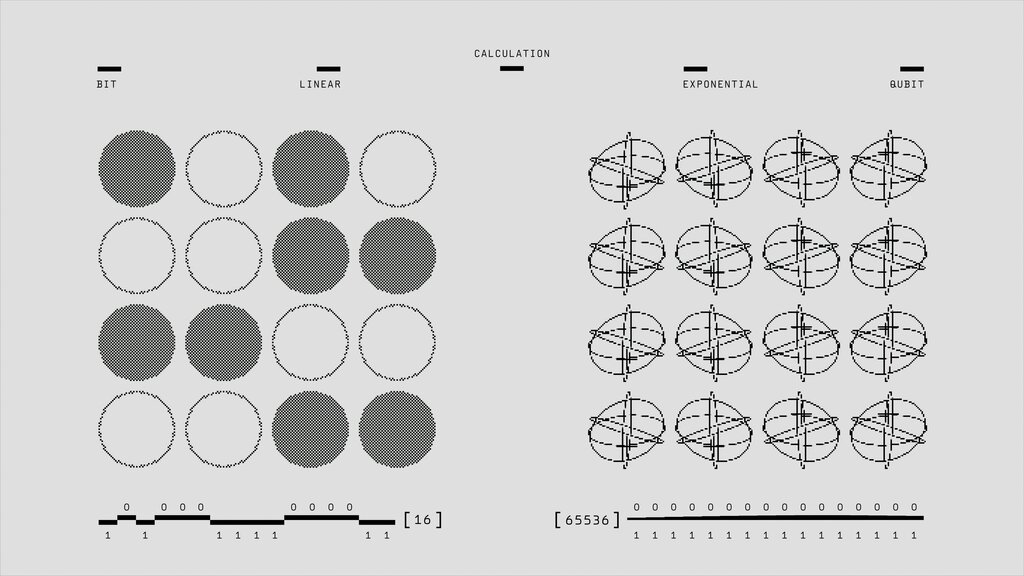
This ability to exist in multiple states at once allows quantum computers to explore many possibilities simultaneously, giving them a massive computational advantage for certain types of problems.
The Language of Qubits
To describe the state of a qubit, we use a special notation called Dirac notation, or bra-ket notation. The two basic states, equivalent to 0 and 1, are written as (pronounced "ket zero") and (pronounced "ket one").
Because of superposition, a qubit's state, often represented by the Greek letter psi (), is a combination of these two basis states.
Here, and are special numbers called probability amplitudes. They are complex numbers that tell us the probability of the qubit collapsing to either or when measured. The probability of measuring 0 is , and the probability of measuring 1 is . Because these are the only two outcomes, the probabilities must add up to 1.
A great way to visualize a qubit's state is with the Bloch sphere. It's a conceptual sphere where any point on the surface represents a possible state for a single qubit. The North Pole typically represents , and the South Pole represents . All other points on the sphere represent a superposition of the two.
Gates and Entanglement
To perform calculations, we need to manipulate the states of qubits. This is done using quantum gates, which are the building blocks of quantum circuits. A quantum circuit is a sequence of gates applied to a set of qubits.
One of the most fundamental gates is the Hadamard gate (H). It's a workhorse for creating superposition. If you apply an H gate to a qubit in the state, it transforms it into an equal superposition of and .
Another key gate is the Controlled-NOT (CNOT) gate. This gate operates on two qubits: a control qubit and a target qubit. If the control qubit is , the CNOT gate flips the state of the target qubit (from to or vice versa). If the control qubit is , it does nothing to the target.
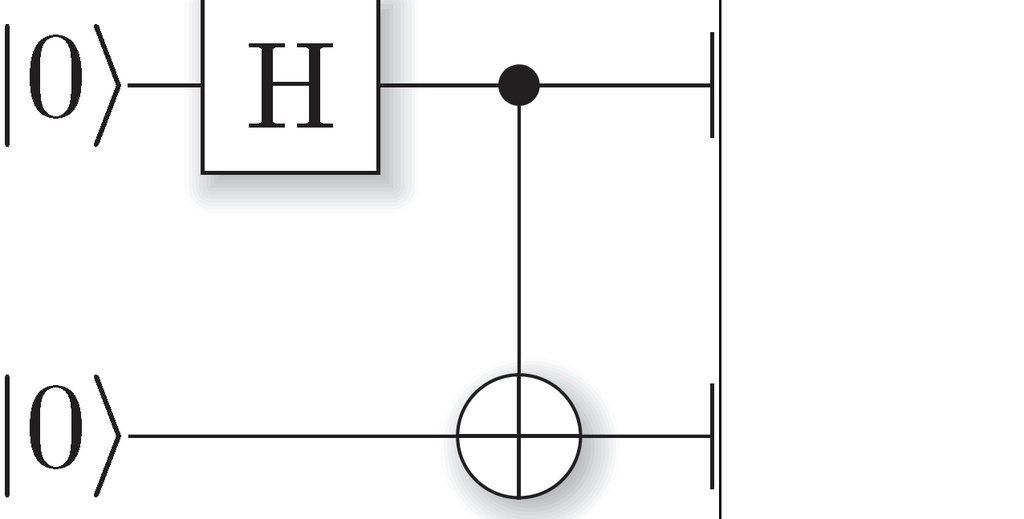
The CNOT gate is special because it can create a remarkable quantum phenomenon: entanglement.
Two concepts in quantum physics that are the building blocks of quantum computing are superposition and entanglement.
Entanglement is a deep connection linking two or more qubits. When qubits are entangled, their fates are intertwined, no matter how far apart they are. If you measure the state of one, you instantly know the state of the other.
For example, if we use a Hadamard gate on one qubit and then a CNOT gate linking it to a second, we create an entangled pair. Before measurement, neither qubit has a definite state. But if we measure the first qubit and find it to be , we know instantly that the second qubit must also be . Einstein famously called this "spooky action at a distance."
This interconnectedness is a powerful resource. It allows for complex correlations and information processing that are impossible in classical computers.
What is the fundamental unit of information in a quantum computer?
The ability of a qubit to exist in a combination of both |0⟩ and |1⟩ states at the same time is known as:
These core concepts—qubits, superposition, and entanglement—are the foundation upon which the power of quantum computing is built. They allow these machines to navigate vast computational landscapes in a fundamentally new way.