Quantum Entanglement Explained
Introduction to Quantum Mechanics
The Quantum World
At the scale of atoms and particles, the world operates by a different set of rules. This is the realm of quantum mechanics, a theory that describes the strange behavior of matter and energy at the smallest levels. Forget your everyday intuition; things here are probabilistic, interconnected, and frankly, weird.
Instead of predictable, solid objects, we find particles that can be in multiple places at once and behave like spread-out waves. Let's start with this first mind-bending idea: wave-particle duality.
Both a Wave and a Particle
In our daily lives, things are either particles (like a baseball) or waves (like ripples in a pond). A baseball has a definite location. A wave is a disturbance spread out in space. In the quantum world, this distinction breaks down. Tiny objects like electrons and photons can act like both.
This isn't just a quirky idea; it's proven by experiments. The most famous is the double-slit experiment.
Imagine shooting tiny particles, like electrons, one by one at a barrier with two thin slits. If electrons were just particles, you'd expect to see two distinct bands on the detector screen behind the barrier, corresponding to the two slits. But that's not what happens.
Instead, an interference pattern emerges, the same kind you'd see if waves of water passed through the slits and interfered with each other. It seems each electron, traveling alone, somehow passes through both slits at once, like a wave, and interferes with itself.
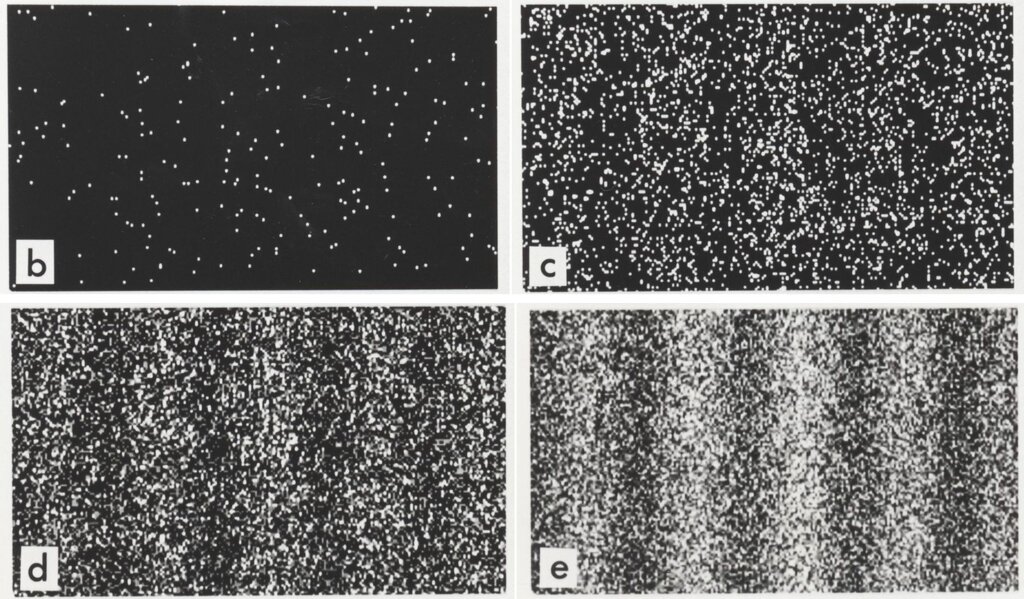
Every quantum object has both particle-like and wave-like properties. Which one you observe depends on how you measure it.
Many States at Once
This wave-like nature leads to another core concept: superposition. Because a quantum object can act like a wave, it doesn't have to be in just one state or location. It can be in a combination of many different states at the same time.
Think of a spinning coin. While it's in the air, it's not heads and it's not tails. It's in a sort of combination of both. Only when it lands (when you "measure" it) does it settle into a single, definite outcome. A quantum particle is similar. Before measurement, an electron might be in a superposition of spinning clockwise and counter-clockwise simultaneously.
Physicists describe this cloud of possibilities with a mathematical tool called a wave function. The wave function contains all the possible states of a system. For a simple system with two possible outcomes, like spin up () and spin down (), the superposition is written like this:
Here, (pronounced "psi") represents the wave function. The symbols and are numbers that tell us the probability of finding the particle in state or when we finally measure it. But before we measure, the particle is truly in both states at once.
The Act of Measuring
So what happens when we try to look? This is where quantum mechanics gets really strange. The moment you measure a quantum system in superposition, the wave function "collapses."
The system is forced to "choose" one of its many possible states. The cloud of possibilities vanishes, and a single, definite reality clicks into place. In the double-slit experiment, if you place a detector at the slits to see which one the electron goes through, the interference pattern disappears! By observing its path, you force it to act like a particle and go through only one slit, not both.
This isn't about clumsy measurements disturbing the system. The very act of gaining information about a quantum property fundamentally changes the outcome. Before the measurement, there are only probabilities. After, there is a certainty.
In the quantum world, observation isn't a passive act. Measuring a system forces it out of superposition and into a single, definite state.
These three ideas—wave-particle duality, superposition, and the role of measurement—are the bedrock of quantum mechanics. They challenge our classical view of the world and pave the way for understanding even more complex quantum phenomena.
Let's review what you've learned.
What is the central idea of wave-particle duality in quantum mechanics?
In the double-slit experiment, what is the surprising result when individual electrons are sent one by one towards two slits without being observed at the slits?