Quantum Entanglement Explained
Introduction to Quantum Mechanics
The Quantum Leap
The world we see every day follows predictable rules. A baseball flies in a smooth arc, a car stays in one lane, and a light switch is either on or off. This is the realm of classical physics. But when we zoom way, way down to the level of atoms and electrons, the rules change completely. Welcome to quantum mechanics, a world that’s less about certainty and more about probability.
Wave or Particle?
One of the first strange ideas to grapple with is that tiny things, like electrons, can act as both particles and waves. This is called wave-particle duality. It's not that an electron is sometimes a particle and sometimes a wave; it's somehow both at once.
The most famous demonstration of this is the double-slit experiment. Imagine firing tiny particles, like electrons, one by one at a barrier with two thin, parallel slits. Behind the barrier is a detector screen that records where each electron lands. If electrons were just tiny balls, you'd expect to see two distinct bands on the screen, right behind the slits.
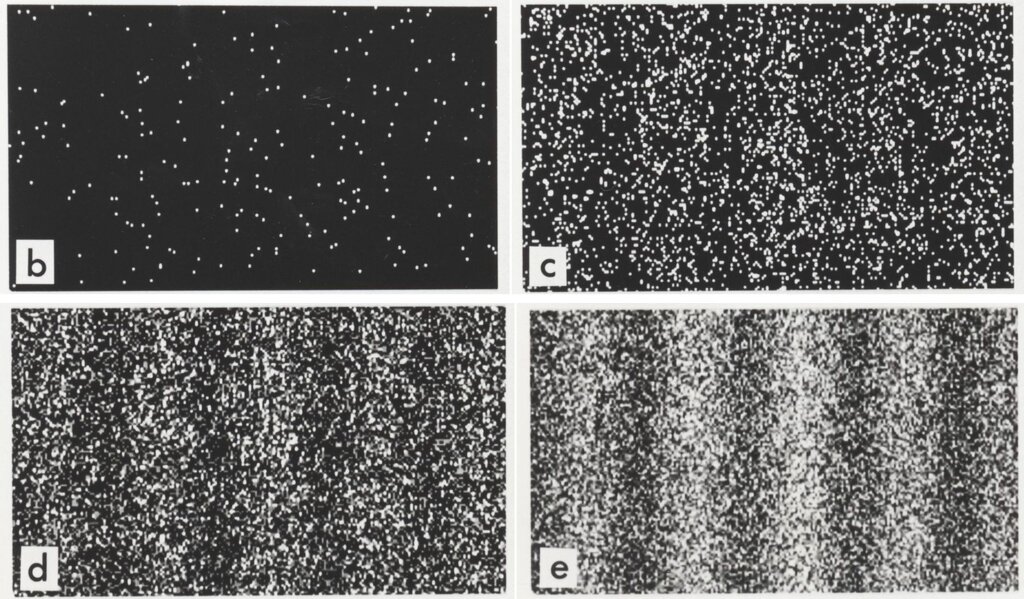
But that's not what happens. At first, the electrons seem to land randomly. But as more and more electrons hit the screen, a pattern of alternating bright and dark bands emerges. This is an interference pattern, something you only get from waves. The peaks of one wave combine with the peaks of another to create a brighter spot, while peaks and troughs cancel each other out, creating a dark spot.
The only way for an interference pattern to form is if each electron acts like a wave, passes through both slits simultaneously, and then interferes with itself before hitting the screen. It behaves like a particle when it hits the screen at a single point, but it travels like a wave.
Being in Two States at Once
The idea that an electron can pass through two slits at once leads us to another core concept: superposition. Superposition is the principle that a quantum system can exist in multiple states or locations at the same time. The electron isn't just going through the left slit or the right slit; it's in a superposition of both paths.
This isn't just a clever trick of words. The system is genuinely in all possible states at once until we try to measure it. The moment you place a detector at one of the slits to see which path the electron takes, the wave behavior vanishes. The electron picks a single slit, and the interference pattern on the screen disappears. The act of measuring forces the system to "choose" a single state.
Superposition means a quantum system isn't limited to a single definite state, but can be a combination of several states simultaneously.
Describing the Quantum World
So how do we describe a system that's in multiple states at once? We use a mathematical object called a quantum state, often represented by the Greek letter psi (). This state contains all the information about the system, but not in the way we're used to.
Instead of telling us exactly where a particle is, the quantum state gives us the probabilities for all possible outcomes. For the electron in the double-slit experiment, its quantum state would describe the probability of finding it at any given point on the screen. The interference pattern shows us where those probabilities are high (bright bands) and where they are low (dark bands).
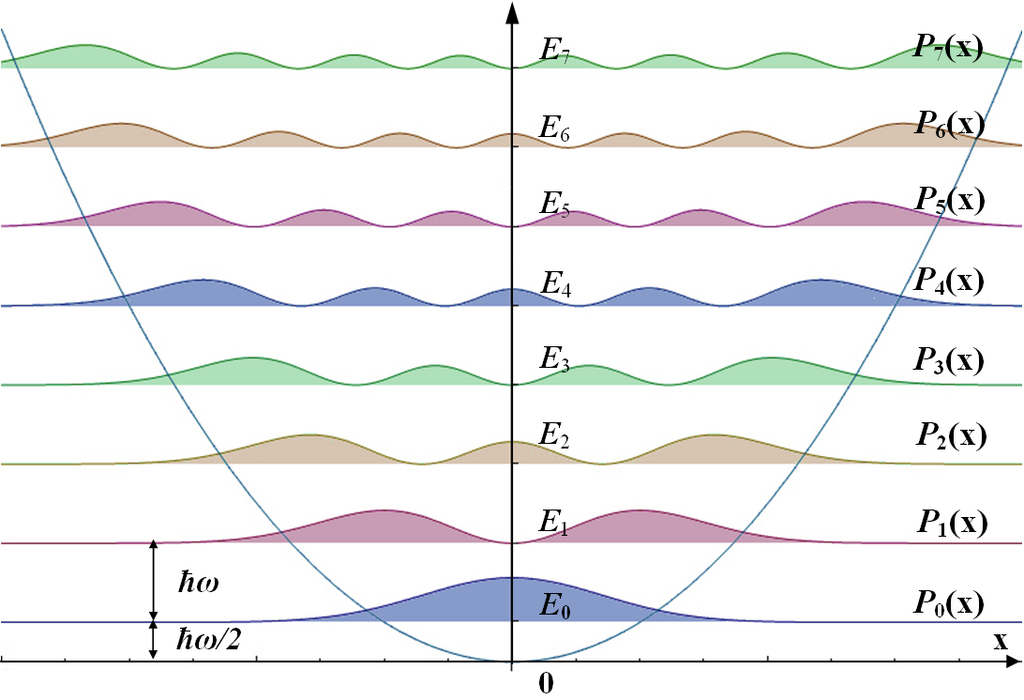
When we make a measurement, the system collapses from its superposition of possibilities into a single, definite outcome. We can't predict the exact outcome beforehand, only the probability of each one. This inherent uncertainty is not due to a lack of information; it's a fundamental feature of the quantum world.
These principles—wave-particle duality, superposition, and the probabilistic nature of quantum states—form the foundation of quantum mechanics. They challenge our classical intuition but are essential for describing the universe at its most fundamental level.