Quantum Computing With Trapped Ions
Introduction to Quantum Computing
Beyond Bits and Bytes
Classical computers, from your phone to the most powerful supercomputers, think in a very straightforward way. They use bits, which are tiny switches that can be either on or off, represented by a 1 or a 0. All the amazing things classical computers do boil down to manipulating billions of these simple ones and zeroes.
Quantum computers operate on a completely different set of rules, borrowed from the strange world of quantum mechanics. Instead of bits, they use qubits.
qubit
noun
The basic unit of quantum information. A qubit can represent a 0, a 1, or a quantum superposition of both states.
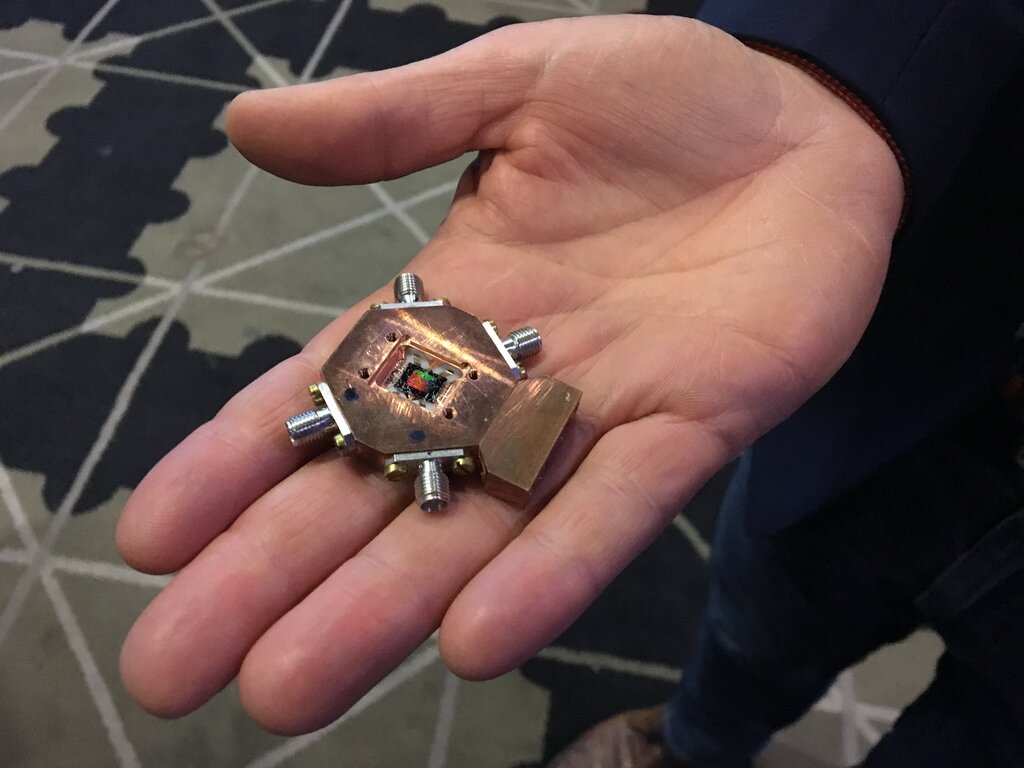
A qubit isn't a tiny switch. It's a physical system, like a single electron or a photon, whose quantum properties can be controlled. Because it follows quantum laws, a qubit can exist in a state of 0, 1, or a combination of both at the same time.
Living in Superposition
The ability to be in multiple states at once is called superposition. Think of a spinning coin. While it's in the air, it's neither heads nor tails. It's a blend of both possibilities. Only when it lands and you measure it does it settle into a single, definite state.
A qubit is like that spinning coin. Before it's measured, it exists in a superposition of 0 and 1. We can represent this state mathematically as a combination of the state (pronounced "ket zero") and ("ket one").
Here, and are probability amplitudes. When we measure the qubit, the probability of it collapsing to is , and the probability of it collapsing to is . The only rule is that the probabilities must add up to 1.
This ability to explore many possibilities simultaneously is where quantum computers get their power. With just two qubits, you can represent four states (00, 01, 10, 11) at the same time. With three qubits, you can represent eight. As you add more qubits, the number of states you can handle grows exponentially. This is a massive leap from classical bits.
Spooky Connections
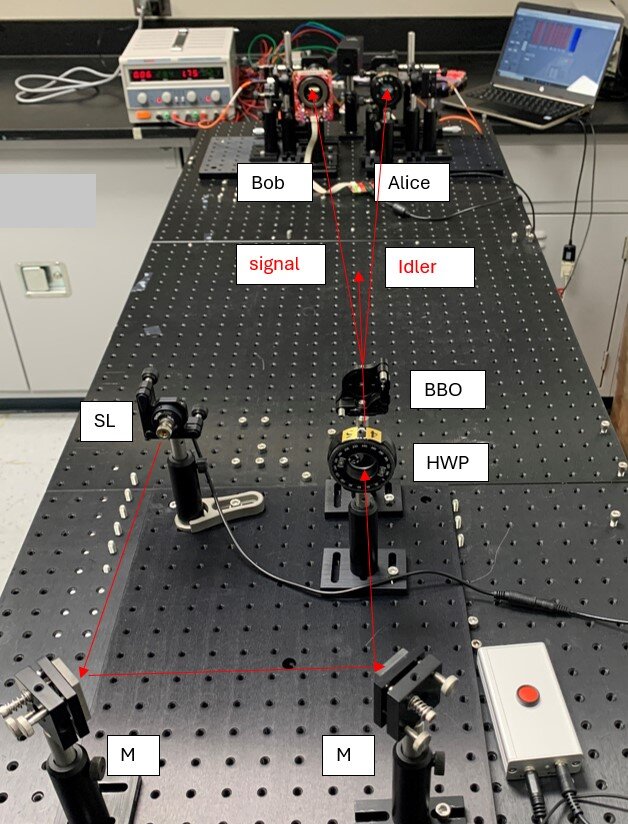
The other mind-bending principle is entanglement. This happens when two or more qubits become linked in a way that their fates are intertwined, no matter how far apart they are. If you measure one entangled qubit, you instantly know the state of the other.
Imagine you have two "magic" coins. You know one is heads and one is tails, but you don't know which is which. You give one to a friend who travels to the other side of the world. The moment you look at your coin and see it's heads, you know with absolute certainty that your friend's coin is tails. Entanglement is the quantum version of this, but even stranger because before you look, neither coin is heads or tails—they are both in a superposition.
This connection between entangled particles is instantaneous, faster than the speed of light. Albert Einstein famously called it "spooky action at a distance."
New Rules, New Algorithms
Because they work so differently, quantum computers need their own kinds of algorithms. These aren't just faster versions of classical algorithms; they are entirely new ways of solving problems that take advantage of superposition and entanglement.
Two of the most famous examples are Shor's algorithm and Grover's algorithm.
Shor's algorithm is designed for factoring large numbers. This is a task that's incredibly difficult for classical computers, and it's the foundation of much of modern cryptography. A large-scale quantum computer running Shor's algorithm could break many current encryption methods.
Grover's algorithm is a search algorithm. Imagine trying to find a specific name in a massive, unsorted phone book. A classical computer would have to check each entry one by one. Grover's algorithm provides a quadratic speedup, allowing a quantum computer to find the entry much faster by exploring many possibilities at once.
| Feature | Classical Computing | Quantum Computing |
|---|---|---|
| Basic Unit | Bit (0 or 1) | Qubit (0, 1, or both) |
| State | Definite (On or Off) | Superposition |
| Processing | Sequential/Parallel | Quantum Parallelism |
| Best For | Everyday tasks, data storage | Optimization, simulation, cryptography |
It's important to remember that quantum computers won't replace your laptop. They are specialized machines designed to tackle problems that are currently impossible for even the fastest classical supercomputers to solve.
Ready to test your knowledge on these foundational ideas?
What is the fundamental unit of information in a quantum computer?
Which quantum principle describes the phenomenon where two qubits are linked in such a way that the state of one instantly affects the other, regardless of distance?
These concepts form the building blocks of the entire field. By harnessing superposition and entanglement, quantum computers open up new frontiers in science, medicine, and technology.