Quantum Computing vs. Classical Computing
Introduction to Quantum Mechanics
The Quantum Realm
In our everyday world, things are predictable. If you kick a soccer ball, you can calculate its path. You know where it is and where it's going. The world of quantum mechanics, which governs the universe at the scale of atoms and electrons, isn't so straightforward. It's a place where the rules of our big, classical world break down.
Quantum mechanics describes nature at its smallest scales—a universe where particles exist in many states at once and outcomes emerge from probabilities.
Instead of certainty, the quantum world runs on probability. It's less like a soccer ball and more like a cloud of possibilities.
A World of Probabilities
Imagine an electron orbiting an atom. In the classical view, you might picture it as a tiny planet circling a sun. But in quantum mechanics, the electron doesn't have a precise location. Instead, it exists in a 'probability cloud.' This cloud, called a wavefunction, describes where the electron is likely to be found if you were to look for it.
Some areas of the cloud are denser, meaning there's a higher chance of finding the electron there. Other areas are thinner, indicating a lower chance. But until you make a measurement—until you actually 'look' at the electron—it is in all of those possible places at once. The act of measuring forces the particle to 'choose' a single location, collapsing the cloud of probability into a definite point.
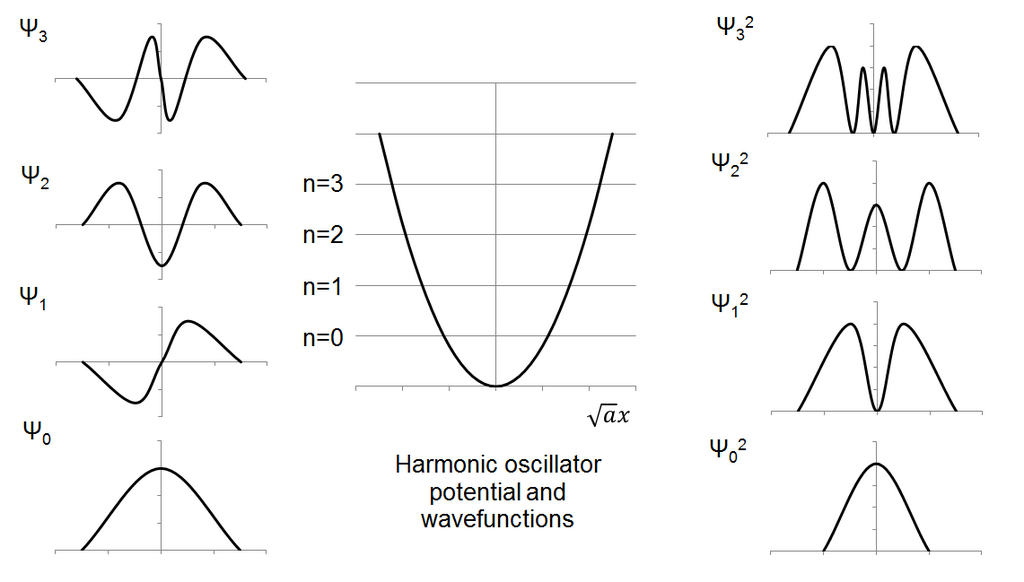
This probabilistic nature is a fundamental departure from classical physics. Nothing is certain until it's observed.
Wave or Particle?
Another strange quantum concept is wave-particle duality. It means that things like electrons and photons (particles of light) can behave as both particles and waves, depending on how you observe them.
Think of a particle as a single, tiny ball. It has a definite position. A wave, on the other hand, is spread out, like ripples on a pond. It doesn't have one single location. How can something be both at the same time?
The famous double-slit experiment demonstrates this perfectly. If you shoot a stream of electrons at a screen with two slits, you might expect to see two bands on the detector behind it, right where the electrons passed through. But that's not what happens. Instead, you get an interference pattern—a series of many bands, just as you would if waves were passing through the slits and interfering with each other.
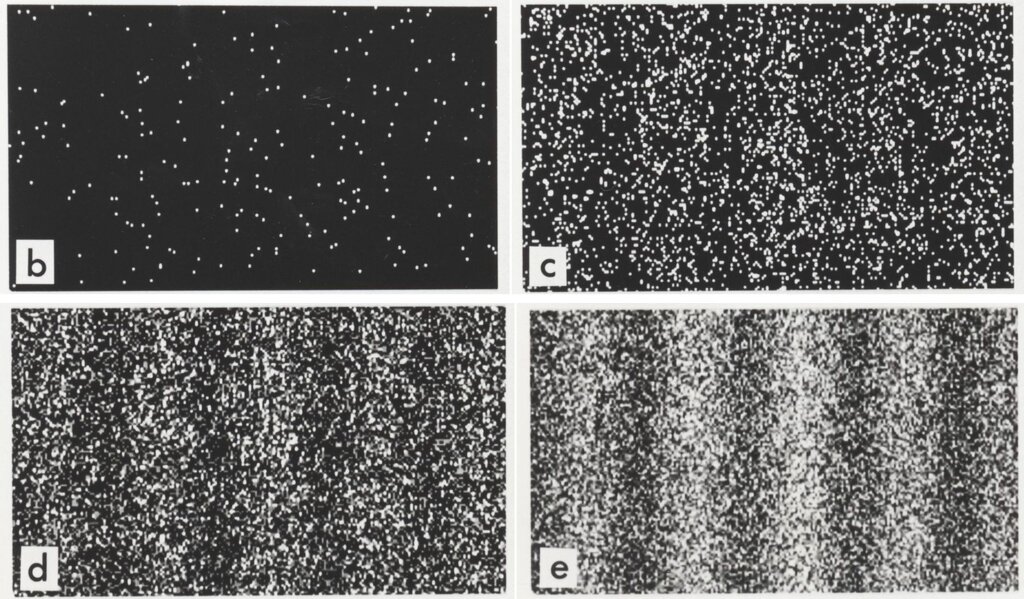
The weirdest part? Even if you send the electrons one by one, the interference pattern still emerges over time. It's as if each individual electron passes through both slits simultaneously as a wave and interferes with itself. This duality is a core principle of the quantum world: objects are neither just particles nor just waves; they are a quantum blend of both.
The Math of Quantum States
To describe these strange behaviors, physicists use the concept of a 'quantum state.' A quantum state is a complete mathematical description of a quantum system. It contains all the information about the system—its energy, momentum, position, and all other properties—in the form of probabilities.
This information is encoded in a mathematical object called a state vector, often written using Dirac notation, like . This vector lives in a special kind of abstract space called a Hilbert space. You don't need to be an expert in Hilbert spaces, but the key idea is that the state vector points in a certain direction in this space, and that direction represents the state of the particle.
The state is not just a single number; it's a vector that captures the entire cloud of possibilities for a quantum object.
As long as a quantum system is left alone, its state evolves smoothly and predictably over time. This evolution is described by a fundamental equation of quantum mechanics.
Schrödinger equation
noun
A fundamental equation in quantum mechanics that describes how the quantum state of a physical system changes over time.
The Schrödinger equation tells us how the state vector rotates and changes in its abstract space. Its evolution is continuous and deterministic. The randomness only enters when we perform a measurement, which abruptly collapses the state from a superposition of possibilities into a single, concrete outcome.
Let's test your understanding of these foundational ideas.
According to quantum mechanics, what is the most accurate way to describe the position of an electron in an atom before it is measured?
In the double-slit experiment, an interference pattern emerges on the screen even when electrons are sent through one by one. What does this imply?
These principles—probability, duality, and the mathematical description of states—form the bedrock of quantum mechanics. While strange, they provide an incredibly accurate description of the subatomic world and are the foundation upon which quantum computing is built.