Quantum Computing Reality Check
Quantum Computing Basics
Beyond Bits and Bytes
Classical computers, from your smartphone to the most powerful supercomputers, are built on a simple foundation: the bit. A bit is a tiny switch that can be in one of two states, either off or on, which we represent as 0 or 1. All the complex tasks your computer performs boil down to manipulating billions of these simple 0s and 1s.
Quantum computing operates on a completely different principle. It uses a new kind of information unit, one that isn't limited to just on or off.
qubit
noun
The basic unit of quantum information. It is the quantum analogue of the classical bit.
A qubit can be a 0, a 1, or a blend of both states at the same time. This ability to exist in multiple states at once is what gives quantum computers their extraordinary potential. It's a property that stems directly from the strange rules of quantum mechanics.
Superposition and Entanglement
Two core concepts unlock the power of qubits: superposition and entanglement.
Superposition is the principle that a qubit can be a combination of 0 and 1 simultaneously. Think of a spinning coin. While it's in the air, it's not definitively heads or tails—it's a blur of both possibilities. Only when it lands (or when we measure it) does it settle into a single, definite state. A qubit in superposition is like that spinning coin. It exists in a combination of states until it's measured, at which point its state collapses to either 0 or 1.
In this equation, represents the state of the qubit. The values and are probability amplitudes. The square of their magnitudes, and , gives the probability of the qubit collapsing to or when measured. The key is that before measurement, the qubit is in both states.
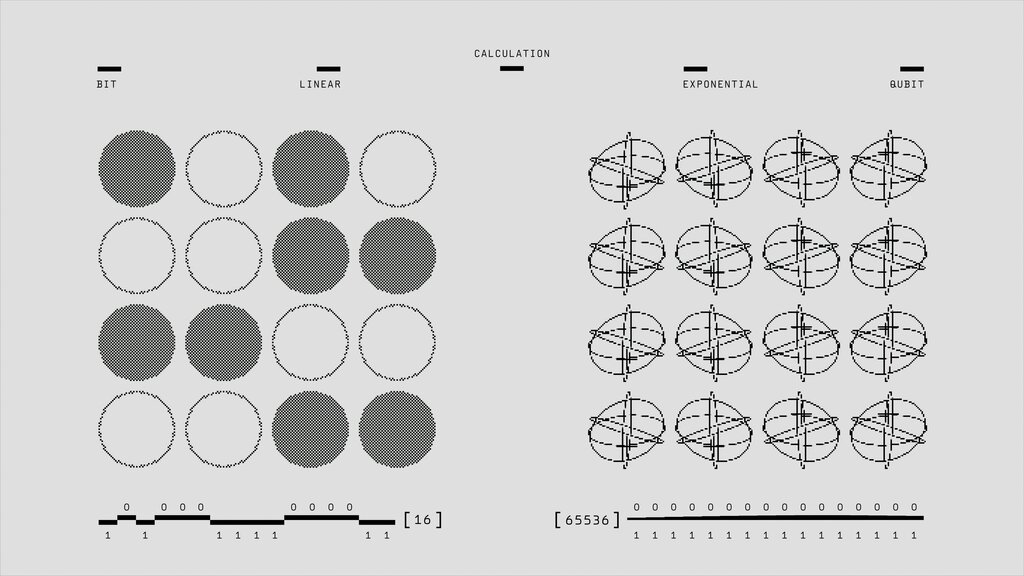
This ability to explore many possibilities at once is a huge advantage. As you add more qubits, the number of states they can represent grows exponentially. Two qubits can represent four states at once, three qubits can represent eight, and so on. This is where the massive computational power comes from.
The second key concept is entanglement. This is a special connection between two or more qubits. When qubits are entangled, their fates are linked, no matter how far apart they are. If you measure the state of one entangled qubit, you instantly know the state of the other. It's as if you had two coins that were magically linked, so that if one lands on heads, the other is guaranteed to land on tails, every single time.
Quantum Gates and Circuits
To perform calculations, we need to manipulate these qubits. In classical computing, logic gates like AND, OR, and NOT operate on bits. Quantum computers use a similar idea, called quantum gates, to perform operations on qubits.
Quantum gates are the building blocks of quantum circuits. They can put qubits into superposition, entangle them, or rotate their state. By stringing together a sequence of these gates, we create a quantum algorithm.
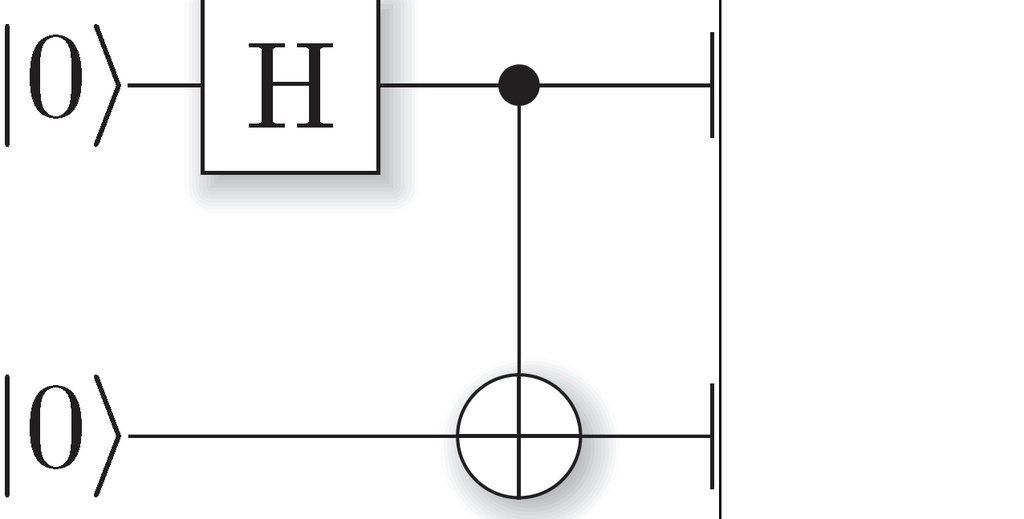
The diagram above shows a basic quantum circuit. The horizontal lines represent two qubits, starting in the state. The box labeled 'H' is a Hadamard gate, which puts the top qubit into a superposition of 0 and 1. The connected symbols represent a Controlled-NOT (CNOT) gate, which uses the top qubit to flip the state of the bottom qubit. This simple two-gate circuit creates an entangled state.
Models of Quantum Computing
Not all quantum computers work the same way. There are different models for how to harness quantum mechanics for computation. The two most common are the gate-based model and quantum annealing.
| Model | Description | Best For |
|---|---|---|
| Gate-Based | A universal model that uses quantum gates to build circuits, much like a classical computer. | A wide range of problems, including factoring numbers and simulating quantum systems. |
| Quantum Annealing | A more specialized approach. Instead of running circuits, it guides a system of qubits toward its lowest energy state. | Optimization problems, like finding the most efficient route for a delivery truck. |
The gate-based model, also called a universal quantum computer, is the most flexible. It aims to solve any computational problem that a classical computer can, and many that it can't. Quantum annealing is less versatile but can be very effective for a specific class of problems related to finding the best possible solution out of many options.
What is the fundamental difference between a classical bit and a quantum bit (qubit)?
The principle that a qubit can exist in a combination of 0 and 1 at the same time is known as:
These concepts form the bedrock of quantum computing. Understanding qubits, superposition, and entanglement is the first step toward grasping how these revolutionary machines operate.