Quantum Computing Fundamentals
Introduction to Quantum Mechanics
The Rules of the Small
The world we see every day follows a predictable set of rules. If you throw a ball, you can calculate its path. If you drop a glass, it shatters. This is the realm of classical physics, and it works beautifully for things our size or larger. But when we zoom way, way down to the level of atoms and electrons, those familiar rules break down. A completely new, and much stranger, set of rules takes over. This is the world of quantum mechanics.
Wave or Particle?
One of the first strange rules you encounter is that things in the quantum world don't have to be just one thing. Classically, an object is either a particle, like a marble, or a wave, like a ripple in a pond. A marble has a definite location. A wave is spread out. They seem like complete opposites.
To see how quantum objects break this mold, consider a famous experiment. Imagine a wall with two thin, parallel slits in it. If you shoot marbles at this wall, some will go through one slit, some through the other, and they'll hit a screen behind the wall, forming two distinct bands. Simple enough. If you send water waves toward the same wall, the waves will pass through both slits, creating new waves on the other side. These new waves interfere with each other, creating a pattern of peaks and valleys on the screen behind. This is called an interference pattern.
Now, what happens if we shoot tiny particles, like electrons, one by one at the double slits? Since they are particles, we'd expect them to act like the marbles and create two bands. But they don't. As more and more electrons hit the screen, they build up an interference pattern, just like the waves did.
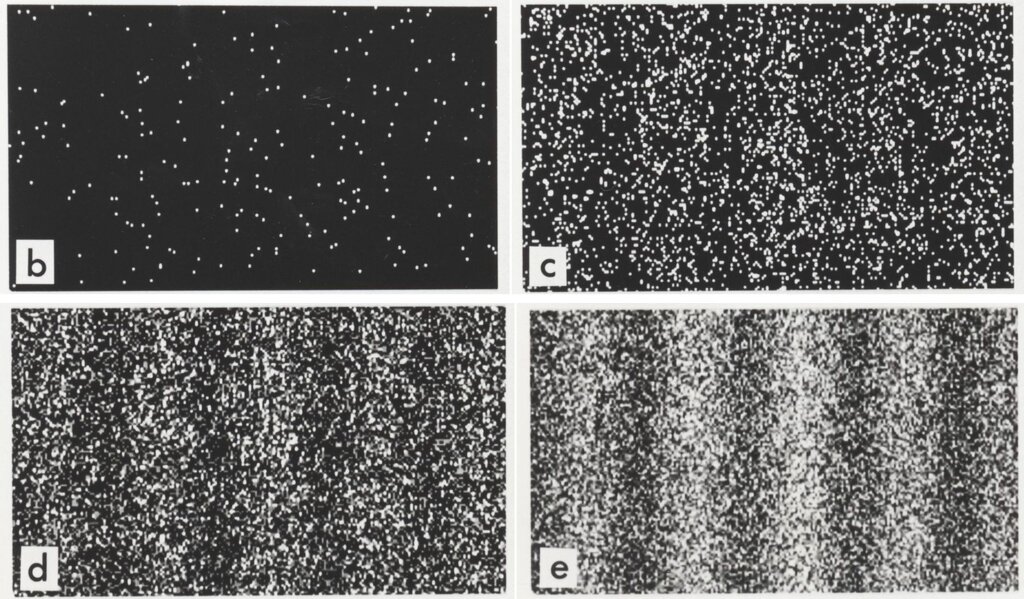
This result is deeply weird. Each electron is a single particle, yet it seems to have traveled through both slits at once to interfere with itself, as if it were a wave. This phenomenon is called wave-particle duality. Quantum objects like electrons, photons, and atoms exhibit properties of both particles and waves. They aren't one or the other; they are a strange combination of both, and which property you observe depends on how you measure them.
A Fundamental Uncertainty
Another core idea of the quantum world is that there's a built-in limit to what we can know. The Heisenberg Uncertainty Principle states that you cannot simultaneously know certain pairs of properties of a particle with perfect accuracy. The most famous pair is position and momentum (which is mass times velocity).
The more precisely you measure a particle's position, the less precisely you can know its momentum. And the more precisely you measure its momentum, the less you know about its exact location. This isn't a problem with our measuring instruments being clumsy. It's a fundamental property of nature itself. The very act of measuring one property inevitably disturbs the other in an unpredictable way.
In this formula, is the uncertainty in position, is the uncertainty in momentum, and is a tiny fundamental constant of nature called the reduced Planck constant. The principle tells us that the product of these two uncertainties can never be smaller than a certain minimum amount. If you squeeze down the uncertainty in one (making tiny), the uncertainty in the other must expand to keep the product above that minimum value.
Describing the Wave
If quantum objects behave like waves, how do we describe them? The answer is an equation that's as central to quantum mechanics as Newton's laws are to classical physics: the Schrödinger equation.
This equation describes a particle's wave function, usually represented by the Greek letter psi, . The wave function doesn't tell you where the particle is. Instead, it tells you the probability of finding the particle at any given point in space. Where the wave function's amplitude is large, there's a high probability of finding the particle. Where it's small, the probability is low.
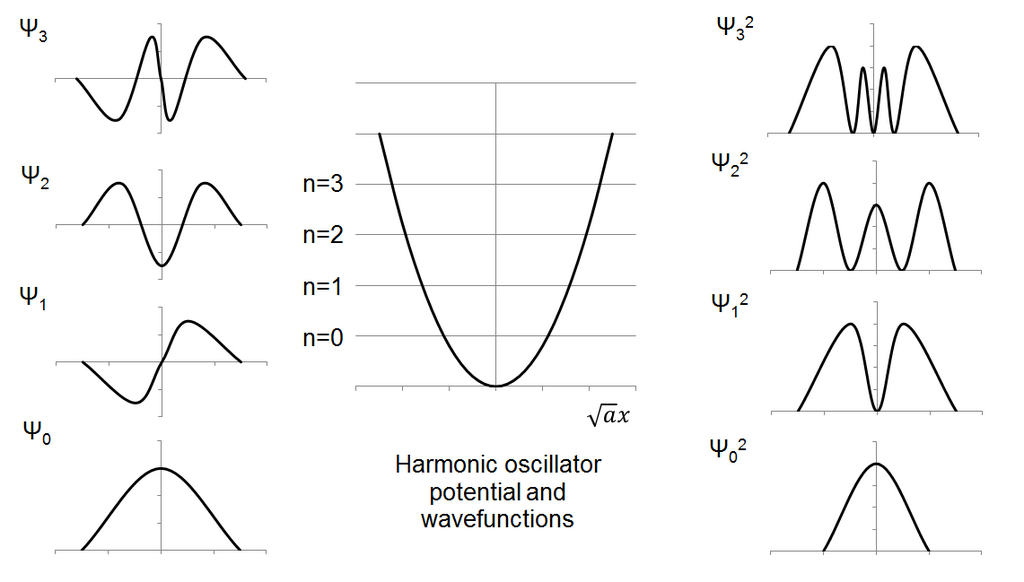
The Schrödinger equation allows physicists to calculate how the wave function of a system evolves over time. By solving this equation, we can predict the probable outcomes of experiments and understand the behavior of atoms and molecules. It's the mathematical engine that drives our understanding of the quantum realm.
Unlike in classical physics, quantum mechanics doesn't deal in certainties. It deals in probabilities, all governed by the wave function.
These three ideas—wave-particle duality, the uncertainty principle, and the Schrödinger equation's probabilistic wave function—form the bedrock of quantum mechanics. They paint a picture of a universe that is fundamentally fuzzy, probabilistic, and far stranger than it appears at first glance.