Quantum Computing Fundamentals
Quantum Mechanics Basics
From Bits to Qubits
In the world of classical computers, everything boils down to bits. A bit is the smallest unit of data, and it can only be in one of two states: a 0 or a 1. Think of it like a light switch. It's either on or it's off. There's no in-between.
Quantum computing operates on a different fundamental unit: the qubit.
Qubit
noun
The basic unit of quantum information, analogous to the classical bit. A qubit can exist in a state of 0, 1, or a superposition of both.
A qubit can also be a 0 or a 1. These are its two basis states, which we write as and . The special notation, called Dirac or ket notation, is just a standard way to label quantum states. But unlike a bit, a qubit can also exist in a combination of both states at the same time.
The Superposition Principle
This ability to be in multiple states at once is called superposition. It's one of the core principles that makes quantum computing so powerful.
Imagine flipping a coin. A classical bit is like the coin after it has landed: either heads (0) or tails (1). A qubit in superposition is like the coin while it's still spinning in the air. In that moment, it’s a blur of both heads and tails. Only when you catch it—when you measure it—does it settle into one definite state.
Before measurement, the qubit exists in a blend of possibilities. We can describe this state mathematically.
This means a single qubit can hold more information than a classical bit. While a bit is stuck at one of two poles, a qubit can be any point on a sphere of possibilities.
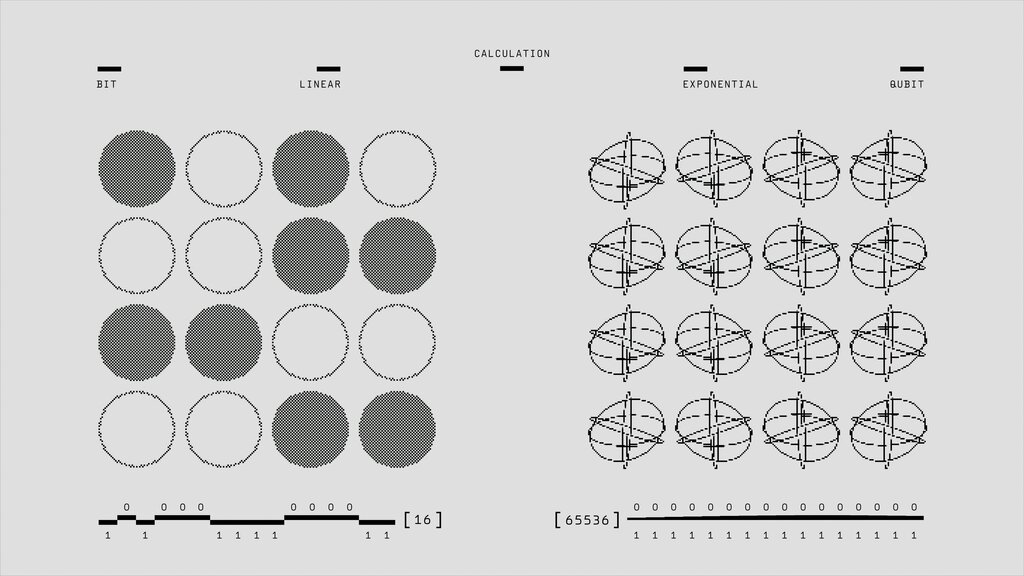
If you have two classical bits, you can represent one of four possible combinations: 00, 01, 10, or 11. But with two qubits, you can represent all four of those combinations simultaneously in a single superposition. With three qubits, you can represent eight combinations. This exponential scaling is what gives quantum computers their incredible potential.
Quantum Entanglement
Things get even stranger with another quantum phenomenon called entanglement. This is a special connection that can link two or more qubits together.
When qubits are entangled, their fates become intertwined. They behave as a single system, no matter how far apart they are. If you measure the state of one entangled qubit, you instantly know the state of the other. Albert Einstein famously called this "spooky action at a distance."
Imagine you have a pair of gloves, one left and one right. You put each one into a separate box and mail them to opposite ends of the earth. You don't know which box has which glove. The moment you open your box and see a left glove, you instantly know, without a doubt, that the other box contains a right glove. Entangled qubits are like that, but with quantum states.
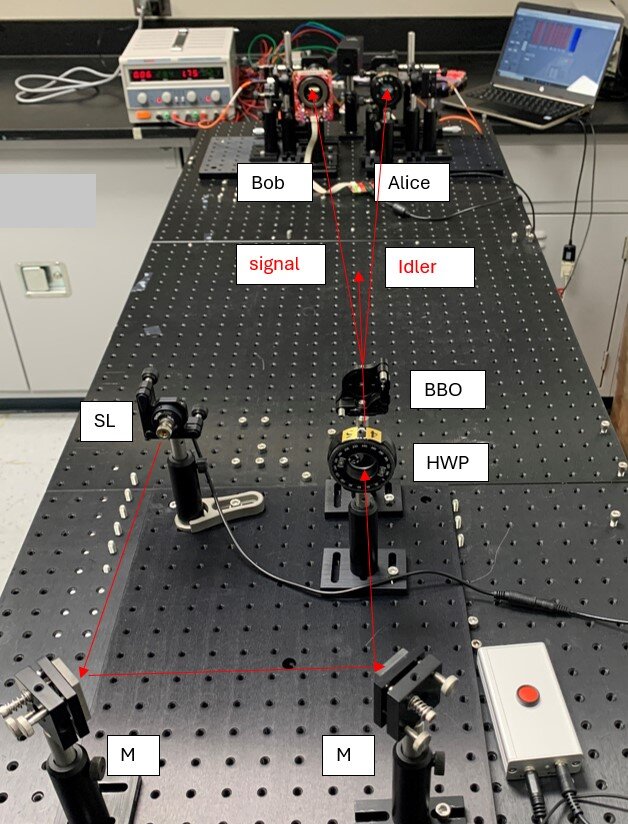
Let's say we have two entangled qubits. We can create a state where if one qubit is measured as , the other will always be measured as . And if one is measured as , the other will also be measured as . Before measurement, neither qubit has a definite state—they are both in a superposition. But their outcomes are perfectly correlated.
This perfect correlation is a resource. Entanglement allows for powerful quantum algorithms and is essential for tasks like quantum teleportation and cryptography. It allows qubits to work together in complex ways that have no classical equivalent.
These three concepts—qubits, superposition, and entanglement—are the pillars of quantum computing. They rewrite the rules of information processing and open the door to solving problems that are currently impossible for even the most powerful supercomputers.
What is the fundamental unit of information in a quantum computer?
The principle that allows a qubit to exist in a combination of both and states at the same time is known as: