Quantum Computing Fundamentals for Security Professionals
Introduction to Quantum Computing
A New Kind of Computing
For decades, computers have operated on a simple principle: bits. A bit is the most basic unit of information, and it can only be in one of two states, a 0 or a 1. Think of it like a light switch. It's either on or off. All the incredible things classical computers do, from sending rockets to space to letting you watch videos, are built on this simple binary foundation.
Quantum computing is a completely different game. It's not just about making faster classical computers. It's a new approach to calculation that uses the principles of quantum mechanics, the physics that governs how matter behaves at the atomic and subatomic levels. This allows quantum computers to solve certain types of problems that are practically impossible for even the most powerful supercomputers.
From Bits to Qubits
The heart of a quantum computer is the quantum bit, or qubit. Unlike a classical bit that is either a 0 or a 1, a qubit can be a 0, a 1, or both at the same time. This strange but powerful property is called superposition.
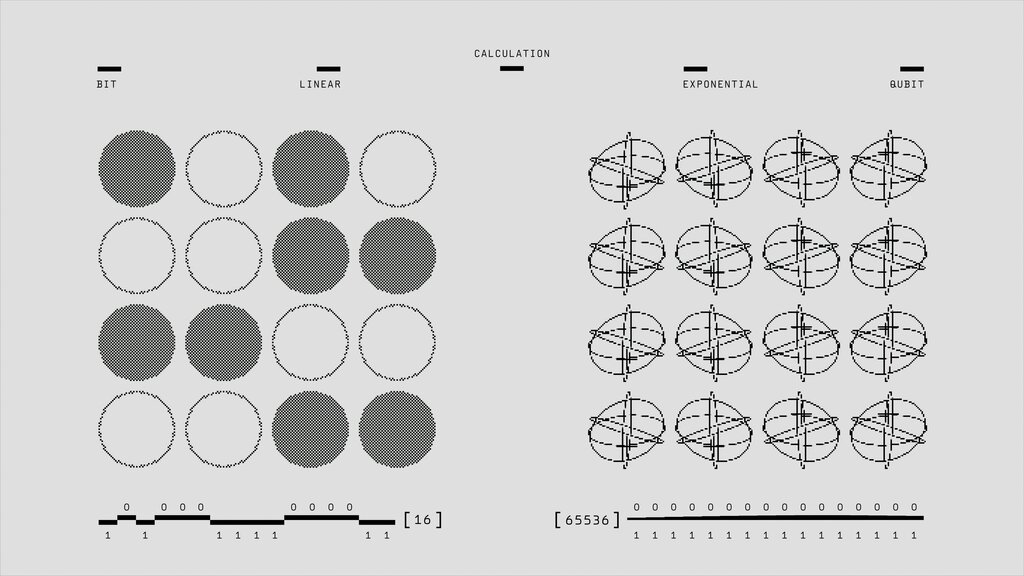
Think of a spinning coin. While it's in the air, it's neither heads nor tails. It's in a combination of both states. Only when it lands (when we measure it) does it settle into a definite state of either heads or tails. A qubit in superposition is like that spinning coin. It exists in a combination of 0 and 1 until it's measured, at which point its state collapses to a definite 0 or 1.
Superposition allows a single qubit to explore multiple possibilities simultaneously.
This ability to exist in multiple states at once is what gives quantum computers their power. Two classical bits can be in one of four possible combinations (00, 01, 10, 11). Two qubits, however, can represent all four of those combinations simultaneously. As you add more qubits, the information capacity grows exponentially. With just 300 qubits, you could represent more states than there are atoms in the known universe.
Quantum States
To describe the state of a qubit, we use a special notation from physics. We represent the classical states 0 and 1 as and . A qubit in superposition is a combination of these two basis states.
In this equation, (pronounced "psi") represents the quantum state of the qubit. The symbols and are complex numbers called probability amplitudes. When we measure the qubit, the probability of it collapsing to is , and the probability of it collapsing to is . These probabilities must always add up to 1.
For example, a qubit in the state has a 50% chance of being measured as 0 and a 50% chance of being measured as 1.
Another key principle is entanglement, where two or more qubits become linked in such a way that their fates are intertwined. If you measure the state of one entangled qubit, you instantly know the state of the other, no matter how far apart they are. This interconnectedness is a crucial resource for quantum algorithms.
Two concepts in quantum physics that are the building blocks of quantum computing are superposition and entanglement.
By harnessing superposition and entanglement, quantum computers can process information in a fundamentally new way, opening doors to breakthroughs in medicine, materials science, and artificial intelligence.