Quantum Computing Fundamentals Explained
Introduction to Quantum Computing
A New Kind of Computing
Quantum computing isn't just about making today's computers faster. It's a completely different approach to processing information. While classical computers, like the one you're using now, rely on the laws of classical physics, quantum computers tap into the strange and wonderful rules of quantum mechanics.
Quantum computers approach solving problems in a fundamentally new way.
This allows them to tackle certain types of problems that are practically impossible for even the most powerful supercomputers to solve. Think of it as the difference between a candle and a lightbulb. Both produce light, but the lightbulb does it using a completely different principle, opening up a world of new possibilities. Quantum computers do the same for computation.
Bits vs. Qubits
The basic unit of information in a classical computer is a bit. A bit is like a light switch: it can be either on or off, representing a 1 or a 0. All the complex tasks your computer performs, from browsing the web to playing a video, are broken down into billions of these simple on-or-off calculations.
Quantum computers use a different building block called a quantum bit, or qubit. This is where things get interesting. A qubit can be a 0, a 1, or both at the same time.
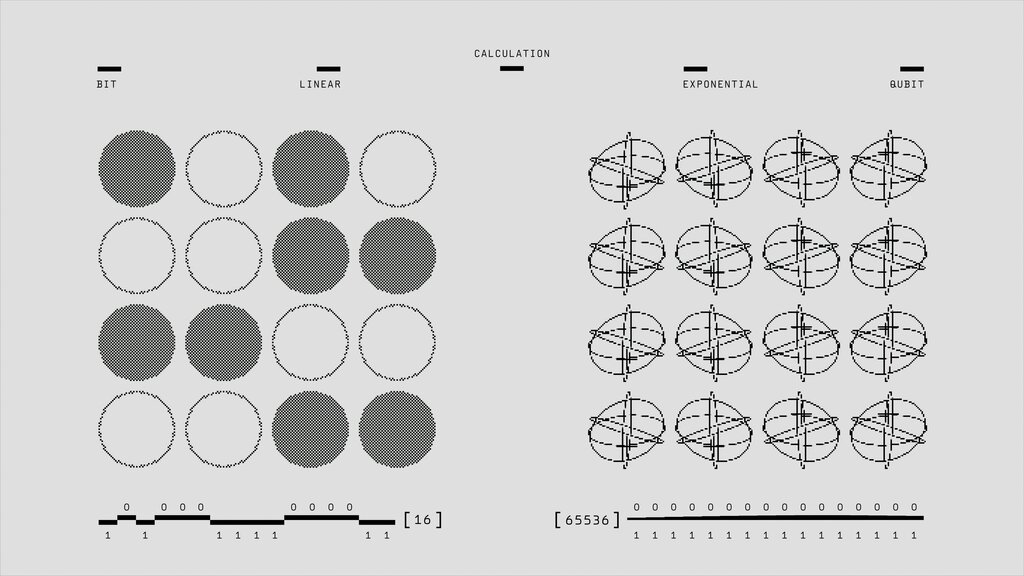
This ability to exist in multiple states at once is what gives quantum computers their power. While a classical computer with 4 bits can only represent one of 16 possible combinations at any given moment, a quantum computer with 4 qubits can represent all 16 combinations simultaneously. This parallel processing capability grows exponentially with each additional qubit.
The Quantum Rules
Two key principles of quantum mechanics make qubits so powerful: superposition and entanglement.
Superposition is the principle that allows a qubit to be in a combination of both 0 and 1 at the same time. Think of a spinning coin. While it's in the air, it's not definitively heads or tails—it's in a superposition of both states. Only when it lands (when we measure it) does it settle into one specific state.
Because qubits can hold multiple values at once, a quantum computer can explore a huge number of possibilities in parallel. This is what allows them to solve complex optimization and simulation problems far more efficiently than classical computers.
The second principle is entanglement.
Entanglement is a special connection between two or more qubits. When qubits are entangled, their fates are linked, no matter how far apart they are. If you measure the state of one, you instantly know the state of the other. Albert Einstein famously called this "spooky action at a distance."
Imagine you have a pair of entangled gloves, one left and one right. You put them in separate boxes and mail one to the other side of the world. The moment you open your box and see a left glove, you know instantly that the other box contains a right glove. Entangled qubits work in a similar way, creating a powerful interconnected network for processing information.
These concepts might seem abstract, but they are the foundation of a technology with the potential to revolutionize fields like medicine, materials science, and artificial intelligence.
Ready to test your understanding?
What is the fundamental difference between a classical computer and a quantum computer?
The ability of a qubit to exist as a 0, a 1, or both at the same time is a principle known as:
By moving beyond the simple on/off logic of classical bits, quantum computing opens up a new frontier for tackling some of the world's most challenging problems.