Quantum Computing Fundamentals
Introduction to Quantum Mechanics
The Quantum World
Classical physics, the kind that describes a thrown baseball or a planet's orbit, works beautifully for the world we see. But when we zoom in to the scale of atoms and electrons, the rules change. Welcome to quantum mechanics. It’s the set of laws that govern the very small, and it operates in ways that can seem strange and counterintuitive.
At its heart, quantum mechanics tells us that the universe is not as clear-cut as it appears. Instead, it’s a world of probabilities and possibilities, where particles can be in multiple places at once and observing something can change what you see.
Waves and Particles in One
In our everyday experience, things are either particles or waves. A grain of sand is a particle. You can point to it and say, "It's right there." A ripple in a pond is a wave. It's a disturbance that spreads out, not a single object in a fixed location.
Quantum mechanics blurs this line completely. It turns out that tiny objects like electrons and photons (particles of light) act like both particles and waves at the same time. This is called wave-particle duality.
The most famous demonstration of this is the double-slit experiment. Imagine a wall with two vertical slits in it and a screen behind it. If you shoot tiny pellets through the slits, you'd expect to see two bands on the screen, right where the pellets passed through. This is classic particle behavior.
If you send waves through the slits, they interfere with each other. Where the crest of one wave meets the crest of another, they get bigger. Where a crest meets a trough, they cancel out. This creates a distinctive interference pattern of many bright and dark bands on the screen. This is classic wave behavior.
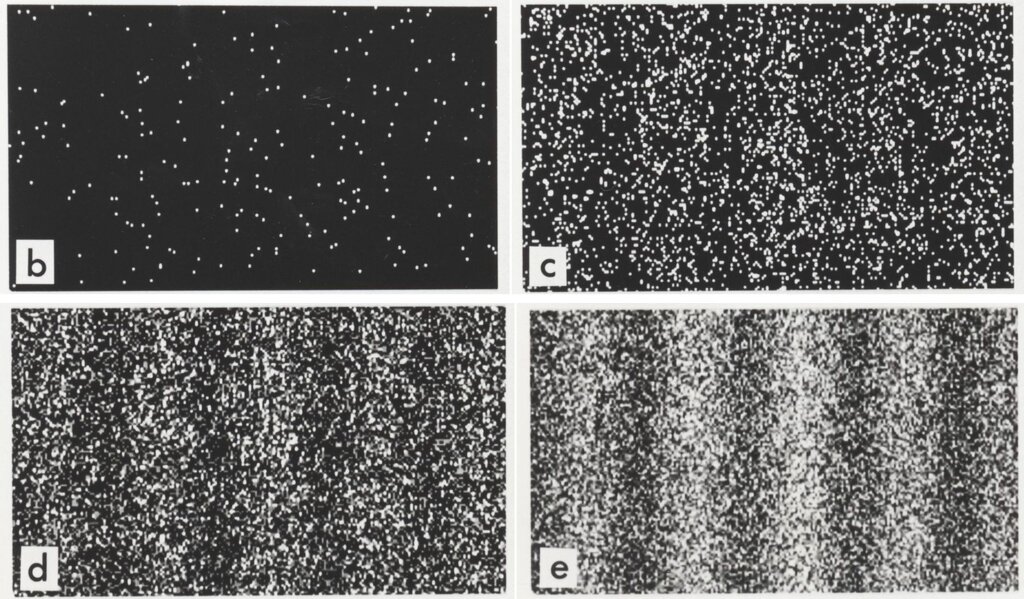
So, what happens when we fire electrons, one at a time, at the slits? At first, they appear to land randomly. But as more and more electrons hit the screen, they slowly build up the same interference pattern as the waves. It's as if each individual electron passed through both slits simultaneously and interfered with itself. This is the bizarre reality of the quantum world. An electron is not a particle or a wave; it's a quantum object that exhibits properties of both.
A Fundamental Fuzziness
Another core idea in quantum mechanics is the uncertainty principle, introduced by Werner Heisenberg. It states that there's a fundamental limit to how precisely we can know certain pairs of properties of a particle at the same time. The most famous pair is position and momentum (which is mass times velocity).
momentum
noun
A measure of the quantity of motion of a moving body, expressed as the product of its mass and velocity.
The more precisely you know a particle's position, the less precisely you know its momentum, and vice versa. It’s not about having imperfect measuring instruments; it's a fundamental property of nature. The universe has a built-in fuzziness.
Think of it like trying to measure a ripple in a pond. To know its wavelength (related to momentum), you need to see the whole wave spread out. But if you see the whole wave, you can't pinpoint its exact location. If you want to know its exact location, you have to focus on a tiny part of the ripple, but then you lose information about its wavelength. There is always a trade-off.
This formula is the mathematical statement of the principle. Here, is the uncertainty in position, is the uncertainty in momentum, and (h-bar) is a very small fundamental constant. The formula says that the product of these uncertainties can never be smaller than a certain minimum amount. If you make one smaller, the other must get larger.
Describing Quantum States
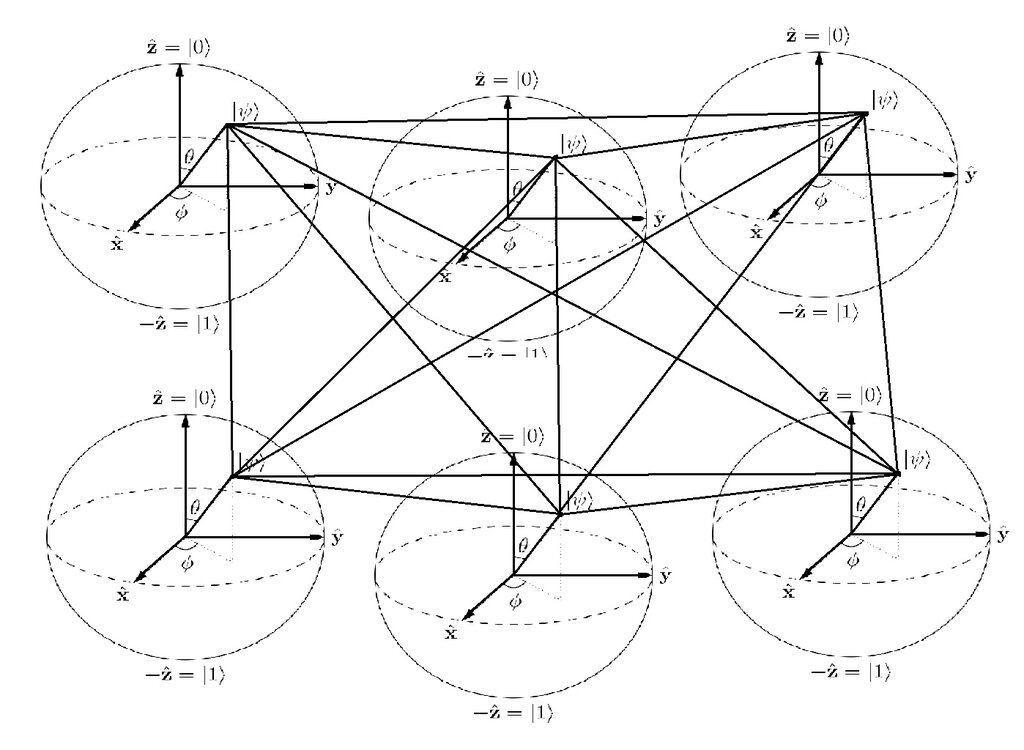
Since we can't know everything about a quantum particle with perfect certainty, how do we describe it? We use a mathematical concept called a quantum state. A quantum state contains all the information about the system—it's a complete description of the particle's properties, but in terms of probabilities.
For example, the state of an electron before it hits the screen in the double-slit experiment isn't "going through the left slit" or "going through the right slit." Its state is a combination, or a superposition, of both possibilities. The quantum state tells us the probability of finding the electron at any given point on the screen.
The act of measurement is crucial. When we measure a property of the particle, like its position, the quantum state "collapses." The cloud of possibilities sharpens into a single, definite outcome. Before we looked, the electron in the double-slit experiment had the potential to be anywhere in the interference pattern. The moment it hits the screen—our measurement—its position becomes definite, and it appears as a single dot.
A quantum state doesn't describe what a particle is doing, but what it could be doing, along with the likelihood for each possibility.
These three concepts—wave-particle duality, the uncertainty principle, and the probabilistic nature of quantum states—form the bedrock of quantum mechanics. They describe a reality that is fundamentally different from our everyday intuition, setting the stage for technologies that operate on these strange and powerful principles.