Quantum Computing Fundamentals and Algorithms
Qubits and Quantum States
The Quantum Bit
In the world of classical computers, everything boils down to bits. A bit is the smallest unit of data, and it can be in one of two states: a 0 or a 1. Think of it like a light switch, which is either off or on. There's no in-between.
Quantum computers work with a different fundamental unit called a qubit. While a qubit can also be a 0 or a 1, it has a special property that completely changes the game.
Qubit
noun
The basic unit of quantum information. It is the quantum analogue of the classical bit.
A qubit can be a 0, a 1, or a blend of both states at the same time. This 'both-at-once' idea is called superposition. It's not like a dimmer switch, which is just a value between off and on. It's a fundamentally different way of existing, where both possibilities are simultaneously true until the moment we check.
Writing Down a Qubit
To work with qubits, we need a way to describe their states with math. We start by giving names to the two basic states, and . This special notation is called Dirac notation, or bra-ket notation, and it's a standard way to write quantum states.
Mathematically, we can represent these states as vectors.
A general state of a qubit, which we can call (pronounced "sigh"), is a linear combination, or superposition, of these two basic states. We write this as:
The squares of the absolute values of these amplitudes tell us the probability of finding the qubit in each state when we measure it. Because probabilities must add up to 100%, these amplitudes must follow a specific rule.
For example, a qubit could be in the state . Here, , and . This means there's a 50% chance of measuring a 0 and a 50% chance of measuring a 1.
Visualizing a Qubit
Trying to picture a combination of 0 and 1 can be tricky. Thankfully, there's a helpful geometric tool called the Bloch sphere. It gives us a way to visualize the state of a single qubit.
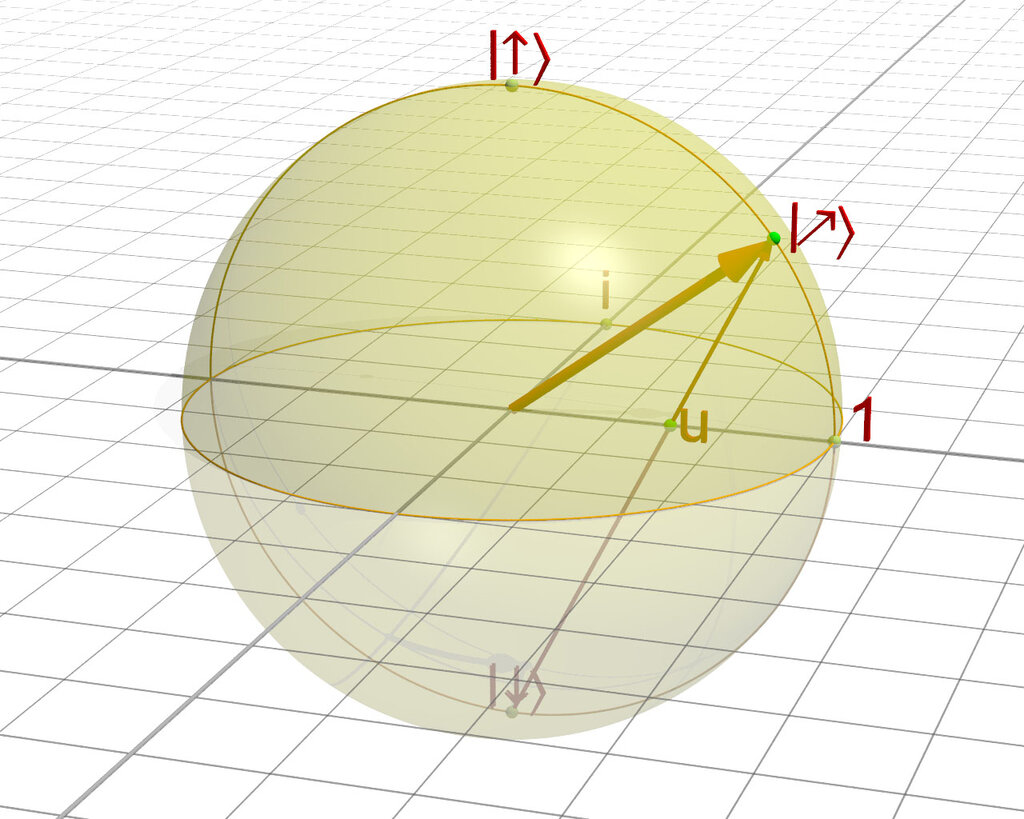
Imagine a globe. The North Pole represents the pure state . The South Pole represents the pure state .
What about every other point on the surface of the sphere? Each one represents a different superposition state. The qubit's state can be represented by a vector pointing from the center of the sphere to any point on its surface. This shows that a qubit can exist in an infinite number of states, not just two.
The Moment of Truth
A qubit can be in a rich superposition of states, but we can't directly 'see' this superposition. The moment we try to measure a qubit's value, its complex state collapses into a simple, classical bit: either a 0 or a 1.
This process is called quantum measurement.
Before measurement, the qubit exists in a state described by the amplitudes and . But when measured, it's forced to 'choose' a side. The probability of collapsing to is , and the probability of collapsing to is .
Once the measurement is made, the qubit's superposition is gone. It is now in a definite state of either 0 or 1, just like a classical bit. This is a key aspect of quantum computing: the power lies in the manipulation of superposition states before the final measurement.
What is the fundamental unit of information used in quantum computing?
The principle that allows a qubit to exist in a combination of both 0 and 1 states simultaneously is known as:
Understanding these core ideas about qubits, superposition, and measurement is the first step into the fascinating world of quantum computation.