Quantum Computing Fundamentals
Bits and Qubits
The Familiar World of Bits
Every computer you've ever used, from your laptop to your phone, thinks in a very simple language. It's a language with only two words: ON and OFF. These are represented by the numbers 1 and 0.
Each 1 or 0 is called a 'bit.' Think of a bit as a light switch. It can be flipped on, or it can be flipped off. There's no in-between. All the amazing things your computer does, from streaming movies to sending emails, are built by combining billions of these simple on-or-off switches.
A classical bit has two possible states: 1 (ON) or 0 (OFF).
A New Kind of Information
Quantum computers use a different kind of building block. Instead of a bit, they use a qubit (short for 'quantum bit'). A qubit can be a 1, and it can be a 0. But it can also be something else entirely: a combination of both 1 and 0 at the very same time.
This strange property is called superpositions. To understand it, imagine spinning a coin. While it's in the air, spinning, is it heads or tails? It's neither, really. It's a blur of both possibilities. Only when it lands and you look at it does it settle into a definite state of either heads or tails. A qubit is like that spinning coin. As long as it's undisturbed, it exists in a superposition of 0 and 1.
When we measure a qubit, it 'collapses' into a definite state, just like the coin landing. It will be either a 0 or a 1. But before that measurement, it holds the potential for both outcomes simultaneously. This is the first key to a quantum computer's power.
More States More Power
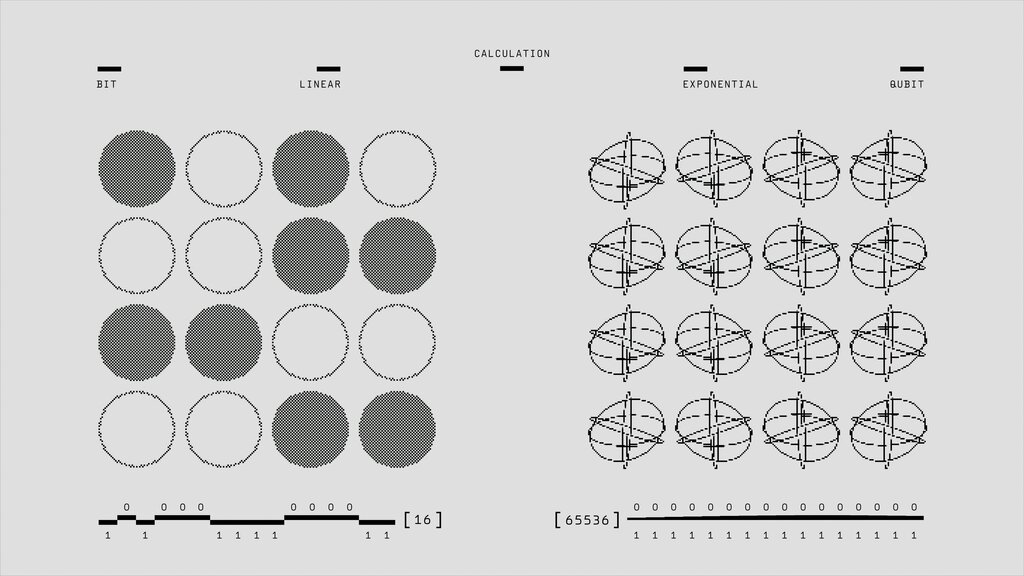
Because a single qubit can represent more than just a 0 or a 1, it has a larger information capacity. This advantage grows exponentially as you add more qubits.
Let's compare. If you have two classical bits, you can represent one of four possible combinations at any given time: 00, 01, 10, or 11. But two qubits, thanks to superposition, can represent all four of those combinations simultaneously.
With 3 bits, you get one of 8 combinations. With 3 qubits, you get all 8 at once. By the time you get to 300 qubits, you can represent more combinations than there are atoms in the known universe. This massive parallelism is what allows quantum computers to tackle problems that are simply impossible for even the most powerful supercomputers today.
Ready to check your understanding of this new kind of bit?
What is the fundamental unit of information in a classical computer?
The ability of a qubit to be both 0 and 1 at the same time is called what?
This ability to exist in multiple states at once is the first major step into the world of quantum computing. Next, we'll explore another strange quantum property that links qubits together.