Quantum Computing Fundamentals
Introduction to Quantum Computing
Beyond Bits and Bytes
Classical computers, from your smartphone to the most powerful supercomputers, work with bits. A bit is a simple switch, either on or off, represented by a 1 or a 0. All the amazing things classical computers do boil down to manipulating billions of these tiny switches. Quantum computing operates on a completely different set of rules, borrowed from the strange world of quantum mechanics.
Instead of rigid on/off switches, quantum computers use something far more flexible: the qubit.
qubit
noun
The basic unit of quantum information. It is the quantum analogue of the classical binary bit.
A qubit can be a 0, a 1, or a blend of both at the same time. This 'both-at-once' property is called superposition. Think of a spinning coin. While it's in the air, it's not heads and it's not tails, it's a mix of both possibilities. Only when it lands and you measure it does it settle into one definite state. A qubit is like that spinning coin.
Superposition in Action
In the language of quantum mechanics, we represent the two basic states of a qubit as and . A qubit in superposition is a combination of these two states. We can write its state, called a quantum state, like this:
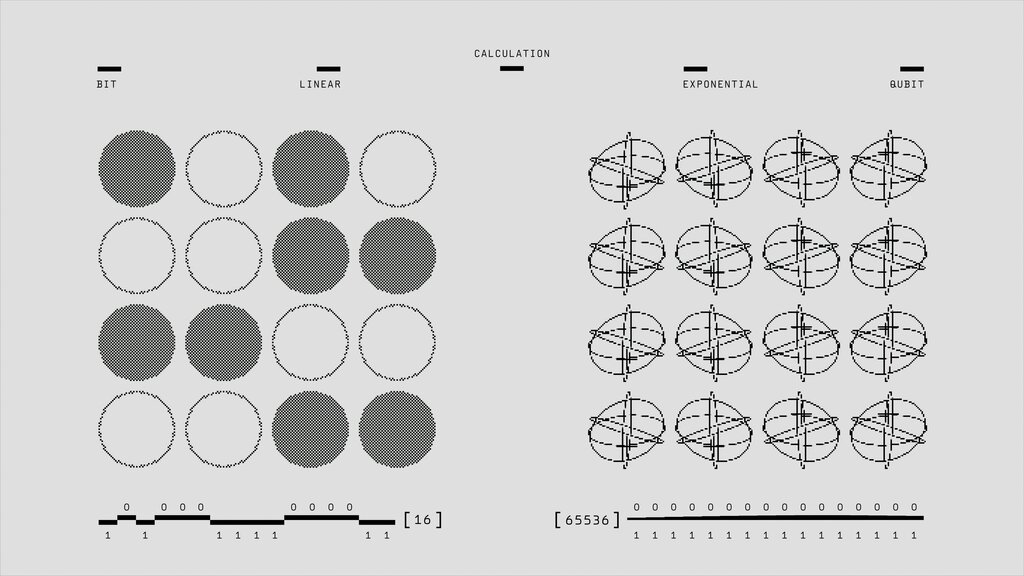
Here, and are numbers that represent the probability of the qubit collapsing to or when measured. The key is that before measurement, the qubit exists in both states simultaneously. This ability to hold multiple values at once is what gives quantum computers their incredible potential. While a classical computer with 4 bits can only represent one of 16 possible values at a time, a quantum computer with 4 qubits can represent all 16 values at the same time.
A Spooky Connection
Another core concept is entanglement. This is a strange and powerful connection that can exist between two or more qubits. When qubits are entangled, their fates are linked, no matter how far apart they are. If you measure one entangled qubit and find it's a 0, you instantly know that its entangled partner is a 1, and vice versa. Albert Einstein famously called this 'spooky action at a distance.'
Imagine you have two 'magic' coins. You know one is heads and one is tails, but you don't know which is which. You put them in separate boxes and mail one to the other side of the world. The moment you open your box and see a heads, you know, instantly, that the other box contains a tails. Entangled qubits behave in a similarly linked way.
This linked behavior is crucial for quantum algorithms. It allows for complex correlations and information processing that are impossible in classical systems.
Classical vs Quantum
The differences between these two computing paradigms are fundamental. Here's a quick comparison:
| Feature | Classical Computing | Quantum Computing |
|---|---|---|
| Basic Unit | Bit (0 or 1) | Qubit ($ |
| State | Definite (on or off) | Superposition (a mix of states) |
| Processing | Sequential | Highly parallel |
| Core Principle | Deterministic Logic | Probabilistic Quantum Mechanics |
Because of these differences, quantum computers aren't just faster versions of the computers we have today. They are a completely different tool, designed to solve specific, complex problems that are currently intractable for even the most powerful classical supercomputers. This includes tasks in drug discovery, materials science, and cryptography.
What is the fundamental unit of information in a quantum computer called?
The principle that allows a qubit to be a 0, a 1, or both at the same time is called:
By harnessing the principles of superposition and entanglement, quantum computing opens up a new frontier for calculation and discovery.