Quantum Computing Fundamentals
Quantum Mechanics Basics
The Quantum Rules
At its heart, quantum mechanics is a set of rules that describe how the universe works at the smallest scales. These rules, often called postulates, are the foundation for everything else. The first, and most important, is about how we describe a quantum system.
Unlike a classical object, like a baseball, which has a definite position and momentum, a quantum particle's state is described by a mathematical object called a state vector. We write this using a special notation called a ket, which looks like this: . Think of it as an arrow pointing to a specific location in an abstract space called Hilbert space. This arrow contains all the information there is to know about the system before it's measured.
States and Wavefunctions
So what information does the state vector actually hold? For a particle, it's often represented by a mathematical function called the wavefunction, written as . This function doesn't tell you where the particle is, but rather where it might be.
The probability of finding the particle at a specific position is given by the square of the absolute value of the wavefunction at that point, . A higher value means a higher probability of finding the particle there. The particle exists in a cloud of probabilities, spread out according to its wavefunction.
One of the most mind-bending ideas in quantum mechanics is the principle of superposition. This rule states that if a system can be in state A and it can also be in state B, then it can also be in a combination of both states at the same time.
A quantum bit, or qubit, can be in the state , the state , or in a superposition of both. It's not one or the other; it's a blend of the two possibilities until the moment you look at it.
Measurement and Collapse
The superposition persists only as long as the system is not observed. The moment we perform a measurement on a quantum system, something dramatic happens. The wavefunction collapses. The system is forced to 'choose' one of its possible states.
If we measure the qubit from the example above, it will randomly collapse to either or . It will never be in a superposition again (unless it's put back into one). The probability of it collapsing to is , and the probability of it collapsing to is . The act of measuring fundamentally alters the system.
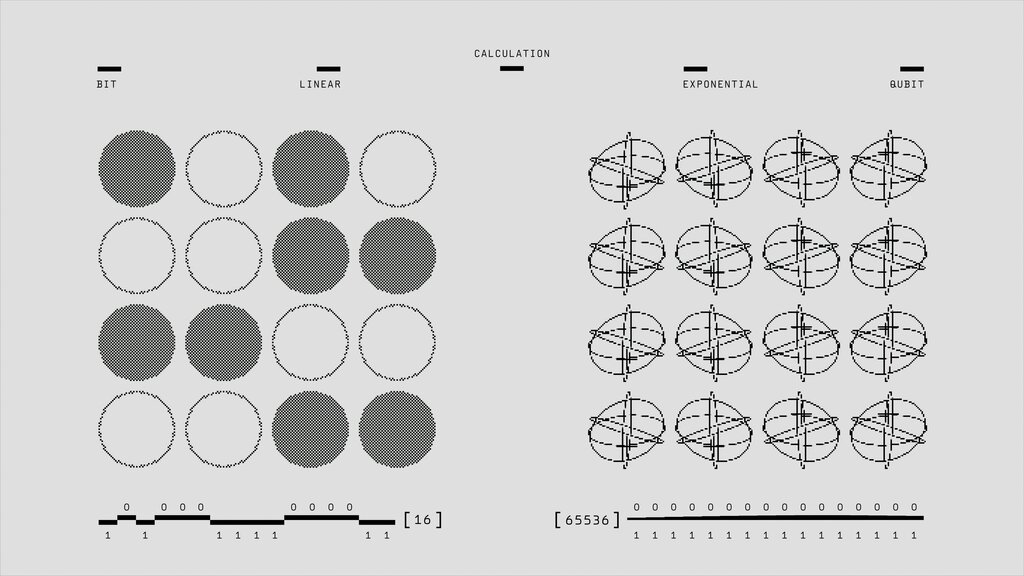
The things we can measure, like position, energy, or spin, are called observables. In the mathematical language of quantum mechanics, every observable is associated with a specific operator. When this operator acts on the state vector, it extracts the possible values that the measurement can yield.
This interplay between superposition, measurement, and probability is what makes quantum mechanics so different from the classical world we experience every day. It's also what gives quantum computing its power.
What does the state vector, represented by the ket notation |ψ⟩, describe in quantum mechanics?
If a particle's state is described by the wavefunction ψ(x), what does the value of |ψ(x)|² represent?
These core ideas are the building blocks we'll use to understand how quantum computers work.