Quantum Computing Fundamentals
Introduction to Quantum Computing
Beyond Bits and Bytes
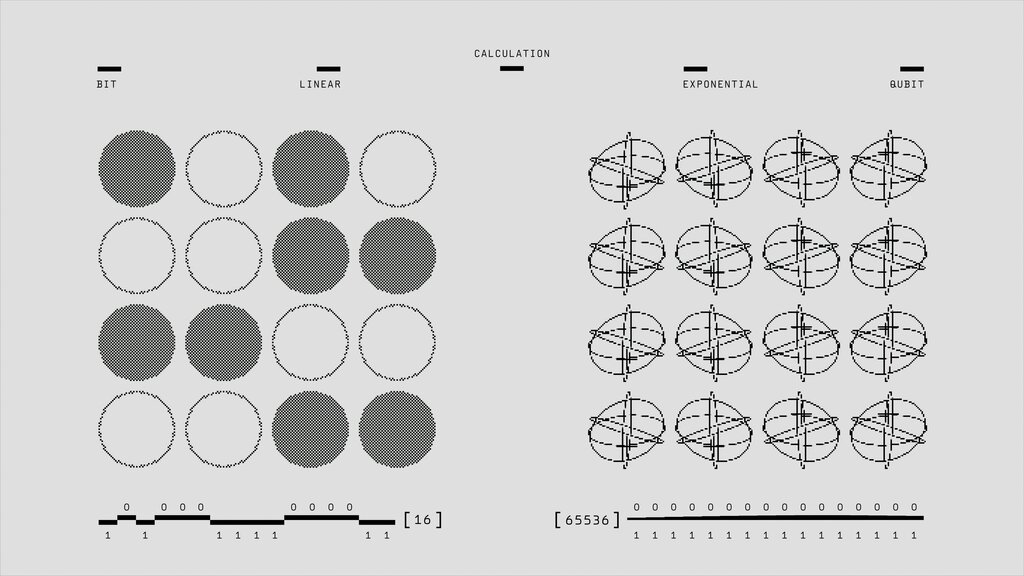
Classical computers, from your smartphone to the most powerful supercomputers, think in a very straightforward way. They use bits, which are tiny switches that can be either on or off, represented by a 1 or a 0. All the amazing things they do boil down to manipulating billions of these simple ones and zeros.
Quantum computing operates on a completely different level. It taps into the strange and counterintuitive rules of quantum mechanics, the science of the ultra-small. Instead of bits, quantum computers use qubits.
qubit
noun
The basic unit of quantum information. It is the quantum analogue of the classical bit.
A bit is like a light switch: it's either on (1) or off (0). There's no in-between. A qubit, however, is more like a dimmer switch. It can be fully on (1), fully off (0), or somewhere in between. This “in-between” state is where the magic happens.
The Power of Superposition
This ability for a qubit to be in a combination of states at the same time is called superposition. Think of a spinning coin. While it's in the air, it's not heads and it's not tails. It's in a fuzzy, probabilistic state of being both. Only when it lands (or when we measure it) does it settle into a definite state of heads or tails.
A qubit in superposition is like that spinning coin. It exists as a blend of both 0 and 1 simultaneously. Mathematically, we can write the state of a qubit, often shown with the Greek letter psi (), like this:
Here, and represent the two basic states, similar to a classical bit. The symbols (alpha) and (beta) are probability amplitudes. They tell us the likelihood of the qubit collapsing to either 0 or 1 when we measure it. The key is that before we measure, the qubit is in both states at once.
Because a single qubit can represent both 0 and 1, a system of quantum computers can explore a huge number of possibilities all at once. Two qubits can represent four states (00, 01, 10, 11) simultaneously. Three qubits can represent eight. This computational power grows exponentially with each added qubit.
Superposition allows quantum computers to perform a kind of massive parallel processing, evaluating millions of possibilities at the same time.
Spooky Connections
The other mind-bending concept is entanglement. Albert Einstein famously called it “spooky action at a distance.” Entanglement is a special connection that can link two or more qubits together. When qubits are entangled, they behave as a single system, even if they are physically separated by vast distances.
Imagine you have a pair of gloves, one left and one right. You put each into a separate box and mail one to the other side of the world. The moment you open your box and see a left glove, you instantly know the other box contains a right glove. You don't have to see it to know. Entangled qubits have a similar, but much stronger, connection. If you measure the state of one entangled qubit, you immediately know the state of its partner, no matter how far away it is.
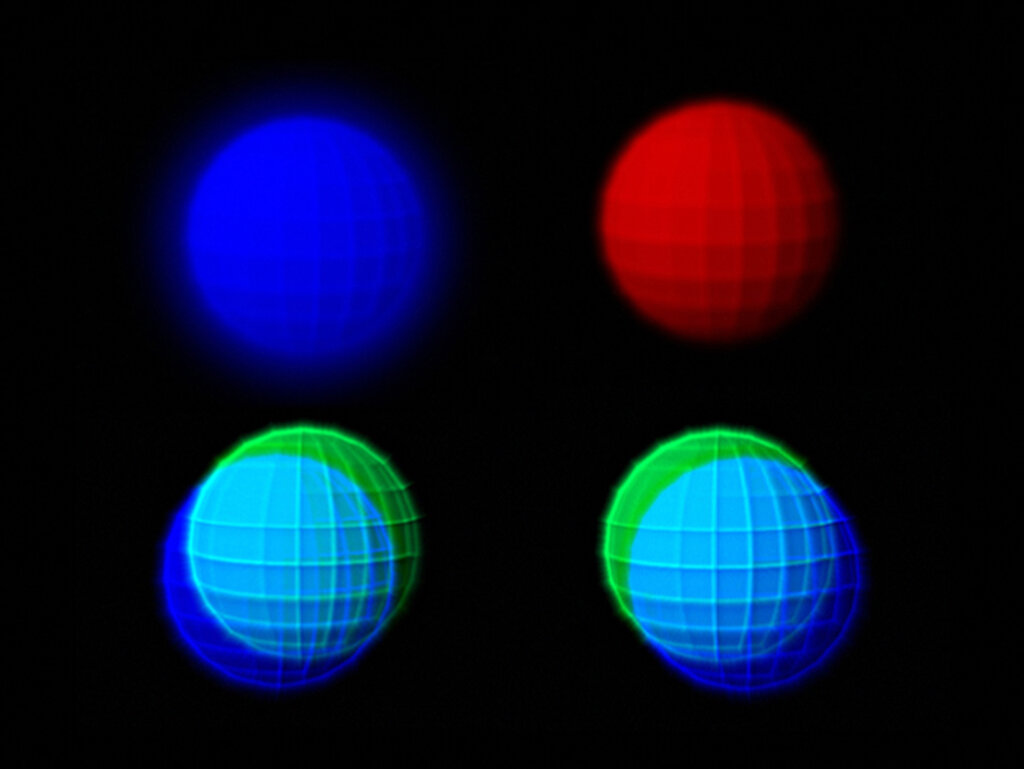
This interconnectedness is a powerful resource. It allows for incredibly complex information processing and is the foundation for many quantum algorithms that promise to solve problems that are currently intractable for even the most powerful classical supercomputers. By leveraging superposition and entanglement, quantum computers aren't just a faster version of what we have now; they are a fundamentally new way of computing.