Quantum Computing Fundamentals
Introduction to Quantum Computing
Beyond Bits and Bytes
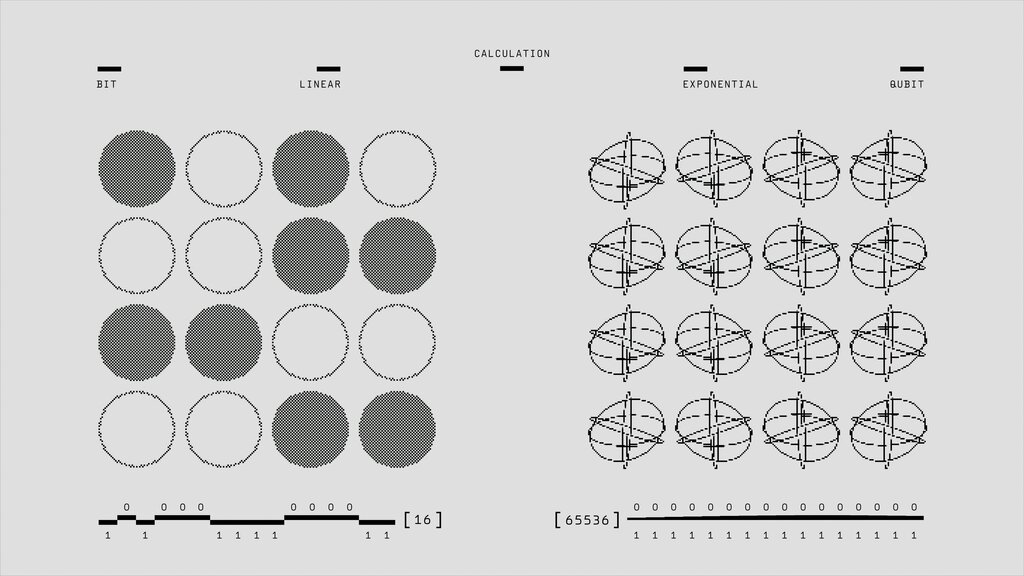
Classical computers, from your smartphone to the most powerful supercomputers, think in a very straightforward way. They use bits. A bit is a tiny switch that can be either on or off, represented by a 1 or a 0. Every app you use, photo you see, and message you send is ultimately just a very long sequence of these ones and zeros. This binary system is powerful, but it has limits. Some problems are so complex that even the fastest classical computer would take billions of years to solve them.
Quantum computing is a completely different approach. It’s built on the principles of quantum mechanics, the strange and fascinating rules that govern the universe at the scale of atoms and subatomic particles. Instead of bits, quantum computers use qubits.
The Quantum Rules
Two key principles of quantum mechanics give qubits their power: superposition and entanglement.
Superposition means a qubit can be a 0, a 1, or both at the same time. Think of it like a spinning coin. While it's in the air, it's neither heads nor tails—it's a blend of both possibilities. Only when it lands (when we measure it) does it settle into one definite state. This ability to exist in multiple states at once allows quantum computers to explore many potential solutions to a problem simultaneously.
The second principle is entanglement. This is a strange connection that can exist between two or more qubits. When qubits are entangled, their fates are linked, no matter how far apart they are. If you measure one entangled qubit and find it's a 0, you instantly know the other will be a 1 (or whatever its correlated state is). Albert Einstein famously called this "spooky action at a distance."
Entanglement is like having two magic coins. If you flip them and one lands on heads, you know with absolute certainty the other has landed on tails, even if it's on the other side of the world.
Building a Qubit
A qubit isn't just a concept; it's a physical object. Scientists have built qubits using various quantum systems, like the spin of an electron, the energy level of an atom, or tiny superconducting circuits. These systems are incredibly delicate. Any disturbance from the outside world, like a stray vibration or a change in temperature, can knock a qubit out of its special quantum state and destroy the computation. This fragility is one of the biggest challenges in building large-scale, reliable quantum computers.

By harnessing superposition and entanglement, quantum computers can process a vast amount of information in a fundamentally new way. They won't replace your laptop for everyday tasks, but for specific, complex problems in fields like medicine, materials science, and cryptography, they promise to be revolutionary.
Ready to check your understanding?
What is the fundamental difference between a classical bit and a quantum qubit?
The principle that allows a qubit to be both a 0 and a 1 at the same time is called:
Now that you understand the basic building blocks, you're ready to see how they come together to perform computations.