Quantum Computing Fundamentals
Introduction to Quantum Mechanics
The Quantum World
In our everyday lives, the rules of physics are predictable. If you throw a ball, you can calculate its path. It has a definite position and speed. But when we zoom in to the world of atoms and electrons, these familiar rules break down. Welcome to quantum mechanics, the physics of the very small, where things behave in ways that can seem strange and counterintuitive.
This isn't just abstract theory. The principles of quantum mechanics are the foundation for technologies like lasers, transistors in your computer, and MRI machines. To understand how next-generation technologies like quantum computers work, we first need to grasp the fundamental concepts that govern their bizarre world.
Wave or Particle?
Imagine firing tiny marbles one by one through two parallel slits in a wall and seeing where they land on a screen behind it. You'd expect to see two distinct bands, corresponding to the two slits. This is how particles behave.
Now, imagine sending waves through the same two slits. The waves would interfere with each other, creating a pattern of bright and dark stripes on the screen. This is how waves behave.
In the late 19th and early 20th centuries, experiments showed something astonishing. When electrons—which we think of as tiny particles—were fired one at a time through two slits, they created an interference pattern, just like waves. It was as if each electron passed through both slits simultaneously and interfered with itself. This bizarre behavior is called wave-particle duality.
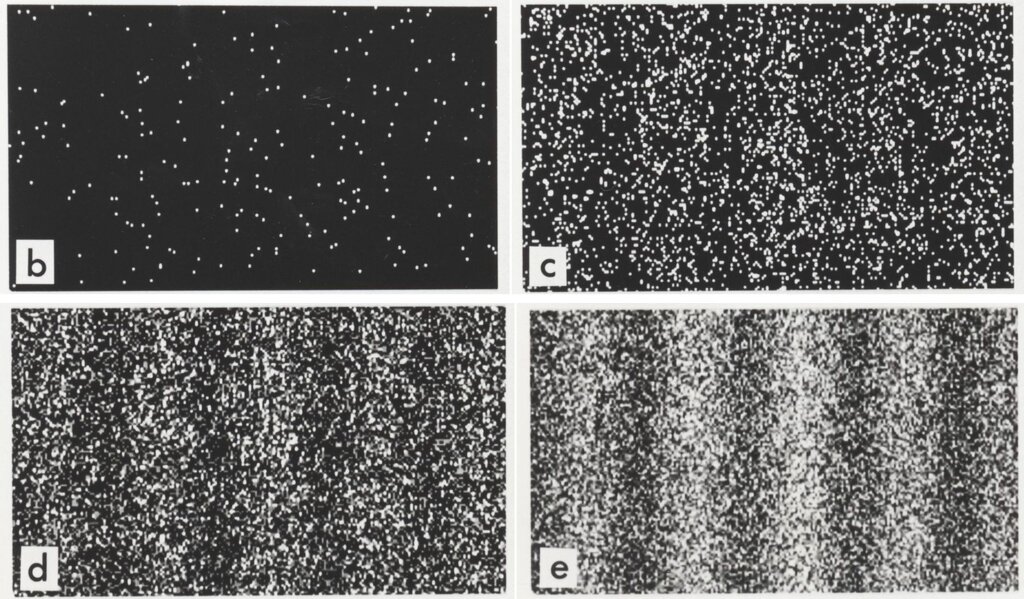
This duality is a central concept in quantum mechanics. Quantum objects aren't strictly particles or waves; they are a unique quantum entity that can exhibit properties of both. Which property you observe depends entirely on how you measure it. If you set up an experiment to detect which slit the electron goes through, the interference pattern disappears. The very act of observation forces the electron to behave like a particle and pick a single path.
Limits of Knowledge
This leads to another cornerstone of quantum mechanics: the Heisenberg Uncertainty Principle. It states that there's a fundamental limit to how precisely we can know certain pairs of properties of a particle at the same time. The most famous pair is position and momentum.
Think of it this way: to measure the precise position of an electron, you need to interact with it, perhaps by bouncing a photon of light off it. But this interaction inevitably gives the electron a kick, changing its momentum in an unpredictable way. The more precisely you try to pinpoint its position (by using a higher-energy photon), the bigger the kick and the more uncertain its momentum becomes.
momentum
noun
A measure of the mass and velocity of an object. In simple terms, it's the quantity of motion an object has.
This isn't a limitation of our measuring instruments. It's a fundamental property of nature. The uncertainty is built into the fabric of the quantum world. Mathematically, it's expressed as:
Here, is the uncertainty in position, is the uncertainty in momentum, and (h-bar) is a tiny fundamental constant. The formula shows that as the uncertainty in one value ($\