Quantum Computing Fundamentals
Introduction to Quantum Computing
Beyond Bits and Bytes
Classical computers, from your smartphone to the most powerful supercomputers, work with bits. A bit is the simplest possible piece of information. It's like a light switch: it can be either on, represented by a 1, or off, represented by a 0. Every email you send, video you watch, and app you use is built on top of this simple binary system of ones and zeros.
Quantum computing is a completely different way of processing information. It’s not just a faster version of the computers we have today. Instead, it uses the strange and counterintuitive rules of quantum mechanics to solve problems that are impossible for even the most powerful classical computers.
Quantum computers approach solving problems in a fundamentally new way.
The Quantum Bit
The heart of quantum computing is the quantum bit, or qubit. Unlike a classical bit, which must be either a 0 or a 1, a qubit can be a 0, a 1, or a blend of both states at the same time. This property is called superposition.
qubit
noun
The basic unit of quantum information, analogous to the classical bit. A qubit can exist in a superposition of states.
Think of a spinning coin. While it's in the air, it's not definitively heads or tails; it's a mix of both possibilities. Only when it lands and you look at it—when you measure it—does it settle into one definite state. A qubit in superposition is like that spinning coin. It holds multiple values simultaneously until it's measured, at which point it “collapses” into either a 0 or a 1.
This equation shows a qubit in superposition. Here, and are probability amplitudes that tell us the likelihood of the qubit collapsing to 0 or 1 upon measurement. This ability to exist in multiple states at once is what gives quantum computers their immense potential power.
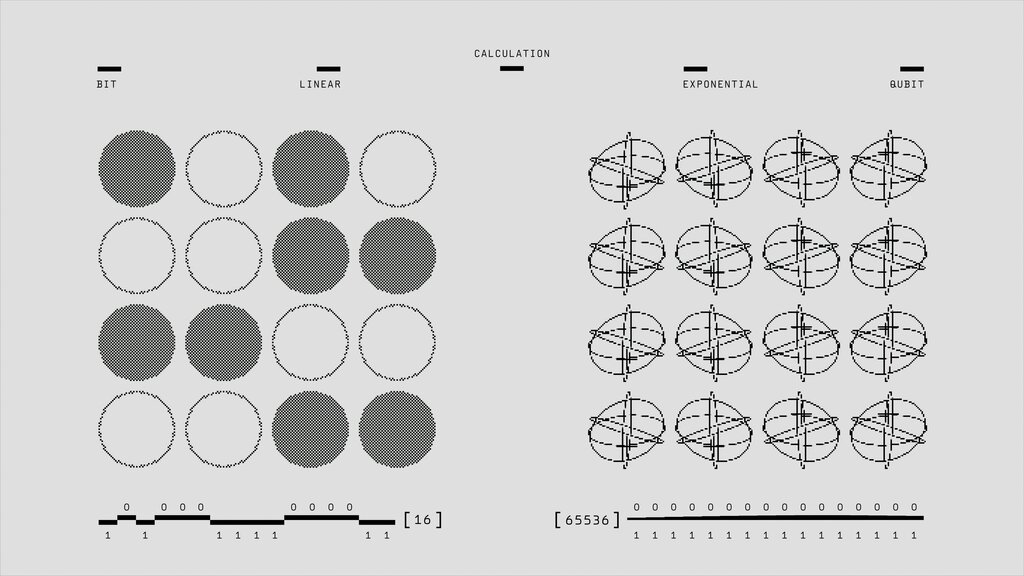
If you have two classical bits, you can represent one of four possible combinations: 00, 01, 10, or 11. But with two qubits, you can represent all four of those combinations at the same time thanks to another quantum phenomenon called entanglement.
entanglement
noun
A quantum mechanical phenomenon in which the quantum states of two or more objects are linked in such a way that they must be described with reference to each other, even though the individual objects may be spatially separated.
When qubits are entangled, their fates are intertwined. If you measure the state of one qubit, you instantly know the state of the other, no matter how far apart they are. Albert Einstein famously called this “spooky action at a distance.” This connection allows for complex calculations to be performed in a coordinated way across all the qubits in a system.
What Is It Good For?
Quantum computers won't replace your laptop for everyday tasks like writing emails or browsing the web. They are specialized machines designed to tackle specific, incredibly complex problems. The unique properties of qubits make them well-suited for several fields.
Cryptography: Many of today's encryption methods rely on the difficulty of factoring large numbers. A powerful quantum computer could break these codes easily. Conversely, quantum mechanics can also be used to create new, unhackable forms of encryption.
Optimization: Quantum computers could solve complex optimization problems, like finding the most efficient route for a delivery truck fleet or designing more effective drugs by simulating molecular interactions. These are problems with an enormous number of possible solutions, making them intractable for classical computers.
Machine Learning: By processing vast datasets in new ways, quantum computers could revolutionize artificial intelligence. They could help train more sophisticated machine learning models or identify subtle patterns that are invisible to classical algorithms.
While we are still in the early days of quantum computing, the field is advancing rapidly. Understanding these core concepts is the first step toward appreciating how this technology could reshape science, industry, and our world.
Ready to check your understanding? Let's see what you've learned about the fundamentals of quantum computing.
What is the fundamental property that allows a qubit to be both a 0 and a 1 at the same time?
What happens when a qubit in superposition is measured?
You now have a foundational understanding of what makes quantum computing so different and powerful. Next, we'll look at the tools used to build and describe quantum operations.