Quantum Computing for Technologists
Quantum Intuition
The Exponential Leap in State Space
In classical computing, the world is straightforward. If you have a system with 3 bits, you can describe its state with just 3 values: maybe 1, 0, and 1. The system can be in one of $2^3 = 8$ possible configurations (000, 001, etc.), but it only occupies one of them at any given moment. The information is limited by the number of bits.
Quantum computing fundamentally alters this relationship between the number of components and the information they can encode. A system of qubits is not described by values. Instead, its state is described by complex numbers called amplitudes. This collection of amplitudes forms a vector in a high-dimensional space. For just 3 qubits, you need amplitudes to fully describe the system. For 10 qubits, you need amplitudes. For 300 qubits, you need more amplitudes than there are atoms in the known universe.
This exponential scaling of the state space is the source of a quantum computer's potential power. It can explore a vast computational landscape that is utterly inaccessible to classical machines. This is why quantum computers are well-suited for problems with inherent high-dimensional complexity, like simulating molecular interactions or tackling large-scale optimisation problems, but not for everyday tasks like word processing.
Superposition as a Vector Space
Forget the idea of a qubit being both 0 and 1 at the same time. A more powerful and accurate way to think about superposition is through the lens of linear algebra. A qubit's state is a vector in a two-dimensional complex vector space, known as a .
The basis states, and , are just two specific vectors that form the axes of this space. A qubit in superposition is simply a vector that is a linear combination of these basis vectors.
Thinking in terms of vectors makes quantum computation much more intuitive. Quantum gates are no longer mysterious black boxes; they are simply matrices that rotate and reflect these state vectors within the Hilbert space. The entire computation is a sequence of geometric transformations.
Entanglement and Interference
When you have more than one qubit, their individual Hilbert spaces combine. For two qubits, you get a four-dimensional space with basis vectors and . Sometimes, the state of this two-qubit system can be described as a simple combination of the individual qubit states. But the most interesting states are the ones that can't.
This is entanglement: a state of a multi-qubit system that is non-separable. The fates of the qubits are intertwined. You cannot write the state of the whole system as a description of qubit A and a separate description of qubit B. They exist in a single, unified state. A famous example is the .
From a systems design perspective, entanglement is a resource that creates powerful correlations that have no classical analogue. But how do we use these strange states to compute? The answer is interference.
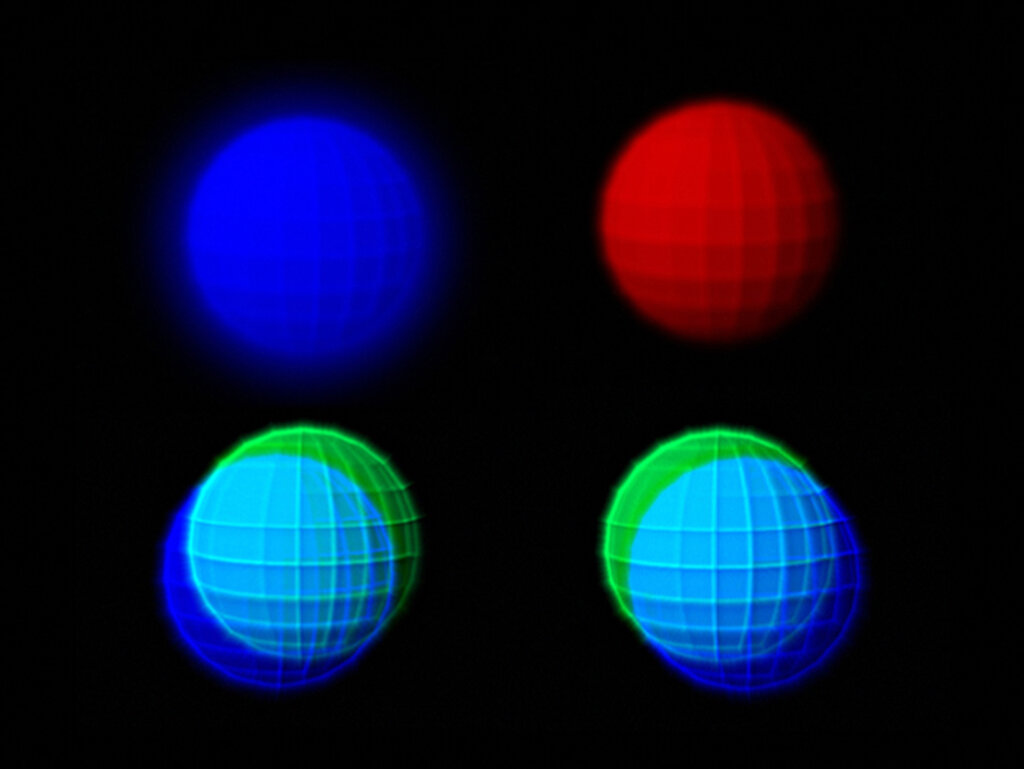
Just like waves in a pond, the complex amplitudes of a quantum state can interfere with each other. A quantum algorithm is designed to choreograph a series of rotations and reflections (gates) that cause the amplitudes leading to wrong answers to destructively interfere (cancel each other out) and the amplitudes leading to the right answer to constructively interfere (amplify each other). When you finally measure the system, you are highly likely to find the correct solution.
The Measurement Problem
The quantum state evolves beautifully and deterministically according to the rules of quantum mechanics, exploring its vast Hilbert space. But all of this rich information is hidden from us. To get an answer, you must perform a measurement.
From an architectural viewpoint, measurement is the process of projecting the high-dimensional quantum state vector onto one of the classical basis states. The moment you measure, the superposition collapses. The amplitudes vanish, and you are left with just classical bits of information. All the quantum parallelism disappears in an instant.
Measurement is an irreversible act that extracts a classical answer from a quantum state, destroying the superposition in the process.
This makes designing quantum algorithms a unique challenge. The entire computation must be structured so that the one classical answer you get at the end is the one you were looking for. You don't get to see the state during the computation; you only get one shot to extract the result. The power lies in manipulating the probabilities before this final, decisive collapse.
How many complex numbers, known as amplitudes, are required to fully describe the state of a 4-qubit quantum system?
From a linear algebra perspective, what is a quantum gate?