Quantum Computing for Medical Diagnostics
Introduction to Quantum Computing
A New Kind of Computing
Classical computers, the ones we use every day, are incredibly powerful. They think in terms of definite states: on or off, true or false, 0 or 1. This binary logic has gotten us very far, from smartphones to supercomputers. But some problems in nature are just too complex for this approach. Simulating molecules for drug discovery or breaking complex codes requires a different way of thinking. Quantum computing is that new approach. It's built on the strange and wonderful rules of quantum mechanics to process information in a fundamentally new way.
From Bits to Qubits
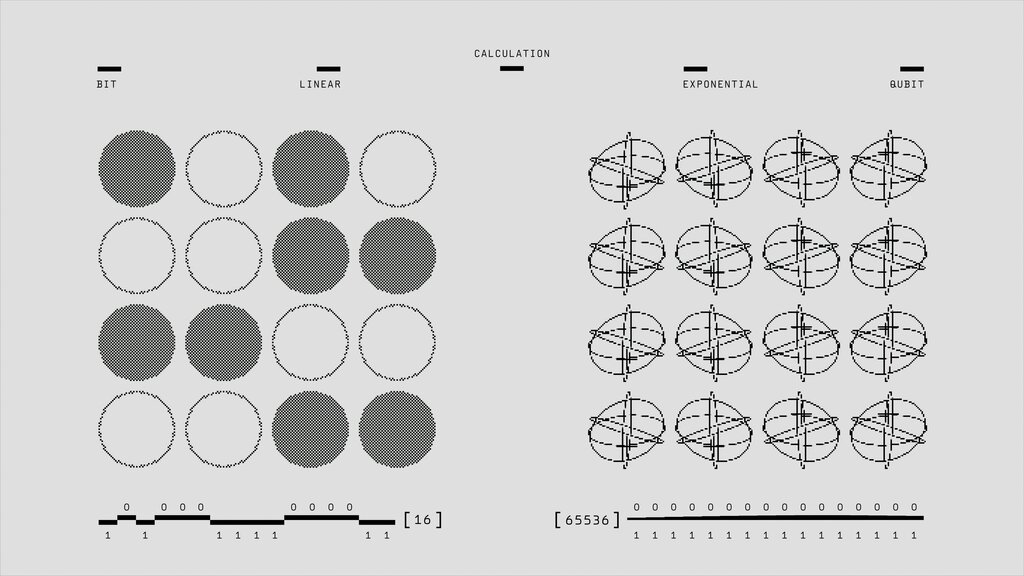
The basic unit of information in a classical computer is a bit. It's like a light switch: it can be either off (representing 0) or on (representing 1). There's no in-between. All the amazing things your laptop does are built on billions of these simple on-or-off switches.
Quantum computers use a different building block called a qubit.
qubit
noun
The basic unit of quantum information. It is the quantum analogue of the classical bit.
A qubit can be a 0, a 1, or both at the same time. This 'both at once' property is called superposition. Think of a spinning coin. While it's in the air, it's not definitively heads or tails—it's a blend of both possibilities. Only when it lands (or when we measure it) does it settle into one definite state. A qubit is like that spinning coin, holding a mix of 0 and 1 until it's observed.
This ability to exist in multiple states simultaneously is what gives quantum computers their power. Where a classical computer with 4 bits can only represent one of 16 possible combinations at a time (like 0101), a quantum computer with 4 qubits can represent all 16 combinations at once. This opens up a vast computational space to explore many solutions in parallel.
Quantum Entanglement
The next mind-bending concept is entanglement. This is a special connection that can exist between two or more qubits. When qubits are entangled, their fates are linked, no matter how far apart they are.
Imagine you have two of those special spinning coins, and they are entangled. If you send one to the other side of the world and then stop it, you instantly know how the other one will land. If yours is heads, you know the other is tails, and vice versa. The measurement of one immediately influences the other. Einstein famously called this 'spooky action at a distance.'
Quantum entanglement is a fundamental resource for quantum computing as it involves the distribution of information in a fundamentally non-classical way.
This deep connection allows quantum computers to perform complex calculations and create powerful correlations that are impossible in the classical world. It's a key ingredient that enables many quantum algorithms to work their magic.
| Feature | Classical Computing | Quantum Computing |
|---|---|---|
| Basic Unit | Bit | Qubit |
| State | 0 or 1 | 0, 1, or superposition of both |
| Key Principles | Binary logic | Superposition & Entanglement |
Now that we've covered the basics, let's check your understanding.
What is the fundamental unit of information in a classical computer?
The principle that allows a qubit to represent both 0 and 1 at the same time is known as:
These three ideas—qubits, superposition, and entanglement—are the pillars of quantum computing. They allow these machines to operate on principles that are entirely different from the computers we know, opening the door to solving a new class of problems.