Quantum Computing for Everyone
Classical vs Quantum
The Light Switch and the Spinning Coin
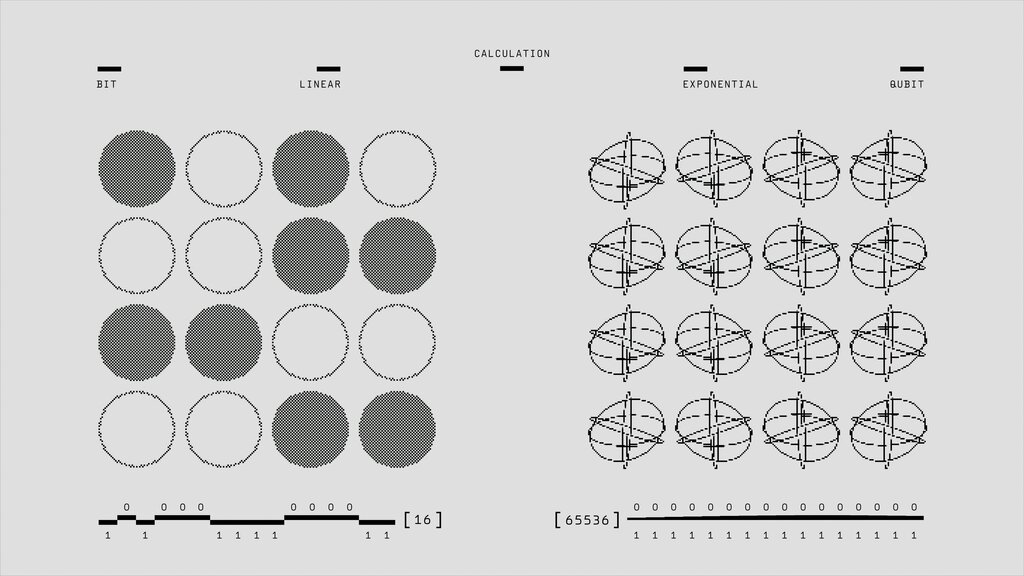
At the heart of every computer, phone, and smart watch is a simple idea: the bit. A bit is the smallest piece of data in computing. Think of it like a light switch. It can only be in one of two states: on or off. We represent these states with the numbers 1 and 0.
Every email you send, photo you take, and video you watch is broken down into millions of these tiny switches, all set to either 1 or 0. Classical computers work through problems by flipping these switches one by one, very, very quickly.
Quantum computing introduces a new player: the s. A qubit is the quantum equivalent of a bit, but it behaves in a much stranger way. Imagine a coin lying flat on a table. It's either heads or tails, just like a bit is either 1 or 0. Now, imagine spinning that coin on its edge. While it's spinning, is it heads or tails? In a way, it's both and neither at the same time. This spinning state is like a qubit.
Only when the coin falls and settles do we get a definite answer, heads or tails. Similarly, when we measure a qubit, it “chooses” a state and becomes either a 0 or a 1. But while it's in its quantum state, it holds the potential for both outcomes at once.
A New Way to Solve Problems
This difference between a bit and a qubit leads to a completely new way of processing information. A classical computer tackles problems sequentially. If it needs to find the right path through a maze, it tries one path, hits a dead end, goes back, and tries another, one after another.
A quantum computer, thanks to its qubits being in multiple states at once, can explore all possible paths through the maze simultaneously. It’s not just about being faster; it’s about a fundamentally more efficient approach for certain types of problems.
So, why do we need this new approach? Some problems are so complex that even the world's most powerful supercomputers would take thousands of years to solve them. A prime example is accurately. Understanding how a new drug will interact with proteins in the human body requires modelling every single atomic interaction, a task that quickly becomes impossibly large for classical computers.
A quantum computer could, in theory, create a perfect simulation, allowing scientists to design new medicines and materials with unprecedented speed and precision.
Quantum computers aren't just faster versions of the computers we use today. They are a different kind of tool for solving a different kind of problem.
This means your laptop and phone are safe. Quantum computers won't replace them for everyday tasks like sending emails, browsing the web, or playing games. Instead, they will work alongside classical machines, tackling the specific, monumental challenges that are currently beyond our reach.