Quantum Computing Explained
Introduction to Quantum Computing
Beyond Bits and Bytes
Classical computers, from your smartphone to the most powerful supercomputers, process information using bits. A bit is a simple switch that can be in one of two states: on or off, represented by a 1 or a 0. All the amazing things classical computers do boil down to manipulating billions of these tiny switches.
Quantum computing is a completely different approach. It's built on the principles of quantum mechanics, the physics that governs the strange world of atoms and subatomic particles. Instead of bits, quantum computers use something far more powerful: qubits.
The Quantum Bit
A qubit, or quantum bit, is the basic unit of information in a quantum computer. Like a classical bit, a qubit can be a 0 or a 1. But here’s where things get interesting. Thanks to a principle called superposition, a qubit can also be a 0 and a 1 at the same time.
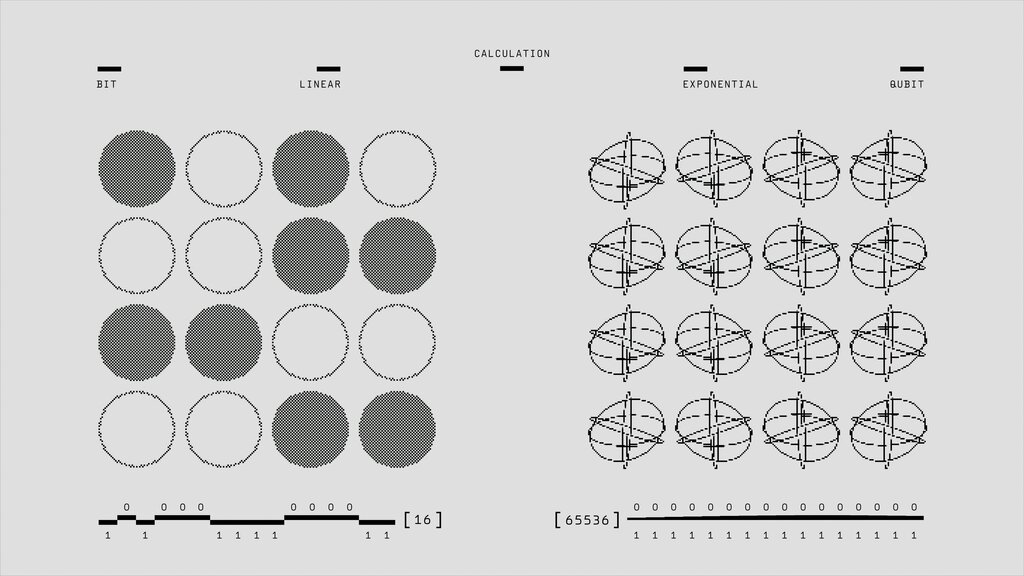
Think of a classical bit as a light switch. It's either on or off. A qubit, however, is more like a spinning coin. While it's spinning, it's not quite heads and not quite tails—it's a blend of both possibilities. Only when you stop it (or “measure” it, in quantum terms) does it land on a definite state, either heads (0) or tails (1).
This ability to exist in multiple states at once is called superposition. It's one of the keys to a quantum computer's power. Mathematically, we represent a qubit's state as a combination of its probability of being 0 and its probability of being 1.
Here, and are probability amplitudes. The probability of measuring the qubit as a 0 is , and the probability of measuring it as a 1 is . Because these are the only two outcomes, the probabilities must add up to 1: .
A Spooky Connection
The other mind-bending principle that powers quantum computing is entanglement. This is a special connection between two or more qubits. When qubits are entangled, their fates are linked, no matter how far apart they are.
entanglement
noun
A quantum mechanical phenomenon in which the quantum states of two or more objects have to be described with reference to each other, even though the individual objects may be spatially separated.
Imagine you have two “entangled” coins. You give one to a friend and keep one. You both flip them at the same time. If your coin lands on heads, you instantly know your friend’s coin landed on tails, and vice versa. Their outcomes are perfectly correlated.
Entanglement creates intricate relationships between qubits, allowing quantum computers to solve complex problems that are impossible for classical computers. By linking qubits together, a quantum computer can perform calculations on a vast number of possibilities simultaneously.
Quantum Circuits
Just as classical computers use logic gates (like AND, OR, and NOT) to manipulate bits, quantum computers use quantum gates to manipulate qubits. These gates can put qubits into superposition, entangle them, or change their probabilities.
A sequence of quantum gates applied to a set of qubits is called a quantum circuit. This is the quantum equivalent of a classical computer algorithm.
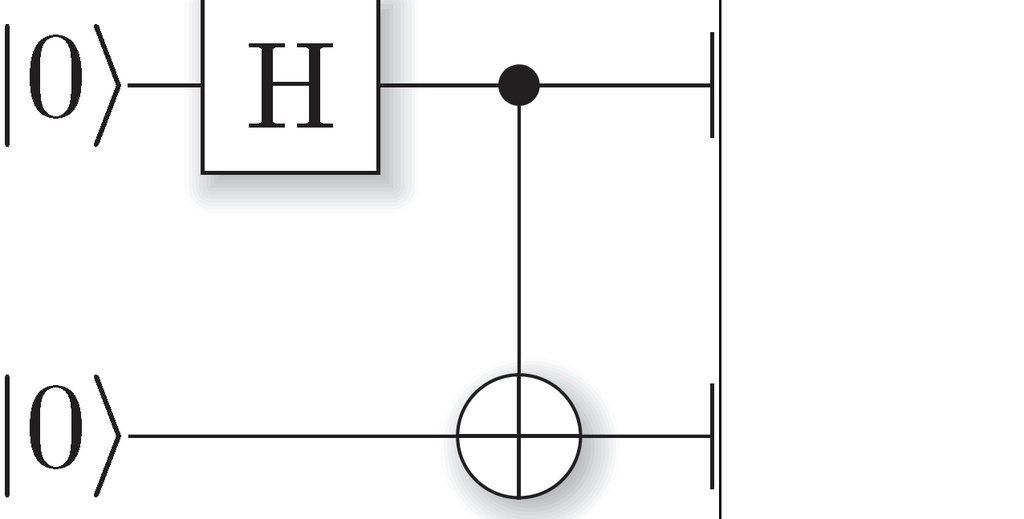
In the circuit above, two qubits start in the state. The top qubit goes through a Hadamard gate (H), which puts it into a superposition of and . Then, a Controlled-NOT (CNOT) gate entangles the two qubits. Now, the state of the second qubit is dependent on the first.
By carefully designing these circuits, scientists can harness the power of superposition and entanglement to perform incredible computations.
Potential Applications:
- Drug Discovery: Simulating molecules to design new medicines.
- Materials Science: Creating new materials with desired properties.
- Finance: Optimizing investment strategies and risk models.
- Cryptography: Breaking current encryption methods and creating new, secure ones.
While we're still in the early days of quantum computing, the technology holds the promise of revolutionizing many fields. Now let's review the key concepts we've covered.
Ready to test your knowledge?
What is the fundamental unit of information in a quantum computer?
The principle that allows a qubit to be both 0 and 1 at the same time is known as:
Quantum computing represents a fundamental shift in how we process information. By leveraging the unique properties of the quantum world, these machines open up new possibilities for solving some of humanity's most challenging problems.