Quantum Computing Explained
Introduction to Quantum Computing
Beyond Bits and Bytes
Classical computers have changed the world. They operate on a simple principle: bits. A bit is like a light switch, it can either be on (represented by a 1) or off (represented by a 0). All the complex tasks your phone or laptop perform boil down to manipulating billions of these tiny switches.
Quantum computing is a completely different approach. It’s not just a faster version of the computers we use today. It’s a new kind of machine that operates using the strange and wonderful rules of quantum mechanics, the science of atoms and particles.
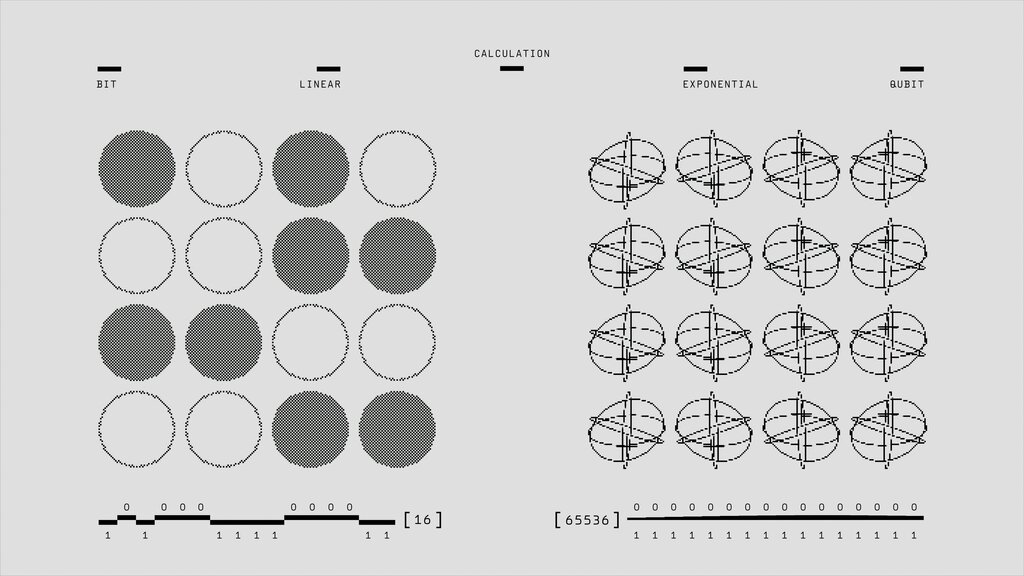
Instead of bits, quantum computers use qubits. A qubit can be a 0 or a 1, just like a classical bit. But it can also be in a combination of both states at the same time. This is a core concept from quantum mechanics called superposition.
Think of a spinning coin. While it's in the air, it's neither heads nor tails—it's a blend of both possibilities. A qubit is like that spinning coin until you measure it, at which point it “chooses” a side and lands on either 0 or 1.
Qubit
noun
The basic unit of quantum information. It's the quantum analogue of the classical bit.
Quantum Superpowers
Superposition is one of the two key principles that give quantum computers their power. Because a qubit can exist in multiple states at once, a quantum computer with just a few qubits can explore a vast number of possibilities simultaneously. Adding just one more qubit doubles the machine's computational space.
The second principle is entanglement. This is a deep, counterintuitive connection between two or more qubits. When qubits are entangled, their fates are linked, no matter how far apart they are. If you measure the state of one, you instantly know the state of the other. Einstein famously called this phenomenon “spooky action at a distance.”

This entanglement allows for complex correlations between qubits, which is essential for running powerful quantum algorithms. It's a resource that doesn't exist in the world of classical computing.
Why Go Quantum?
Quantum computers won't replace your laptop for everyday tasks like sending emails or browsing the web. Classical computers are excellent at those things. Instead, quantum computers are designed to tackle specific, complex problems that are currently impossible for even the most powerful supercomputers to solve.
These problems are often found in fields like medicine, materials science, and finance. For example, a quantum computer could simulate molecules with perfect accuracy, leading to the discovery of new drugs and materials. They could also optimize complex systems, like financial markets or global supply chains, and break modern encryption methods.
The goal isn't to build a faster computer, but to build a different kind of computer that can solve problems we've never been able to touch before.
The field is still in its early days. Building and controlling qubits is incredibly difficult because they are fragile and easily disturbed by their environment. But as the technology matures, quantum computing promises to open up new frontiers in science and technology. Let's test your understanding of these core ideas.
What is the fundamental unit of information used in a quantum computer?
The ability of a qubit to represent both a 0 and a 1 at the same time is a direct result of which quantum mechanical principle?