Quantum Computing Demystified
Introduction to Quantum Computing
A New Kind of Computing
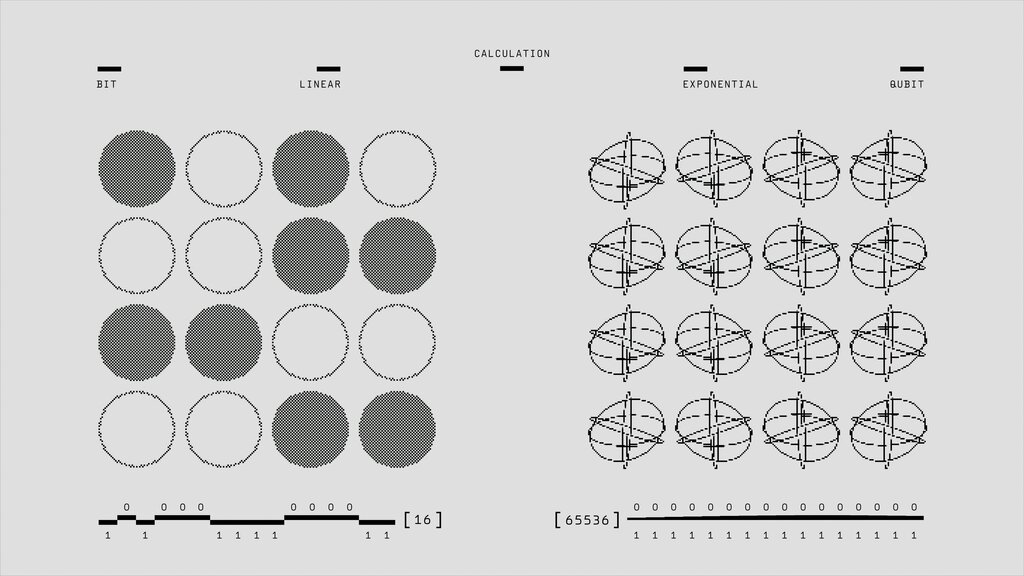
Classical computers, from your smartphone to the most powerful supercomputers, work with bits. A bit is a simple switch that can be either on or off, represented by a 1 or a 0. All the amazing things classical computers do boil down to manipulating billions of these simple switches.
Quantum computing is a completely different approach. It’s built on the strange and counterintuitive rules of quantum mechanics, the science of atoms and subatomic particles. Instead of bits, quantum computers use qubits.
Qubit
noun
The basic unit of quantum information. Unlike a classical bit, a qubit can represent a one, a zero, or both values at the same time.
This ability to exist in multiple states at once is the secret to a quantum computer's power. While a classical computer checks possibilities one by one, a quantum computer can explore a huge number of them all at once. This doesn't just make it faster; it makes it capable of solving problems that are impossible for any classical computer to tackle, no matter how powerful.
The Quantum Rules
Two key principles of quantum mechanics give qubits their power: superposition and entanglement.
Superposition is the idea that a qubit can be a combination of both 0 and 1 simultaneously. Think of a spinning coin. While it's in the air, it's neither heads nor tails—it's a blend of both possibilities. Only when it lands (a process called measurement) does it settle into a definite state.
A quantum computer uses superposition to process millions of possibilities at once. But superposition alone isn't enough. The real magic happens when you add entanglement.
Entanglement is a strange connection between two or more qubits. When qubits are entangled, their fates are linked, no matter how far apart they are. If you measure one and find it's a 0, you instantly know the state of its entangled partner. Albert Einstein famously called this "spooky action at a distance."
This deep connection allows for complex, coordinated calculations that are the basis of powerful quantum algorithms.
What's It Good For?
Quantum computers aren't going to replace your laptop for browsing the internet or writing emails. They are specialized machines designed for specific, incredibly hard problems.
One major area is materials science and drug discovery. Simulating how molecules behave is a hugely complex task for classical computers. A quantum computer could accurately model molecular interactions, allowing scientists to design new medicines or more efficient materials for batteries and solar panels.
Another application is in optimization. Imagine trying to find the most efficient route for a fleet of thousands of delivery trucks. The number of possible combinations is astronomical. Quantum computers could solve these complex logistical problems, saving time and energy.
They also pose a new challenge to cybersecurity. Many of today's encryption methods rely on problems that are too hard for classical computers to solve, like factoring large numbers. A powerful quantum computer could potentially break this encryption, which is why researchers are already working on new, quantum-resistant security methods.
The Race to Build One
Building a functional quantum computer is one of the greatest scientific and engineering challenges of our time. We are still in the very early days.

The biggest problem is that qubits are extremely fragile. The slightest disturbance from their environment—a tiny change in temperature or a stray magnetic field—can destroy their quantum state in a phenomenon called decoherence. This causes errors in the calculation.
To protect qubits, they are kept in highly controlled environments, often cooled to temperatures colder than deep space. Today's devices are known as "Noisy Intermediate-Scale Quantum" (NISQ) computers. They have a limited number of qubits and are still prone to errors, but they are powerful enough for researchers to begin exploring real-world problems.
The journey to a large-scale, fault-tolerant quantum computer is a marathon, not a sprint. But the progress is steady, and the potential payoff is enormous.
Ready to check your understanding?
What is the fundamental unit of information in a quantum computer called?
Which two principles of quantum mechanics give qubits their immense processing power?
Quantum computing represents a fundamental shift in how we process information, opening doors to solving problems once thought impossible.