Quantum Computer Types Explained
Introduction to Quantum Computing
Beyond Bits and Bytes
Classical computers think in bits, which are like light switches: either on (1) or off (0). It's a binary system that has powered everything from your pocket calculator to the servers running the internet. But some problems are so complex that even the fastest supercomputers would take billions of years to solve them.
To tackle these challenges, we need a new kind of computer. Enter the quantum computer. Instead of bits, it uses quantum bits, or qubits. A qubit isn't just on or off; it can be on, off, or both at the same time.
qubit
noun
The basic unit of quantum information. Unlike a classical bit, which can be a 0 or a 1, a qubit can be a 0, a 1, or a superposition of both states.
It might sound complex, but by understanding just three core concepts – qubits, superposition, and entanglement – you'll unlock the fundamental magic that powers this incredible technology.
Superposition and Entanglement
Superposition is the first mind-bending property of qubits. Imagine a spinning coin. While it's in the air, it's neither heads nor tails. It’s in a combination of both states. Only when it lands (when we measure it) does it settle into one definite outcome. A qubit is like that spinning coin. It exists in a fuzzy cloud of possibilities until you look at it.
This ability to hold multiple values at once is what gives quantum computers their power. Where a classical computer with 3 bits can only represent one of eight numbers (000 to 111) at a time, a quantum computer with 3 qubits can represent all eight numbers simultaneously.
The second key property is entanglement. This is a strange connection between two or more qubits. If two qubits are entangled, their fates are linked. No matter how far apart they are, measuring one instantly influences the other. Albert Einstein famously called this "spooky action at a distance."
If you have two entangled qubits, and you measure one to be in state 0, you instantly know the other is in state 0. If one is 1, the other is 1. This happens even if one qubit is on Earth and the other is on Mars. This interconnectedness allows for powerful computations that are impossible classically.
Entanglement links the fates of qubits, allowing for complex calculations where changing one qubit instantaneously affects others, regardless of distance.
Circuits and Challenges
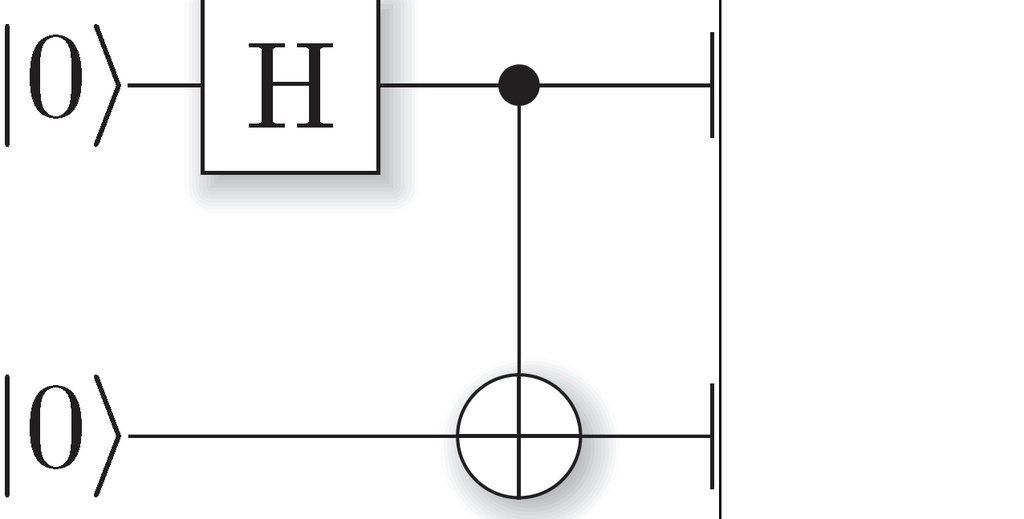
To perform calculations, we need to manipulate these qubits. We do this using quantum gates, which are the building blocks of quantum circuits. A quantum gate is an operation that changes the state of one or more qubits. A sequence of these gates forms a quantum algorithm.
For example, a Hadamard gate can put a qubit into an equal superposition of 0 and 1. A CNOT (Controlled-NOT) gate flips the state of a second qubit (the target) only if the first qubit (the control) is in the state 1. Combining these gates allows us to create complex quantum states and perform powerful computations.
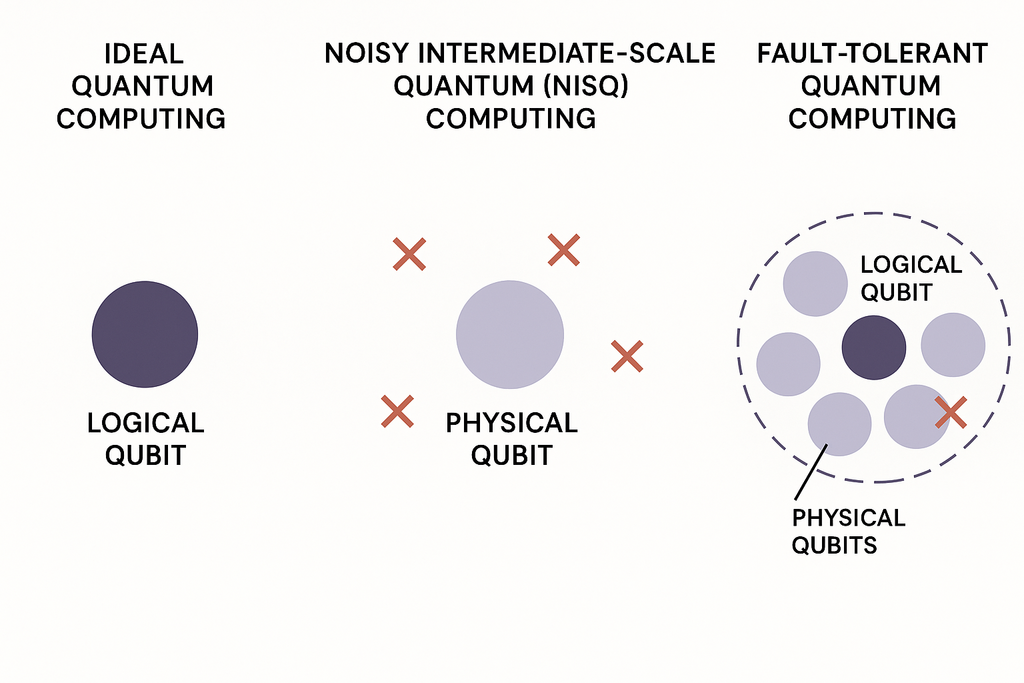
Building quantum computers is incredibly difficult. Qubits are fragile. Any little disturbance from the outside world, like a stray vibration or temperature change, can destroy their quantum state. This is called decoherence. It's like trying to keep a coin spinning on its edge, the slightest breeze will make it fall.
Because of this, today's machines are called Noisy Intermediate-Scale Quantum (NISQ) computers. They have a limited number of qubits (from dozens to a few hundred) and are prone to errors. We are still a long way from building large, fault-tolerant quantum computers that can correct for these errors.
What's It Good For?
Even with these challenges, quantum computers promise to revolutionize many fields. Their ability to explore many possibilities at once makes them ideal for solving certain types of problems that are intractable for classical computers.
| Field | Potential Application |
|---|---|
| Medicine | Designing new drugs and personalized medicines by simulating molecules. |
| Materials Science | Discovering new materials with desired properties, like better superconductors or more efficient solar cells. |
| Finance | Optimizing investment strategies and creating more accurate financial models. |
| Artificial Intelligence | Speeding up machine learning algorithms and training more powerful AI models. |
| Cryptography | Breaking current encryption standards, but also creating new, un-hackable quantum encryption methods. |
Let's review the key concepts we've just covered.
Ready to test your knowledge?
How does a qubit fundamentally differ from a classical bit?
The strange connection between two or more qubits, where their fates are linked no matter the distance, is known as __________.
We've only scratched the surface. Quantum computing is a rapidly evolving field, moving from theoretical physics to practical engineering. The journey from today's noisy devices to powerful, fault-tolerant machines will be long, but the potential is enormous.