Quantum Computation Fundamentals
Introduction to Quantum Computing
The Quantum Leap
Classical computers, from your smartphone to the most powerful supercomputers, think in a very straightforward way. Everything is boiled down to a sequence of bits, which are like tiny light switches. A bit can be either off, represented by a 0, or on, represented by a 1. All the amazing things classical computers do are built on this simple binary foundation.
Quantum computing operates on a completely different set of rules, borrowed from the strange world of quantum mechanics. It doesn't just offer a faster way to do what classical computers do; it offers a fundamentally new way to compute.
qubit
noun
The basic unit of quantum information. It is the quantum analogue of the classical bit.
The building block of a quantum computer is the qubit, short for 'quantum bit.' Like a classical bit, a qubit can be a 0 or a 1. But it can also be in a combination of both states at the same time. This 'both at once' idea is one of the keys to a quantum computer's power.
Superposition: More Than On or Off
Imagine a spinning coin. While it's in the air, it’s not definitively heads or tails. It's in a state that includes both possibilities. Only when it lands (when we measure it) does it settle into one definite state. A qubit is like that spinning coin. This ability to exist in multiple states simultaneously is called superposition.
A classical computer with two bits can represent one of four possible combinations (00, 01, 10, 11) at any given moment. But a quantum computer with two qubits can represent all four of those combinations at the same time. With each additional qubit, this power grows exponentially. Three qubits can hold 8 combinations, four qubits can hold 16, and so on.
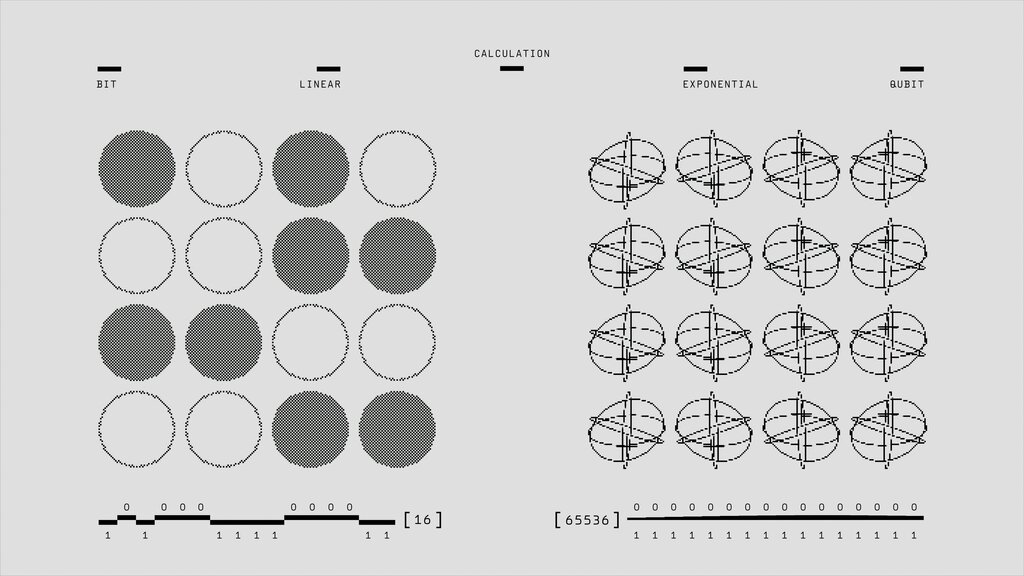
This massive parallelism allows quantum computers to explore a huge number of possibilities simultaneously. But superposition isn't the only strange principle at play.
Entanglement: A Spooky Connection
Entanglement is a quantum phenomenon where two or more qubits become linked in a way that their fates are intertwined, no matter how far apart they are. If you have two entangled qubits, measuring one instantly tells you the state of the other.
Think of it like having two magic coins. You give one to a friend who travels to the other side of the world. The moment you flip your coin and it lands on heads, you know instantly that your friend's coin has landed on tails. Their outcomes are perfectly correlated.
This connection allows for incredibly complex information processing that isn't possible in the classical world. The state of one part of the system gives you information about another part, creating a single, powerful computational entity.
Entanglement links qubits together, so the state of one qubit can depend on the state of another. This creates complex relationships that classical bits can't replicate.
So, how does this all add up? Classical computation is deterministic. It follows a predictable path of 0s and 1s to arrive at a single answer. Quantum computation, on the other hand, operates in a space of probabilities. It explores a vast landscape of potential solutions all at once, and the final answer emerges from this quantum state.
| Feature | Classical Computing | Quantum Computing |
|---|---|---|
| Basic Unit | Bit | Qubit |
| Possible States | 0 or 1 | 0, 1, or a superposition of both |
| Core Principles | Boolean logic | Superposition & Entanglement |
| Processing | Sequential & Parallel | Massively Parallel (probabilistic) |
This new approach doesn't mean quantum computers will replace your laptop for everyday tasks. Instead, they are designed to tackle specific, incredibly complex problems that are currently impossible for even the best classical supercomputers to solve. Now, let's test your understanding of these foundational ideas.
What is the fundamental building block of a quantum computer, analogous to a 'bit' in a classical computer?
The principle that allows a qubit to exist in a combination of both 0 and 1 states simultaneously is known as:
Understanding qubits, superposition, and entanglement is the first step into the revolutionary world of quantum computing.