Quantum Circuit Architectures and Algorithms
Universal Quantum Gate Mechanics
Manipulating Qubits with Unitary Gates
In quantum computing, we change a qubit's state by applying quantum gates. Think of these as the quantum equivalent of classical logic gates like AND or NOT. However, there's a crucial difference: all quantum operations, except for measurement, must be reversible. You have to be able to run the computation backward and perfectly recover the initial state.
This requirement for reversibility means that every quantum gate is represented by a unitary matrix. When you apply a gate to a qubit, you're mathematically multiplying the qubit's state vector by the gate's unitary matrix. This operation transforms the quantum state into a new one, preserving its total probability.
Unitary operators (ÛÛ† = Û†Û = I) represent quantum evolution:
The condition for a matrix to be unitary is that its conjugate transpose, denoted , is also its inverse. In other words, , where is the identity matrix. This property ensures that the length of the state vector remains 1 after the operation, which is essential because the squared magnitudes of its components must sum to one.
Rotations on the Bloch Sphere
A helpful way to visualize single-qubit gates is as rotations on the Bloch sphere. A qubit's state vector points to a specific location on the surface of this sphere. Applying a gate rotates this vector to a new position.
The most fundamental rotation gates are , , and . As their names suggest, they rotate the state vector around the x, y, and z axes of the Bloch sphere, respectively. The angle of rotation is specified as a parameter, .
The sequence in which you apply these gates matters immensely. Rotating by 90 degrees around the x-axis and then 90 degrees around the y-axis () gives a different result than doing it in the opposite order (). This property is called non-commutativity. Because matrix multiplication is not generally commutative (), the order of quantum gates changes the final outcome.
The non-commutativity of quantum gates is a fundamental feature that distinguishes quantum circuits from their classical counterparts. The order of operations is not just important; it's a tool for computation.
Building Universal Computers
The ultimate goal is to build a quantum computer that can run any possible quantum algorithm. To do this, we need a set of gates that can be combined to approximate any arbitrary unitary operation. Such a set is called a universal quantum gate set.
One common universal set includes the Hadamard gate, the CNOT gate, and the T-gate. The Hadamard and CNOT gates belong to a special category known as . While powerful, Clifford gates alone are not enough for universal computation. They can be simulated efficiently on a classical computer, meaning a quantum computer built only with them would offer no speedup.
To achieve universality, we need to add a non-Clifford gate to our toolkit. The most common choice is the T-gate, which is a rotation around the z-axis by .
The T-gate, when combined with Hadamard gates, allows us to create rotations by small, irrational angles. By combining many of these small rotations, we can approximate any arbitrary rotation on the Bloch sphere to a desired precision. This ability to construct any unitary operation is the essence of universality.
Decomposition and Control
Any complex quantum operation, represented by a large unitary matrix, can be broken down into a sequence of simpler gates from a universal set. This process is called gate decomposition or synthesis. For example, any single-qubit unitary operation can be decomposed into a sequence of rotations around the z and y axes.
This principle extends to multi-qubit systems. It's a proven fact that any multi-qubit unitary operation can be decomposed into a sequence of single-qubit gates and CNOT gates. This is a powerful result, as it guarantees that our small universal gate set is sufficient to build any quantum algorithm, no matter how complex.
We can also create more complex multi-qubit gates by adding control conditions to any single-qubit gate. A Controlled-U gate applies the unitary operation to a target qubit only if a control qubit is in the state . We already know the Controlled-NOT (CNOT) gate, but we can construct a Controlled-Hadamard, Controlled-T, or any other Controlled-U gate. These controlled operations are essential building blocks in algorithms like Quantum Phase Estimation.
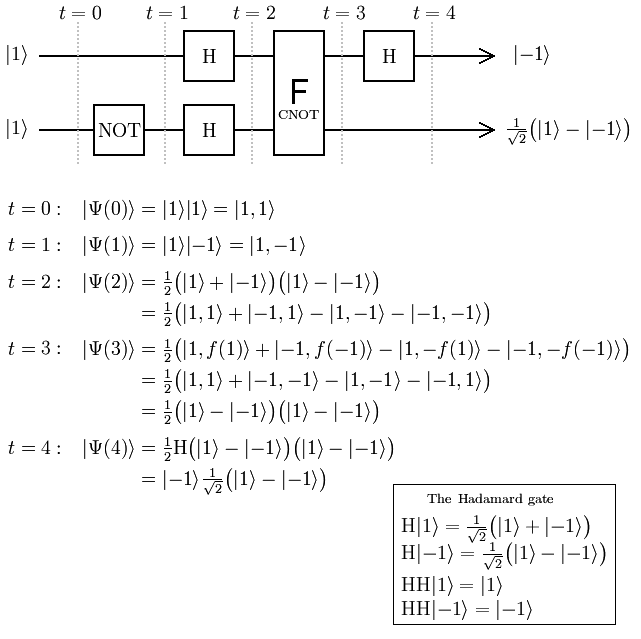
Understanding how to manipulate qubits with these fundamental gates is the key to designing and implementing quantum circuits. By composing rotations, controlled operations, and other gates, we can construct the complex unitary transformations that power quantum algorithms.
Let's test your knowledge on these gate mechanics.
What is the defining mathematical property of a matrix that represents a quantum gate?
Why does the order in which you apply quantum gates typically matter?