Quantum Chemistry in Inorganic Chemistry
Atomic Structure
The Building Blocks of Matter
Everything around you, from the air you breathe to the screen you're reading this on, is made of elements. The smallest unit of an element that still has the properties of that element is called an atom. Think of it like a single Lego brick. You can have a red brick, a blue brick, or a yellow one, and each is the smallest piece of that specific color.
Atom
noun
The smallest unit of an element that maintains the chemical identity of that element.
Atoms themselves are made of even smaller pieces called subatomic particles. The three most important ones are protons, neutrons, and electrons.
Protons and neutrons are packed together in the center of the atom, in a dense region called the nucleus. Electrons are much smaller and move around the nucleus in a cloud. Protons have a positive (+) electrical charge, electrons have a negative (-) charge, and neutrons have no charge at all. In a neutral atom, the number of protons and electrons is equal, so their charges cancel out.
What makes an atom of gold different from an atom of oxygen? It's the number of protons. The number of protons in an atom's nucleus is called its atomic number, and it's what defines an element. For example, every single carbon atom in the universe has 6 protons. If it had 7, it would be a nitrogen atom.
The mass number of an atom is the total count of its protons and neutrons. For example, the most common form of carbon has 6 protons and 6 neutrons, giving it a mass number of 12. This is often written as Carbon-12.
Where Electrons Live
Electrons don't just buzz around the nucleus randomly. They are organized into different energy levels, often visualized as shells. Think of these shells like the layers of an onion, with the nucleus at the very center. Electrons in the shells closest to the nucleus have the least energy, while those in the outermost shells have the most.
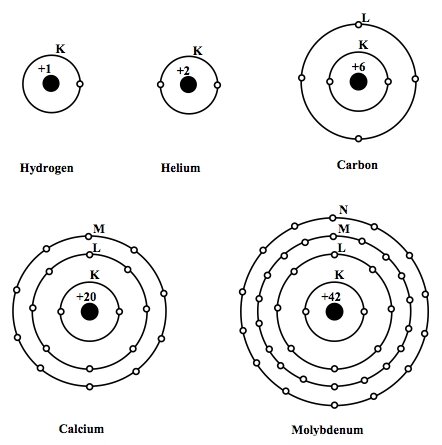
Within these shells are specific regions where an electron is most likely to be found. These regions are called orbitals. Different types of orbitals have different shapes. The simplest is the s orbital, which is spherical. The next type, the p orbital, is shaped like a dumbbell. As you move to higher energy levels, you find more complex orbital shapes, like d and f orbitals.
An s orbital is shaped like a sphere. A p orbital is shaped like a dumbbell. Each orbital can hold a maximum of two electrons.
The specific arrangement of electrons in an atom's orbitals is its electron configuration. Electrons fill the lowest-energy orbitals first before moving to higher-energy ones. This is known as the Aufbau principle. For example, an oxygen atom has 8 electrons. Its configuration is written as $1s^22s^22p^4$. This means it has:
- 2 electrons in the s orbital of the first energy level.
- 2 electrons in the s orbital of the second energy level.
- 4 electrons in the p orbitals of the second energy level.
Organizing the Elements
The periodic table is not just a random chart of elements. It's a masterpiece of organization based on atomic structure. The elements are arranged in order of increasing atomic number, which, as we know, is the number of protons.
The rows of the table are called periods. As you move across a period from left to right, you're adding one proton to the nucleus and one electron to the electron shells. All elements in a period have the same number of electron shells.
The columns are called groups. Elements in the same group have the same number of electrons in their outermost shell. These are called valence electrons, and they are the key players in chemical reactions. Because they have the same number of valence electrons, elements in the same group often have very similar chemical properties.
The periodic table's structure reveals patterns. For instance, elements on the far left are highly reactive metals, while those on the far right (except for the last column) are highly reactive nonmetals. The elements in the very last column, the noble gases, are extremely unreactive because they have full outer electron shells.
This organization also leads to predictable periodic trends, or patterns in elemental properties. For example, as you move from left to right across a period, atoms generally get smaller. This might seem counterintuitive since you're adding more particles, but the increasing number of protons pulls the electrons in more tightly.
As you move down a group, atoms get larger. This is because you're adding new electron shells with each new period, placing the outermost electrons further and further from the nucleus.
| Trend | Across a Period (Left to Right) | Down a Group (Top to Bottom) |
|---|---|---|
| Atomic Radius | Decreases | Increases |
| Ionization Energy | Increases | Decreases |
| Electronegativity | Increases | Decreases |
Understanding this basic structure is the first step to seeing why elements behave the way they do.
What uniquely defines a chemical element?
An atom has 17 protons and 18 neutrons. What is its mass number?