Quantum and Classical Computing: A Hybrid Approach
Classical Computing Basics
The Language of Computers
At its core, a classical computer doesn't understand words, images, or sounds. It only understands two things: on and off. This two-state system is called binary, and it's the fundamental language of every traditional computer.
Think of a light switch. It can either be on or off. There's no in-between. Computers represent these two states with the numbers 1 (on) and 0 (off). Each 1 or 0 is called a bit.
Bit
noun
The smallest unit of data in a computer. A bit has a single binary value, either 0 or 1.
A single bit isn't very useful on its own, but when you string them together, you can represent almost anything. By combining bits in groups, typically of eight (called a byte), computers can represent numbers, letters, and symbols.
For example, the number 2 in binary is 10. The number 3 is 11. Every piece of information on your computer, from the text in this article to the colors on your screen, is just a long sequence of these ones and zeros.
| Decimal | Binary |
|---|---|
| 0 | 0 |
| 1 | 1 |
| 2 | 10 |
| 3 | 11 |
| 4 | 100 |
| 5 | 101 |
| 6 | 110 |
| 7 | 111 |
Tiny Physical Switches
How does a computer physically store these 1s and 0s? It uses billions of microscopic switches called transistors. A transistor is a semiconductor device that can either block or allow an electrical current to pass through it. When it allows current, it represents a 1 (on). When it blocks current, it represents a 0 (off).
Modern processors contain billions of these transistors, all packed onto a chip no bigger than your thumbnail. This incredible density is what gives computers their power.
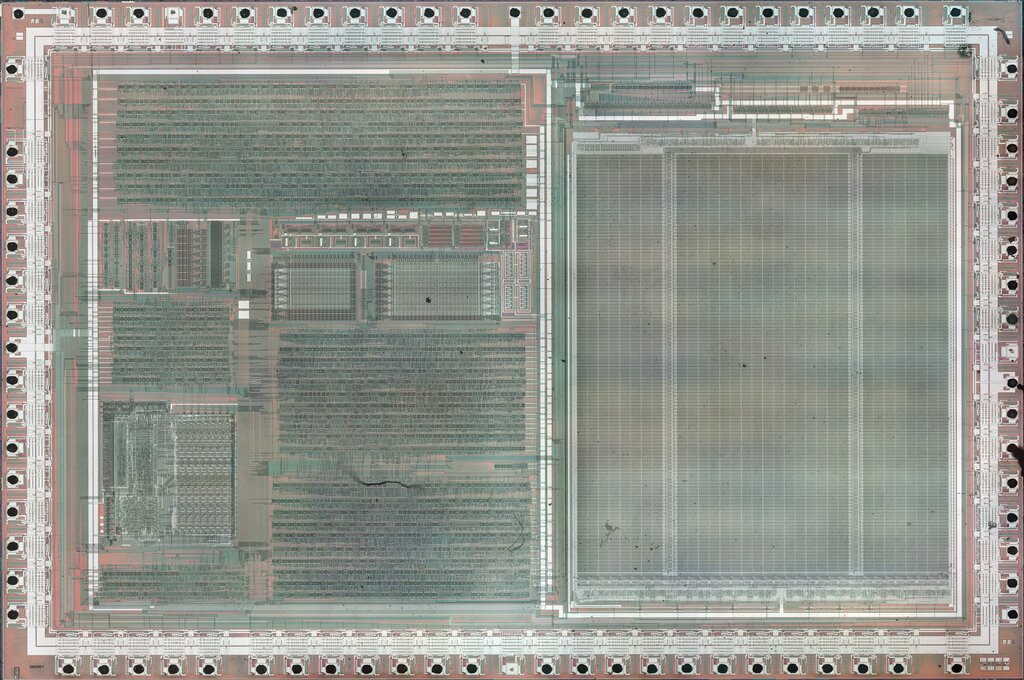
Transistors don't just store information; they also process it. By combining them in specific ways, we create circuits called logic gates. These gates are the basic building blocks of all digital logic. They take one or more binary inputs and produce a single binary output based on a simple rule.
The most common logic gates are AND, OR, and NOT. An AND gate outputs a 1 only if all its inputs are 1. An OR gate outputs a 1 if at least one of its inputs is 1. A NOT gate simply inverts its input, turning a 0 into a 1 and vice versa.
Putting It All Together
By combining millions of these logic gates, engineers build the complex components that make up a computer. The basic architecture of a classical computer has a few key parts that work together.
The CPU (Central Processing Unit) is the brain, executing instructions and performing calculations. Memory (RAM) is the short-term workspace, holding data the CPU is actively using. Storage (like a hard drive) is the long-term memory, keeping your files safe even when the power is off. Input and Output devices let you interact with the computer.
An essential property of this entire system is that it's deterministic. This means that for a given input, a classical computer will follow its instructions precisely and always produce the exact same output. There's no randomness or uncertainty involved in the calculation itself. It's a machine built on logic and predictability.
Now that you understand the basic building blocks, let's test your knowledge.
What is the fundamental language of a classical computer, based on a two-state system?
A transistor is a microscopic switch used to store and process information. How does a transistor typically represent a binary '0'?
Understanding these classical concepts of bits, transistors, and deterministic logic provides a solid foundation for exploring more advanced computing paradigms.