Quantitative Hedge Fund Allocation Mastery
Introduction to Hedge Funds
What Are Hedge Funds?
A hedge fund is a private investment partnership. Unlike a mutual fund that anyone can buy into, hedge funds are typically open only to a specific group of investors. Their primary goal is to produce high returns, often aiming to make money whether the market is going up or down.
This flexibility is their key feature. A standard mutual fund might just buy stocks and hope the market rises. A hedge fund can use a wider, more complex range of tools and strategies to navigate different market conditions. They are generally less regulated than other investment vehicles, which gives their managers more freedom but also comes with higher risk.
accredited investor
noun
An individual or institution that meets certain requirements for income, net worth, or professional experience, allowing them to invest in less-regulated securities.
The name comes from the idea of "hedging" your bets. The original hedge funds aimed to protect, or hedge, against market downturns. They did this by pairing risky investments with safer ones designed to offset potential losses. For example, a fund might buy stocks it expects to rise while simultaneously shorting stocks it expects to fall. The goal is to capture the difference in performance between the two sets of stocks, reducing exposure to the overall market's movement.
Common Strategies
Hedge funds aren't a one-size-fits-all product. They pursue a vast range of strategies, each with its own approach to risk and return. The structure they operate in is often a multi-portfolio manager, or Multi-PM, model where different teams specialize in different strategies under one roof.
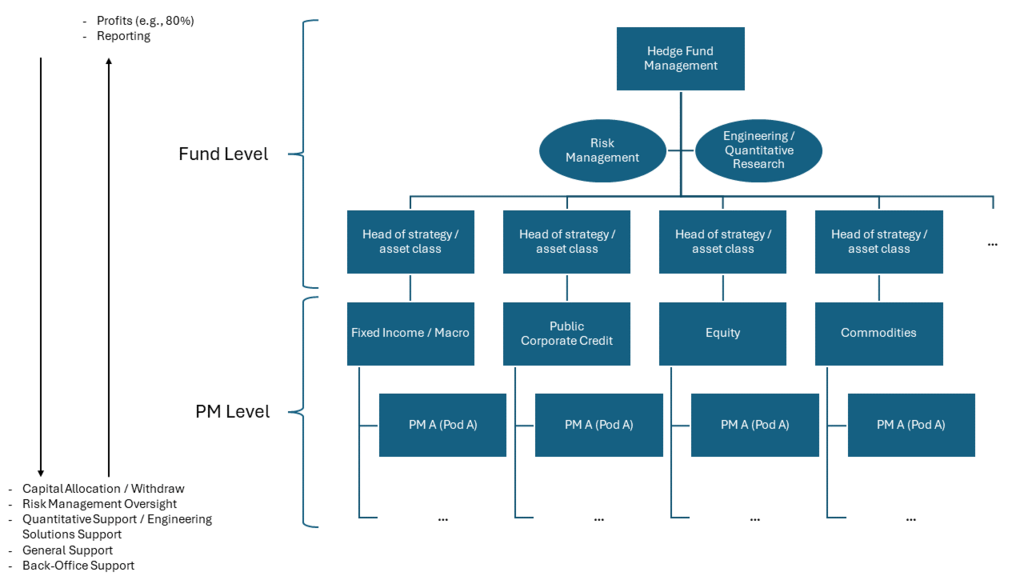
Here are a few common approaches you'll encounter:
-
Long/Short Equity: This is the classic hedge fund strategy. The fund manager buys stocks they believe are undervalued (going long) and sells stocks they believe are overvalued (going short). The net result is a portfolio that can profit from both rising and falling stock prices.
-
Global Macro: These funds make bets on the direction of entire economies. They trade everything from currencies and interest rates to commodities and stock indices based on their predictions for macroeconomic trends, like a country's inflation rate or political changes.
-
Event-Driven: This strategy focuses on specific corporate events. For example, if a company announces a merger, an event-driven fund might buy its stock, betting the deal will go through and the price will rise. Other events include bankruptcies or corporate restructurings.
The Rise of Quants
While many hedge funds rely on human managers to make decisions, a growing number are turning to technology. A quantitative hedge fund, or "quant fund," uses mathematical models and powerful computers to make investment decisions.
These funds are built by teams of mathematicians, physicists, and computer scientists. They develop complex algorithms that analyze vast amounts of data to find patterns, predict market movements, and execute trades automatically. The goal is to remove human emotion and bias from the investment process and rely purely on statistical evidence.
Quant funds don't predict the future with a crystal ball. They use statistics to find small, repeatable advantages in the market and exploit them thousands or millions of times over.
These quantitative approaches can be applied to almost any strategy. For example, a quant fund might run a long/short equity strategy, but instead of a manager picking stocks based on research reports, an algorithm selects them based on hundreds of data points, like a company's cash flow, stock price momentum, and even sentiment from news articles. The scale and speed of these operations are far beyond what any human could manage.
To test your knowledge on these foundational concepts, take the quiz below.
What is the primary goal of a hedge fund?
The original concept of 'hedging' in a hedge fund's strategy involves:
Hedge funds are a complex and varied part of the financial world, defined by their flexibility and their aim to generate returns in any market environment.