Quantitative Glucose Analysis Techniques
Sugar Chemistry Fundamentals
The Reactive Aldehyde
The key to measuring glucose lies in its chemical structure. While glucose can exist in a stable ring form, it's the molecule's ability to temporarily open up into a straight chain that exposes its most reactive component: an aldehyde group. This functional group, written as , consists of a carbon atom double-bonded to an oxygen atom and single-bonded to a hydrogen atom.
This aldehyde group is generous with its electrons. It readily donates them to other molecules in a chemical reaction called oxidation. Because it can reduce other substances by giving them electrons, any sugar with an accessible aldehyde or ketone group is known as a reducing sugar. This property is the cornerstone of many glucose detection methods.
The reaction isn't one-way. Glucose molecules in a solution constantly switch between their ring and open-chain forms. This dynamic equilibrium is called mutarotation. While only a small fraction of glucose is in the open-chain form at any moment, as that fraction reacts, Le Châtelier's principle dictates that more ring forms will open up to replace them, allowing the reaction to proceed to completion.
Reduction as a Signal
Analytical assays for glucose are designed to take advantage of this reducing power. They introduce a compound that changes colour when it accepts electrons from glucose's aldehyde group. By measuring the intensity of this colour change, we can determine the concentration of glucose in a sample. Two classic examples are the reactions with Benedict's reagent and 3,5-dinitrosalicylic acid (DNSA).
Stoichiometry
noun
The relationship between the relative quantities of substances taking part in a reaction or forming a compound.
In the Benedict's test, an alkaline solution containing blue cupric ions () is heated with the sugar. The glucose reduces the copper, transforming it into brick-red, insoluble cuprous oxide (). The amount of red precipitate formed is directly proportional to the amount of reducing sugar present.
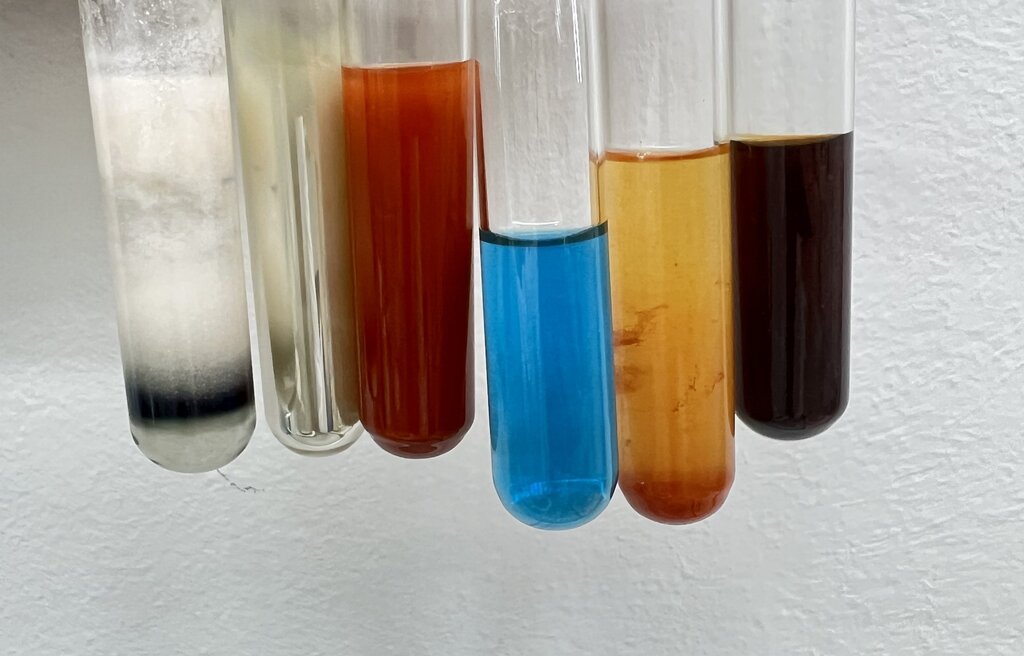
A more modern quantitative method uses DNSA. In this reaction, the yellow DNSA molecule accepts electrons from glucose and is reduced to 3-amino-5-nitrosalicylic acid, which has a reddish-brown colour in alkaline solutions. The intensity of this final colour, measured with an instrument called a spectrophotometer, correlates precisely with the initial glucose concentration. The stoichiometry of these reactions is what allows us to turn a simple chemical change into a reliable measurement.
What is the key reactive functional group in the straight-chain form of glucose that is exploited for its measurement?
Glucose is classified as a 'reducing sugar' because it can:
Understanding this redox chemistry is the first step in seeing how we can quantitatively measure sugars in everything from food science to medical diagnostics.