Quantitative EEG Analysis
Introduction to EEG
Listening to the Brain
Imagine trying to understand a conversation happening inside a crowded stadium, but you can only listen from the outside. You wouldn't hear individual words, but you would pick up the collective roar of the crowd, its rhythm, and its changes in volume. Electroencephalography, or EEG, is a bit like that. It’s a technique for listening to the brain's electrical activity from outside the skull.
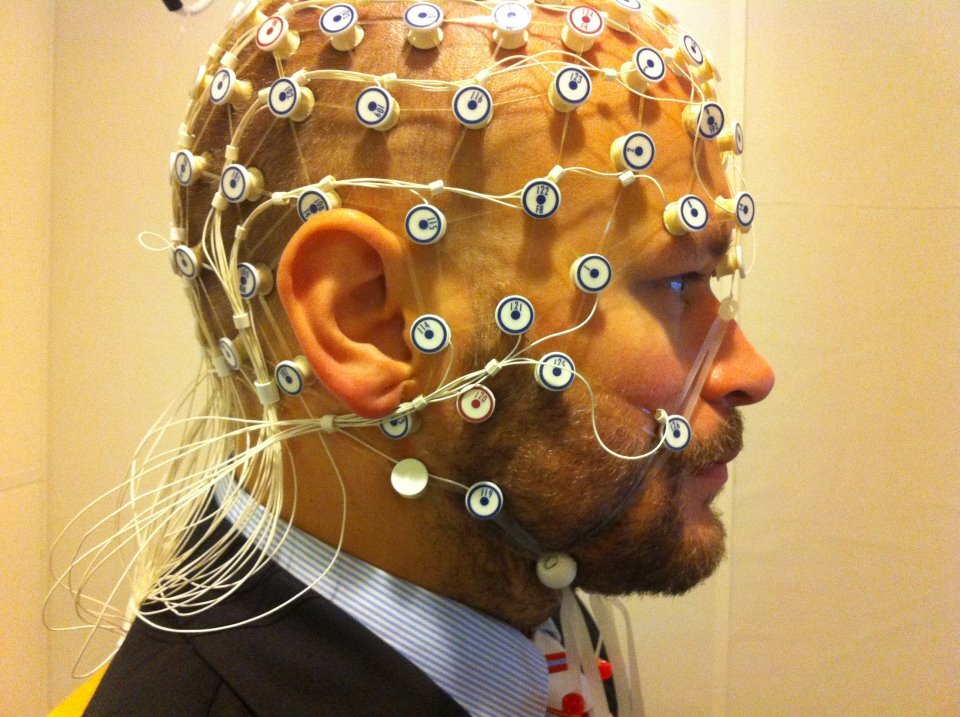
EEG doesn't read thoughts. Instead, it measures the tiny electrical fluctuations that result from the activity of billions of neurons. By placing small metal discs, called electrodes, on the scalp, we can record these signals. The resulting patterns, known as brainwaves, give us a window into the brain's functional state, such as whether a person is awake, asleep, or concentrating.
EEG measures the synchronized activity of large groups of neurons, reflecting the brain's overall electrical rhythm.
The story of EEG begins in the 1920s with a German psychiatrist named Hans Berger. He was convinced that the brain must produce electrical signals, much like other parts of the body. After years of experimenting, he recorded the first human EEG in 1924. He identified the rhythmic electrical activity and named the first-discovered pattern the alpha wave—the calm, idling rhythm of a brain at rest.
From Neuron to Electrode
So, where do these signals actually come from? The answer lies with the brain's fundamental building blocks: neurons.
neuron
noun
A specialized cell transmitting nerve impulses; a nerve cell.
Neurons communicate using electrical signals called action potentials. An individual action potential is far too small and fast to be detected by an EEG electrode on the scalp. It’s like a single person whispering in that crowded stadium—impossible to hear from outside.
However, EEG doesn't measure action potentials directly. It measures something called postsynaptic potentials. When one neuron sends a signal to another, it creates a small, brief voltage change at the receiving neuron's membrane. This is a postsynaptic potential. While one of these is still tiny, they are slower and last longer than action potentials.
When thousands or millions of nearby neurons, particularly the large pyramidal cells in the cortex, are all oriented in the same direction and receive signals in synchrony, their individual postsynaptic potentials add up. This creates a larger electrical field—the stadium's roar. This summed activity is strong enough to travel through the brain tissue, cerebrospinal fluid, skull, and scalp to be detected by the EEG electrodes. It's this synchronized, collective behavior that EEG truly measures, offering a view of the brain's large-scale neural dynamics.
The Language of Brainwaves
The signals recorded by EEG are not random noise. They are rhythmic, oscillating patterns that are categorized into different frequency bands. Each band is associated with different states of brain function.
Here are the primary types of brainwaves:
| Wave Type | Frequency (Hz) | Associated State |
|---|---|---|
| Delta (δ) | 0.5 - 4 Hz | Deep, dreamless sleep, unconsciousness |
| Theta (θ) | 4 - 8 Hz | Drowsiness, meditation, deep relaxation |
| Alpha (α) | 8 - 12 Hz | Awake but relaxed, calm, eyes closed |
| Beta (β) | 12 - 30 Hz | Actively thinking, focused, alert |
| Gamma (γ) | > 30 Hz | Higher-level information processing, concentration |
Think of these waves like gears in a car. Low-frequency waves like Delta and Theta are like first gear, representing slow, powerful states of rest. Higher-frequency waves like Beta and Gamma are the higher gears, used for fast, active processing when you're alert and engaged with the world. Alpha is the neutral gear, a state of relaxed readiness.
By analyzing which frequencies are dominant at any given time, we can infer a great deal about a person's mental and physiological state without ever looking inside their head.
What does an Electroencephalography (EEG) primarily measure?
EEG directly measures the fast, brief signals known as action potentials.
Understanding these fundamentals is the first step toward appreciating the power of EEG as a tool for both research and clinical practice.