Quantitative Aptitude Foundation for Banking
Number Systems
The Building Blocks of Numbers
Let's start with the basics. The first numbers you ever learned were probably the ones you used for counting: 1, 2, 3, 4, and so on. These are called natural numbers. They’re the positive, whole numbers we use every day.
Natural Numbers: {1, 2, 3, 4, ...}
If we take the natural numbers and add just one more number, zero, we get the set of whole numbers. It’s a small change, but an important one.
Whole Numbers: {0, 1, 2, 3, ...}
But what about negative values? When we include the negative counterparts of the natural numbers, we get the integers. This set includes all the whole numbers, plus their negative opposites. Think of a thermometer: the numbers above zero, below zero, and zero itself are all integers.
Expanding the Number Line
Of course, numbers aren't just whole units. We often deal with parts of a whole, like half a pizza or a quarter of a dollar. These are rational numbers. A number is rational if it can be written as a fraction, or a ratio of two integers, where the bottom number isn't zero. This includes simple fractions like and , as well as all integers (since 5 can be written as ).
Rational numbers also include any decimal that ends (like 0.75) or repeats a pattern forever (like , which is ).
Then there are the irrational numbers. These are the rebels that can't be written as a simple fraction. Their decimal forms go on forever without ever repeating a pattern. Famous examples include (pi) and the square root of 2 ().
When you take all the rational numbers and all the irrational numbers and put them together, you get the set of real numbers. Essentially, if you can find a number on the number line, it's a real number.
Primes and Composites
Within the natural numbers, we can make another important distinction. Some numbers are special because they can only be divided evenly by 1 and themselves. These are prime numbers.
Prime Number
noun
A natural number greater than 1 that has no positive divisors other than 1 and itself.
The number 2 is the only even prime number. All other even numbers can be divided by 2, so they aren't prime. Other examples of primes are 3, 5, 7, 11, 13, and so on.
Numbers that are not prime are called composite numbers. These are natural numbers greater than 1 that have more than two factors. For example, 12 is composite because it can be divided by 1, 2, 3, 4, 6, and 12. You can think of composite numbers as being 'composed' of other numbers multiplied together.
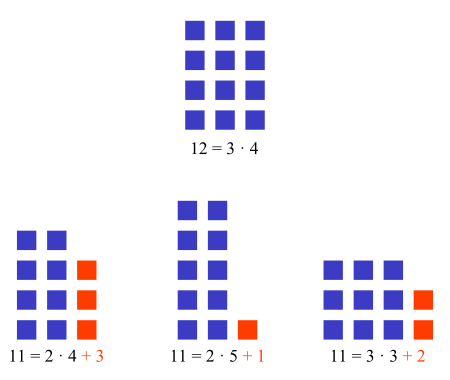
What about the number 1? It's special. It is neither prime nor composite. It only has one factor: itself.
This leads us to a cornerstone of number theory: the Fundamental Theorem of Arithmetic. This theorem states that every integer greater than 1 is either a prime number itself or can be represented as a product of prime numbers. And this representation is unique, except for the order of the factors.
For example, the number 72 can be broken down into its prime factors: No matter how you start factoring 72, you will always end up with three 2s and two 3s.
This theorem is why prime numbers are often called the "building blocks" of the integers. Every non-prime number can be built by multiplying primes together.
Ready to test your knowledge? Let's see how well you've grasped these concepts.
Which of the following numbers is an integer but NOT a natural number?
A number that can be expressed as a fraction of two integers (where the denominator is not zero) is called a(n) __________ number.
Understanding these different types of numbers is the first step toward tackling more complex mathematical problems.