Quant Alpha Generation Evaluation
Quantitative Hedge Fund Overview
What Is a Quant Fund?
A quantitative hedge fund, or "quant fund," is an investment fund that relies on mathematical models and computer algorithms to make trading decisions. This is a big departure from traditional funds, where human portfolio managers make calls based on company research, economic trends, and their own expert judgment.
Instead of relying on intuition or emotion, quant funds trust in data and systematic rules. The core idea is to find patterns, inefficiencies, or relationships in financial data that can be exploited for profit.
These funds are built on the idea that market movements are not entirely random. By analyzing vast amounts of data—stock prices, trading volumes, economic reports, even satellite imagery or social media sentiment—quants look for signals that predict future price changes. An algorithm might, for example, notice that a certain stock tends to rise slightly every time a specific economic indicator is released. The fund's systems will then be programmed to automatically buy that stock when the indicator is published.
Because they operate on algorithms, quant funds can execute a huge number of trades at high speeds, often holding positions for just minutes or even seconds. It’s a world of statistics, probability, and immense computing power, all aimed at finding a profitable edge in the market.
algorithm
noun
A process or set of rules to be followed in calculations or other problem-solving operations, especially by a computer.
From Vegas to Wall Street
The story of quantitative investing doesn't start in a bank, but at a casino card table. In the early 1960s, a mathematics professor named Edward Thorp used probability theory to figure out how to beat the house in blackjack. He published his findings in a bestselling book, "Beat the Dealer."
After his success, Thorp turned his attention to what he called "the biggest casino in the world": Wall Street. He applied similar statistical methods to find pricing anomalies in the stock market, launching one of the very first quantitative hedge funds in 1969. He proved that a disciplined, data-driven approach could consistently outperform human instinct.
But the true giant of the field is James Simons, a brilliant mathematician and former codebreaker. In 1982, he founded Renaissance Technologies and staffed it not with Wall Street veterans, but with scientists, mathematicians, and programmers. His flagship Medallion Fund, which is only open to employees, has since become the most successful hedge fund in history, achieving legendary returns by pioneering complex models to profit from market patterns hidden from the human eye.
Strategies and Structures
Quant funds use a wide array of strategies, but they often fall into a few broad categories. These strategies are not mutually exclusive, and many funds combine elements from several.
| Strategy | Description | Example |
|---|---|---|
| Statistical Arbitrage | Exploiting price differences between similar assets. | Buying an undervalued stock while shorting an overvalued one in the same industry. |
| Market Making | Providing liquidity by placing both buy and sell orders. | Profiting from the bid-ask spread—the small difference between the buy and sell price. |
| Factor Investing | Targeting specific drivers of return, like value or momentum. | Building a portfolio of stocks that have historically low price-to-book ratios (value). |
| High-Frequency Trading (HFT) | Using powerful computers to execute a large number of orders at extremely high speeds. | An algorithm detects a large buy order and places its own order milliseconds before to profit from the anticipated price jump. |
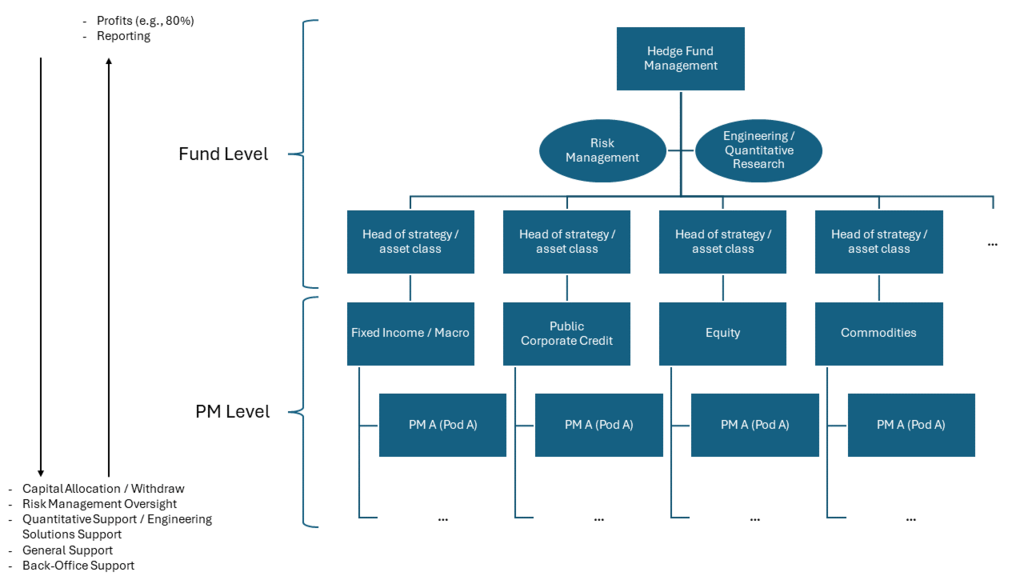
The structure of these firms also differs from traditional funds. They are often organized into teams of researchers, developers, and portfolio managers who collaborate to build and refine trading models. The culture feels more like a tech company or a university research lab than a typical investment bank.
Pros and Cons
The quantitative approach has distinct advantages. By removing human emotion, it avoids common behavioral biases like panic selling or holding onto losing trades for too long. Strategies are rigorously backtested on historical data before any real money is invested, providing a degree of confidence in their potential performance. The systematic nature also allows these funds to operate at a scale and speed no human team could ever match.
However, this approach isn't foolproof. Quant models are only as good as the data they're built on. A model trained on historical data may fail spectacularly during an unprecedented market event, like the 2008 financial crisis or the 2020 pandemic flash crash. These events, often called "black swans," can break the patterns the models were designed to exploit.
There's also the risk of "model decay." As more funds discover and use the same strategy, the market inefficiency it targeted may disappear, rendering the model less profitable over time. This forces quant funds into a constant arms race to find new signals and develop more sophisticated algorithms.
The success of a quant fund depends on its ability to constantly innovate and adapt faster than the market itself.
Now let's check your understanding of these core concepts.
What is the primary basis for decision-making in a quantitative hedge fund?
Who is the mathematician and former codebreaker who founded Renaissance Technologies and pioneered many modern quantitative trading techniques?