Pythonic Computer Networking Fundamentals
Networking Basics
How Computers Talk to Each Other
When you send a message to a friend, you follow certain rules. You use a shared language, maybe some slang, and a structure that makes sense. Computers do the same thing when they communicate over a network. They rely on a set of rules, called protocols, to understand each other.
Think of protocols as the grammar of the internet. They ensure that a request from your laptop for a cat video is understood by a server halfway across the world, and that the video is sent back in a way your device can reassemble and play. Without these shared rules, the internet would be a chaotic mess of incomprehensible data.
The Communication Blueprint
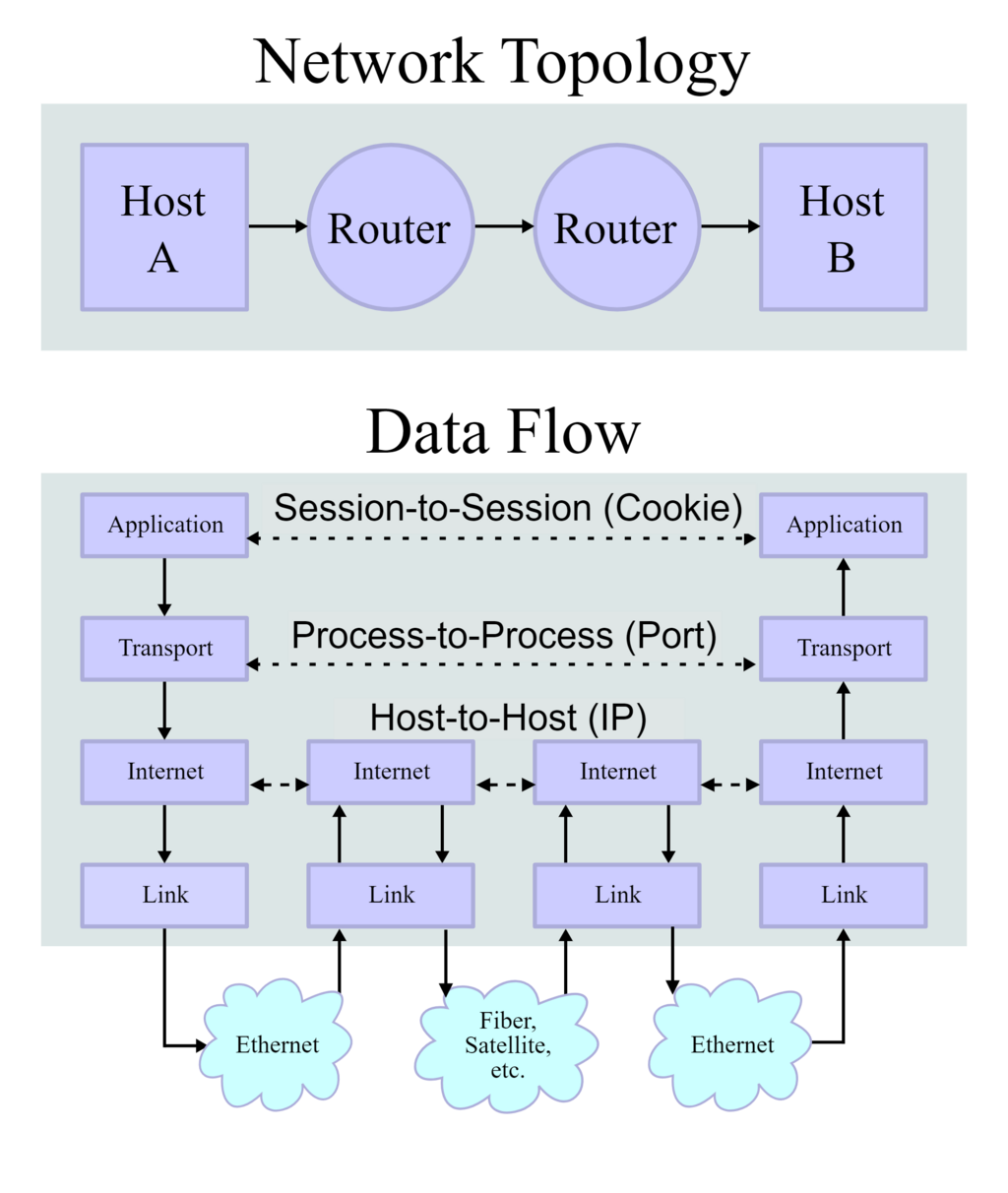
To manage the complexity of network communication, engineers created conceptual frameworks called models. These models break the entire process down into a series of layers. Each layer has a specific job, and it only talks to the layers immediately above and below it. This makes it much easier to design, build, and troubleshoot networks.
The most famous theoretical model is the Open Systems Interconnection (OSI) model. It has seven layers.
While the OSI model is a great tool for learning, the internet in practice uses a simpler, more streamlined model: the TCP/IP model. It combines some of the OSI layers and is often described with four layers.
The Core Protocols
Protocols are the specific rules that operate at each layer of these models. You use them every day, even if you don't realize it. Let's look at the most important ones.
IP Address
noun
A unique numerical label assigned to each device connected to a computer network that uses the Internet Protocol for communication.
Every device on the internet, from your phone to a massive web server, has an Internet Protocol (IP) address. This address works like a mailing address for your house. It tells the network exactly where to send data. It’s the foundation of the Internet layer in the TCP/IP model.
But numbers like 192.0.2.146 aren't easy for humans to remember. That's where the Domain Name System comes in.
The Domain Name System (DNS) acts as the internet's phonebook. It translates human-friendly domain names (like
google.com) into computer-friendly IP addresses. When you type a website's name into your browser, a DNS server looks up the corresponding IP address so your computer knows where to send the request.
Once your computer knows the destination IP address, it needs to send the actual data. This is handled by protocols in the Transport layer. The two most common are TCP and UDP.
Transmission Control Protocol (TCP) is like sending a registered letter. It establishes a connection before sending data, checks to make sure every piece arrives in the correct order, and asks for any missing pieces to be sent again. It's reliable but a bit slower due to all the checking. It's used for things like web browsing and email, where accuracy is critical.
User Datagram Protocol (UDP) is like sending a postcard. You just write the address and send it off. There's no guarantee it will arrive, or that it will arrive in order with other postcards. It's fast and has very little overhead, which makes it perfect for applications like video streaming or online gaming, where speed is more important than perfect reliability. Losing a single frame in a video is better than pausing the whole stream to wait for it.
Finally, at the top of the stack in the Application layer, we have protocols that applications use to format their data.
The most famous is the Hypertext Transfer Protocol (HTTP). This is the protocol that powers the World Wide Web. When you visit a website, your browser sends an HTTP request to the server, asking for the webpage's content. The server then sends back an HTTP response containing the HTML, CSS, and JavaScript files your browser needs to render the page.
These protocols—IP, DNS, TCP, UDP, and HTTP—work together seamlessly, forming the foundation that makes our digital world possible.
Now, let's test your understanding of these core networking concepts.
What is the primary function of a network protocol?
For which of the following applications would the User Datagram Protocol (UDP) be a better choice than the Transmission Control Protocol (TCP)?
Understanding these models and protocols is the first step toward building applications that can communicate over the internet.