Python RAG Pipeline Development
Introduction to RAG
Giving Language Models a Library Card
Large Language Models (LLMs) like ChatGPT are incredibly powerful. They can write essays, generate code, and answer complex questions. But they have a significant limitation: their knowledge is frozen in time. An LLM only knows what it learned during its training period. It can't look up new information on the internet or access private company documents. This can lead to outdated or incorrect answers, a phenomenon often called "hallucination."
What if we could give an LLM access to a library of information it could consult before answering a question? That's the core idea behind Retrieval-Augmented Generation, or RAG.
Retrieval-Augmented Generation (RAG) is an AI framework that connects a language model to an external knowledge repository, allowing the model to fetch and include relevant information when generating an answer.
Instead of relying solely on its pre-trained memory, a RAG system first retrieves relevant information from a specific knowledge source and then uses that information to generate a more accurate, timely, and context-aware response.
How RAG Works
A RAG system is made of two main parts: a retriever and a generator.
-
The Retriever: Think of this as a specialized search engine. When you ask a question, the retriever's job is to search through a designated knowledge base—like a company's internal wiki, a set of legal documents, or a collection of recent news articles—and find the snippets of text that are most relevant to your query.
-
The Generator: This is the LLM itself. It takes your original question and combines it with the relevant information found by the retriever. With this added context, the generator can craft a well-informed answer that's grounded in the provided facts.
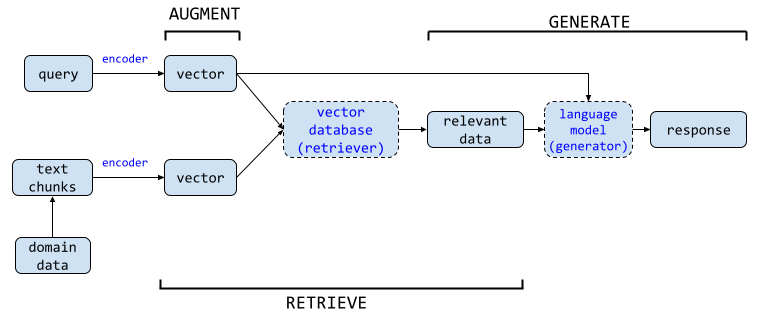
This two-step process allows the LLM to use information it wasn't trained on, effectively giving it a fresh, curated set of notes to study before answering each new question.
The Benefits of RAG
Integrating a retrieval system with a language model offers several key advantages over using a standard LLM alone.
| Feature | Standard LLM | RAG System |
|---|---|---|
| Knowledge Source | Internal, static training data | External, up-to-date knowledge base |
| Factual Accuracy | Prone to "hallucination" | Grounded in retrieved facts |
| Domain-Specific | General knowledge only | Can use specialized, private data |
| Transparency | Opaque reasoning process | Can cite the sources it used |
By grounding the model's responses in specific, verifiable documents, RAG makes the AI more reliable and trustworthy. It's a powerful way to customize an LLM for specific tasks and datasets without the need for expensive and time-consuming retraining.
RAG in the Real World
RAG isn't just a theoretical concept; it's already being used in many practical applications.
- Customer Support: A chatbot can use RAG to search a company's product manuals and FAQs to provide accurate answers to customer questions.
- Healthcare: A tool for doctors could retrieve information from the latest medical journals to help diagnose conditions or suggest treatment plans.
- Financial Analysis: An AI assistant could pull data from up-to-the-minute market reports to answer questions about stock performance.
In each case, RAG allows the AI to provide valuable, context-specific answers by consulting a reliable source of information.
Now that you understand the what, why, and how of RAG, let's test your knowledge.
What is the primary limitation of standard Large Language Models (LLMs) that Retrieval-Augmented Generation (RAG) is designed to solve?
In a RAG system, what is the specific function of the 'retriever' component?
Understanding these fundamentals is the first step toward building powerful AI applications that are not just fluent, but also factual.