Python Programming Fundamentals
Introduction to Python
Meet Python
Python is a high-level, general-purpose programming language. Think of it as a versatile tool. You can build a website, analyze data, automate repetitive tasks, or even dabble in artificial intelligence, all with the same language.
Its design philosophy emphasizes code , with a syntax that allows programmers to express concepts in fewer lines of code than might be used in languages like C++ or Java. This doesn't just make it faster to write; it also makes the code easier to read and maintain, both for you and for others.
Python's versatility is a key reason for its popularity. It's used by companies like Netflix for its recommendation algorithms, by NASA for scientific computing, and by millions of developers for web applications and system scripting.
Setting Up Your Workspace
Before you can write Python code, you need two things: the Python interpreter and a place to write your code.
First, install Python itself. You can download it from the official website, python.org. The installation is straightforward on Windows, macOS, and Linux. This installation includes the , which is the program that reads your Python code and executes the instructions you've written.
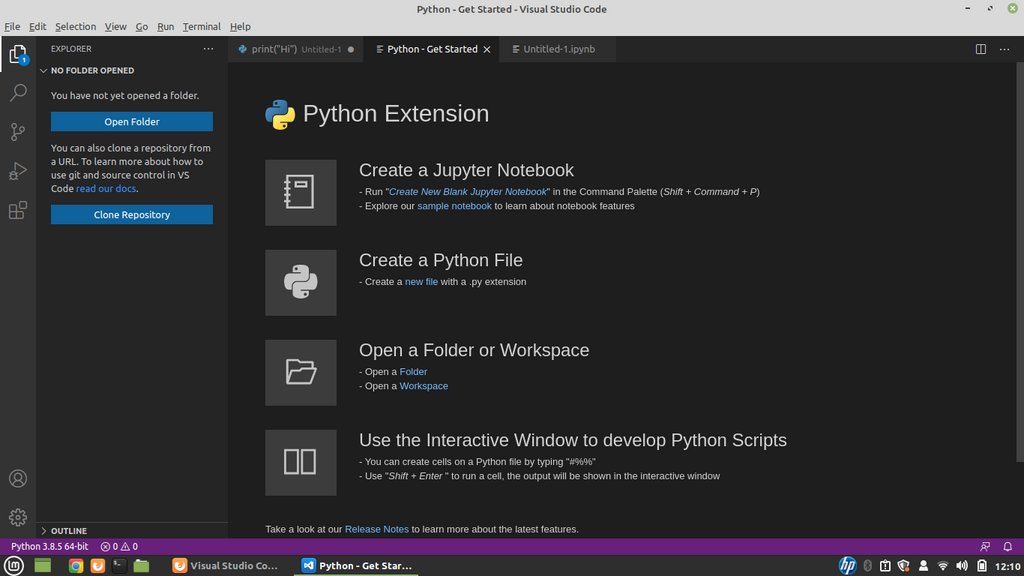
Next, you need a code editor. While you could use a basic text editor like Notepad, it's far more efficient to use an or a modern text editor designed for coding. Popular choices include Visual Studio Code (VS Code), PyCharm, and Sublime Text. These tools provide features like syntax highlighting, code completion, and debugging, which make the development process much smoother.
Your First Program
It's a long-standing tradition in programming to start by making the computer say "Hello, World!". This simple task confirms that your environment is set up correctly and you understand the basic workflow of writing and running code.
- Open your chosen IDE or text editor.
- Create a new file and save it as
hello.py. The.pyextension is important; it tells your computer that this is a Python file. - In that file, type the following line of code:
print("Hello, World!")
Here, print() is a built-in Python function that outputs text to the console. The text you want to print, called a string, goes inside the parentheses and is wrapped in quotation marks.
To run your program, open your computer's command line or terminal. Navigate to the directory where you saved hello.py. Then, type the following command and press Enter:
python hello.py
If everything is set up correctly, you'll see the text Hello, World! printed in your terminal. You've just written and executed your first Python program.
Python's design philosophy places a strong emphasis on which of the following?
What is the role of the Python interpreter?
This is the fundamental cycle of programming in Python: write code in a file, and use the interpreter to run it. With this foundation, you're ready to explore more complex ideas.