Python Programming Fundamentals
Introduction to Python
What is Python?
Think of a programming language as a set of instructions you can give a computer. Python is a popular language because its instructions look a lot like plain English, making it easier for beginners to pick up. Its clean and readable style means you spend less time trying to figure out complex syntax and more time bringing your ideas to life.
Python isn't just for beginners, though. It's a powerful tool used by professionals to build websites, analyze data, create artificial intelligence, and automate tasks. From YouTube to NASA, major organizations rely on Python to get things done. Its versatility comes from a huge collection of pre-written code, called libraries, that you can use to tackle almost any problem.
Getting Set Up
To start writing Python, you need two things: the Python interpreter and an Integrated Development Environment (IDE). The interpreter is the program that reads your Python code and translates it into instructions the computer's processor can execute. The IDE is a text editor with special features that make writing and running code much easier.
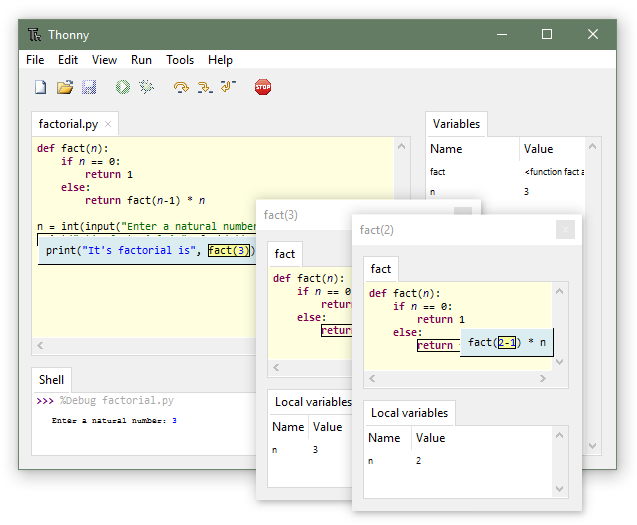
We'll use Thonny, an IDE designed specifically for learning Python. It bundles Python with the editor, so you only need one installation. It also has helpful tools that show you what your code is doing step-by-step.
To install it, go to the official Thonny website (thonny.org), download the installer for your operating system (Windows, Mac, or Linux), and run it. The setup process is straightforward; just follow the on-screen prompts.
Your First Program
It's a tradition for a programmer's first program to simply display the message "Hello, World!" on the screen. Let's write ours.
Open Thonny. You'll see two main areas. The top part is the editor, where you'll write your code. The bottom part is the Shell, which is where you'll see the output of your program. In the editor, type the following line of code.
print("Hello, World!")
This line is a single command. print() is a built-in Python function that tells the computer to display something on the screen. Everything inside the parentheses is the argument we give to the function, which is what we want it to display.
The text surrounded by double quotes, "Hello, World!", is called a string. A string is simply a sequence of characters. You can use single quotes (') or double quotes (") to create strings, as long as you use the same type to start and end it.
To run your program, click the green "Run" button with the play symbol in the toolbar. Thonny will ask you to save the file first. Save it with a name like hello.py. The .py extension is important because it tells the computer that this is a Python file.
Once saved, the program will execute. You should see Hello, World! appear in the Shell at the bottom of the window.
Congratulations, you've just written and executed your first Python program!
How Python Code Executes
When you click "Run," the Python interpreter reads your .py file. It goes through your code line by line, from top to bottom, executing each command it finds.
In our program, there was only one line. The interpreter saw the print() function and knew it needed to display the string you provided. If you had multiple print() statements, it would execute them in order.
print("Line one")
print("Line two")
Running the code above would produce two lines of output in the Shell, one right after the other. This sequential, top-to-bottom execution is a fundamental concept in programming.
Python's syntax is also sensitive to spacing at the beginning of a line, known as indentation. While it doesn't matter for our simple program, it will become very important later when we start writing more complex code with loops and conditions. For now, just remember to start each new line of code without any leading spaces or tabs.
What is the primary role of the Python interpreter?
In the line of code print("Welcome to Python!"), what is the part "Welcome to Python!" called?
That's it for your first step into Python. You've set up your environment, written a program, and learned how the computer executes your instructions.