Python Programming Fundamentals
Python Basics
Getting Set Up
Before you can write any Python code, you need a way to run it. Python is an interpreted language, which means a program called an interpreter reads your code line by line and executes it. You write your code in files, typically ending with .py.
You can write Python in any plain text editor, but it's often easier to use an Integrated Development Environment (IDE). An IDE is a special text editor that understands Python, offering features like syntax highlighting and debugging tools. When you install Python, it comes with a simple built-in IDE called IDLE, which is perfect for beginners.
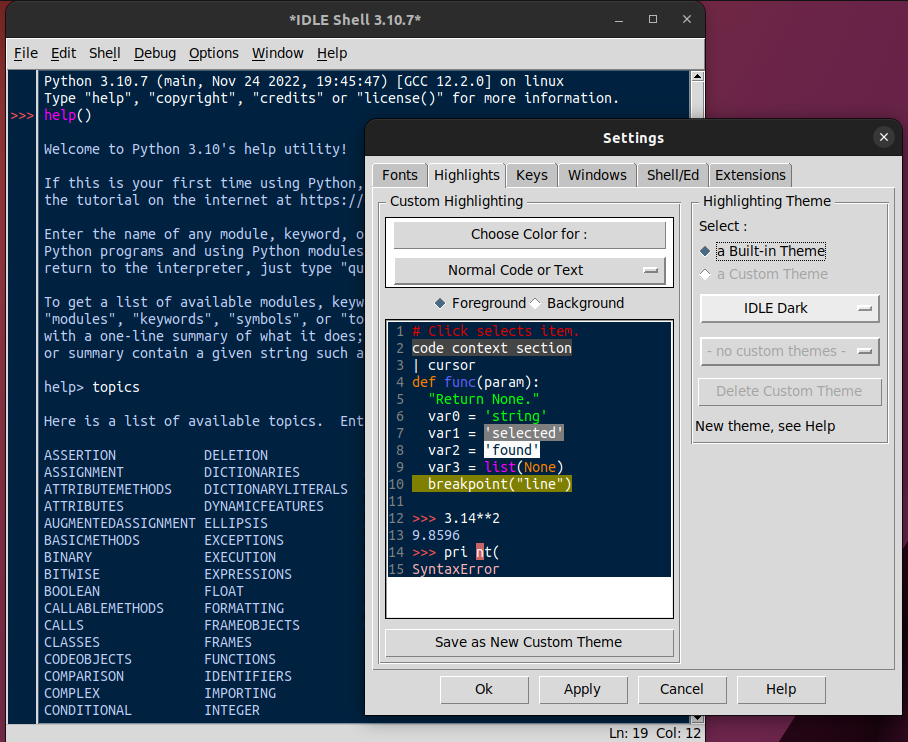
You can download the latest version of Python for free from the official website, python.org. The installation is straightforward, and once it's done, you'll have everything you need to start coding.
Python's Clean Syntax
Every programming language has its own set of rules, called syntax. Python is famous for its clean and readable syntax, which looks a lot like plain English. This makes it one of the easiest languages to learn.
One of Python's most unique features is how it uses indentation. Where other languages might use curly braces {} to group code, Python uses whitespace. This isn't just for looks; it's a strict rule. Code that is part of the same block must be indented by the same amount, typically four spaces.
Consistent indentation is not optional in Python. It's how the interpreter understands the structure of your program.
Another key part of writing clean code is using comments. Comments are notes for humans that the interpreter ignores. In Python, anything on a line after a hash symbol (#) is a comment. They're useful for explaining what your code does.
# This is a comment. The interpreter will ignore it.
# The line below will be executed.
print("Hello, Python!") # Comments can also go at the end of a line.
Storing and Using Data
To do anything useful, programs need to work with data. We store data in variables. Think of a variable as a labeled box where you can put information. You give the box a name and place a value inside it.
name = "Alice"
age = 30
pi_value = 3.14159
In the example above, name, age, and pi_value are variable names. The = sign is the assignment operator; it assigns the value on the right to the variable on the left.
Python automatically figures out the type of data you store. Here are a few basic types:
| Data Type | Description | Example |
|---|---|---|
| String | A sequence of characters (text) | "Hello", 'Python' |
| Integer | A whole number | 10, -5, 0 |
| Float | A number with a decimal point | 98.6, 3.14, -0.5 |
variable
noun
A symbolic name that is a reference or pointer to an object. Once an object is assigned to a variable, you can refer to the object by that name.
Input and Output
A program isn't very interactive if it can't communicate with the user. Python makes it easy to display information and ask for it.
To display output to the screen, you use the print() function. You can give it text (a string) or a variable, and it will show the value.
user_greeting = "Welcome to the program!"
print(user_greeting)

# You can also print values directly
print(42)
print("You can combine text and variables, too.")
To get input from a user, you use the input() function. This function prompts the user with a message, waits for them to type something and press Enter, and then returns whatever they typed as a string.
# The text inside input() is the prompt shown to the user.
user_name = input("Please enter your name: ")

# Now we can use the input we received.
print("Hello, " + user_name + "!")
Notice the + operator. When used with strings, it joins them together. This is called concatenation.
One important thing to remember is that input() always returns a string, even if the user types a number. If you need to treat the input as a number, you have to convert it first.
age_string = input("Enter your age: ")
age_number = int(age_string) # Convert the string to an integer

years_to_100 = 100 - age_number
print("You will be 100 in", years_to_100, "years.")
Here, int() is a function that converts a string into an integer. There's a similar float() function for converting to decimal numbers. Now that you know the basics of setting up your environment, writing valid syntax, and handling data, you're ready to start building simple programs.
What is the role of an interpreter in Python?
In Python, how do you define a block of code, such as the body of a function or a loop?