Python Memoization Techniques
Understanding Recursion
A Function That Calls Itself
Imagine you have a set of Russian nesting dolls. To find the smallest doll, you open the current one, which reveals a slightly smaller doll. You repeat this process—opening a doll to find another one inside—until you reach the final doll that can't be opened.
This process is a great analogy for recursion. It's a method of solving a problem where the solution depends on solutions to smaller instances of the same problem. In programming, this means a function calls itself.
Recursion
noun
A process in which a function calls itself directly or indirectly as part of its execution.
A recursive function needs two key components to work correctly. First is the recursive case, where the function calls itself, but with a slightly simpler or smaller input. This is like opening a nesting doll to find the next smaller one.
Second, and most importantly, is the base case. This is a condition that tells the function when to stop calling itself. For our nesting dolls, the base case is finding the doll that won't open. Without a base case, a recursive function would call itself forever, creating an infinite loop.
Recursion in Action
Let's look at a classic example: calculating a factorial. The factorial of a non-negative integer , denoted as , is the product of all positive integers up to . For example, . Notice a pattern? is just . And is , and so on. This structure is perfect for recursion.
To calculate factorial(4), the function calls factorial(3). That call then triggers factorial(2), which calls factorial(1), which finally calls factorial(0).
At factorial(0), we hit our base case. The function knows the answer is 1 and stops making new calls. It returns 1 to factorial(1). Now, factorial(1) can finish its job: it calculates and returns 1 to factorial(2). This continues back up the chain until factorial(4) gets its result and can return the final answer, 24.
def factorial(n):
    # Base case: if n is 0, factorial is 1
    if n == 0:
        return 1
    # Recursive case: n * factorial of (n-1)
    else:
        return n * factorial(n - 1)

# Example usage:
print(factorial(4)) # Output: 24
Another famous recursive sequence is the Fibonacci sequence. It starts with 0 and 1, and each subsequent number is the sum of the two preceding ones.
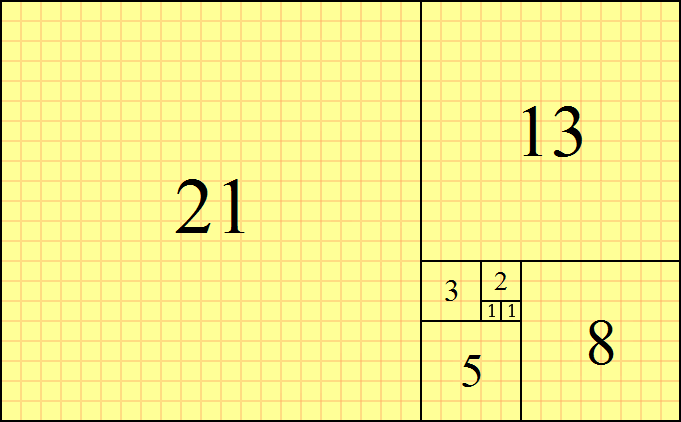
The sequence goes: 0, 1, 1, 2, 3, 5, 8, 13, and so on. The definition itself is recursive. To find the -th Fibonacci number, you need to know the two before it.
def fibonacci(n):
    # Base cases: for n=0 and n=1
    if n <= 1:
        return n
    # Recursive case: sum of the previous two
    else:
        return fibonacci(n-1) + fibonacci(n-2)

# Example usage:
print(fibonacci(7)) # Output: 13
Avoiding Infinite Loops
The most common pitfall in recursion is forgetting or incorrectly defining the base case. Without a clear stopping point, the function will call itself over and over again. This doesn't go on forever, though. The computer keeps track of each function call in a special area of memory called the call stack.
Every recursive function must have a base case that stops the recursion.
If a recursive function never stops, it keeps adding more and more calls to this stack. Eventually, the computer runs out of memory for the stack and the program crashes. This is known as a stack overflow error. It's the programming equivalent of our nesting dolls having no smallest doll, just an infinite number of dolls inside dolls.
What is the primary purpose of a base case in a recursive function?
If a recursive function is missing a base case or the base case is never reached, what error is most likely to occur?
Recursion is a powerful way to think about and solve problems that can be broken down into smaller, self-similar pieces. Once you get the hang of identifying the base and recursive cases, it becomes a valuable tool.