Python Fundamentals Unlocked
Introduction to Python
What is Python?
Python is a programming language known for its simple, readable syntax. It was created in the late 1980s by Guido van Rossum, who wanted a language that emphasized code readability and allowed programmers to express concepts in fewer lines of code than languages like C++ or Java.
Its design philosophy is all about clarity. If you look at Python code, it often reads a bit like plain English. This makes it one of the easiest languages for beginners to pick up. But don't let its simplicity fool you. Python is incredibly powerful and used by companies like Google, Netflix, and NASA.
It also has a massive and supportive community. This means there are countless libraries (collections of pre-written code) that you can use to do complex things without starting from scratch, from building websites to analyzing financial data.
What's It Used For?
Python is a general-purpose language, which means it’s a jack-of-all-trades. You can find it almost anywhere.
Some of the most common areas include:
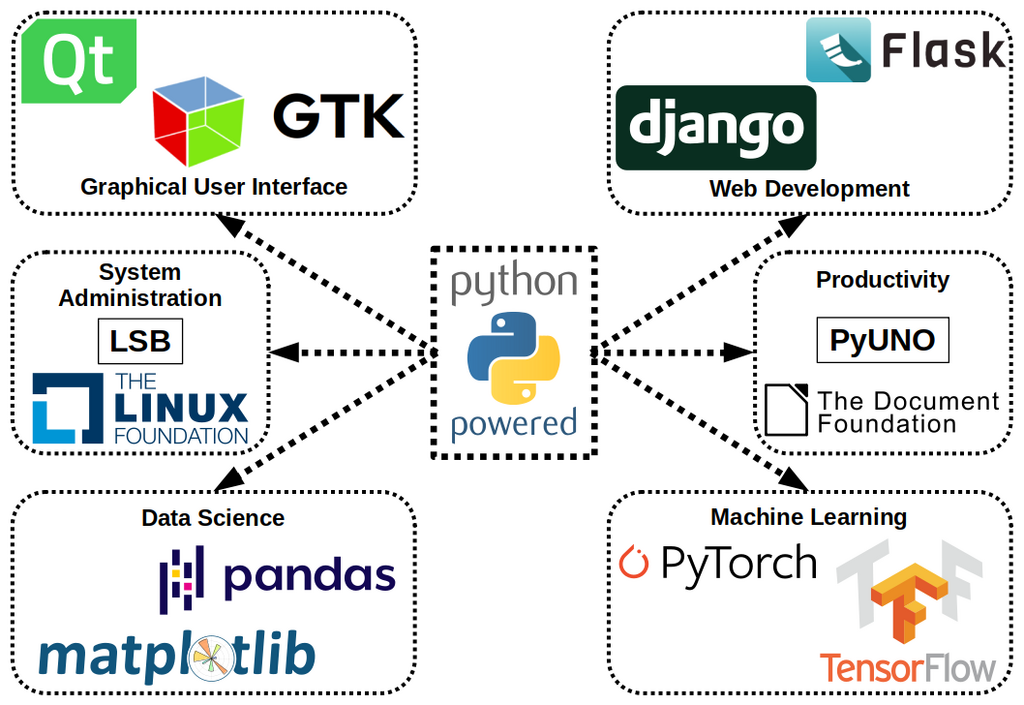
- Web Development: Building the server-side logic of websites and applications. Frameworks like Django and Flask make this process much faster.
- Data Science and Machine Learning: Analyzing large datasets, creating visualizations, and building artificial intelligence models. This is one of Python's most popular uses today.
- Automation and Scripting: Writing small programs (scripts) to automate repetitive tasks, like renaming files, sending emails, or scraping information from the web.
- Software Development: Creating desktop applications, games, and other software tools.
Getting Set Up
To start writing Python, you need two things: the Python interpreter and a place to write your code.
The interpreter is the program that reads your Python code and carries out its instructions. You can download it for free from the official Python website, python.org.
An Integrated Development Environment (IDE) is a text editor built specifically for programming. It includes helpful features like syntax highlighting (coloring your code to make it easier to read) and tools for running and debugging your programs. While you could use a plain text editor, an IDE makes the process much smoother.
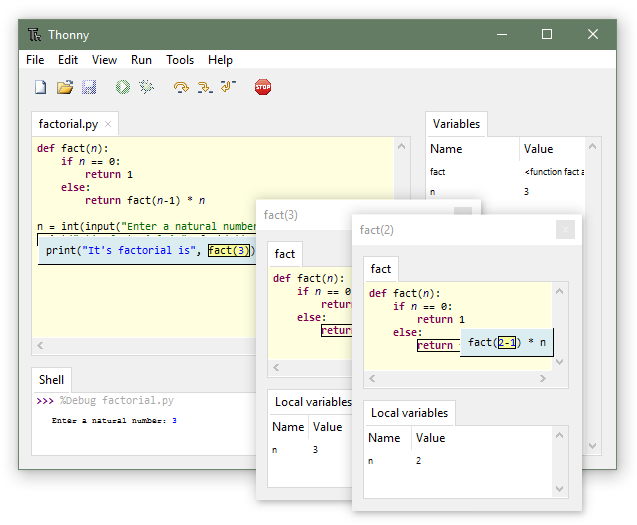
For beginners, a great choice is Thonny. It's a simple IDE that comes with Python already built-in, so you only need one download. It’s designed for learning and keeps things straightforward. Go to thonny.org to install it for your operating system.
Your First Program
It's a long-standing tradition in programming to make your first program display the message "Hello, World!" on the screen. It's a simple way to confirm that your setup is working correctly.
Once you have Thonny open, type the following line into the main editor window:
print("Hello, World!")
This code uses the built-in print() function. A function is a named block of code that performs a specific task. In this case, the print() function's job is to display whatever you put inside its parentheses on the screen.
To run your program, click the green "Run" button (it looks like a play symbol) in the Thonny toolbar. You'll be prompted to save the file first. Save it as hello.py. The .py extension is how we tell the computer it's a Python file.
After saving, you should see the text Hello, World! appear in the "Shell" panel at the bottom of the Thonny window. Congratulations, you've just run your first Python program!
Now you have everything you need to start exploring Python.
Who is credited with creating the Python programming language?
What is the primary design philosophy of Python?