Python Fundamentals Mastery
Python Basics
Getting Started with Python
Python is a popular, high-level programming language known for its readability. Created by Guido van Rossum and first released in 1991, its design philosophy emphasizes code clarity with a syntax that allows programmers to express concepts in fewer lines of code than might be used in languages like C++ or Java.
It's an interpreted language, which means the code is executed line by line by an interpreter program. This differs from compiled languages, where the entire code is translated into machine code before it's run. Python is also dynamically typed, giving you the flexibility to change a variable's type on the fly.
Setting Up Your Environment
Before you can write any code, you need to install Python. The best place to get it is from the official website, python.org. Download the latest stable version for your operating system (Windows, macOS, or Linux) and follow the installation instructions.
During installation on Windows, make sure to check the box that says "Add Python to PATH." This allows you to run Python from your computer's command line or terminal, which is a common way to execute scripts.
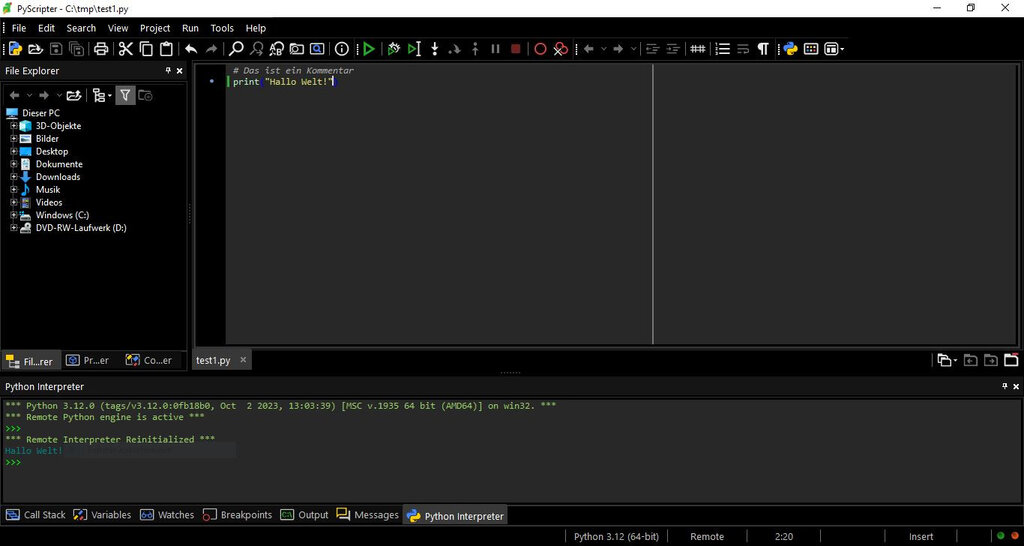
Once Python is installed, you have a few options for writing code. You can use a simple text editor like Notepad++ or Sublime Text, or you can use an Integrated Development Environment (IDE) like VS Code or PyCharm. IDEs offer helpful features like syntax highlighting and debugging tools that make programming easier.
Your First Program
A long-standing tradition in programming is to make your first program display the text "Hello, World!". In Python, this is incredibly simple. All you need is the built-in print() function.
print("Hello, World!")
To run this, open a text editor, type that single line of code, and save the file as hello.py. The .py extension is important as it tells your computer this is a Python file.
Next, open your terminal or command prompt, navigate to the directory where you saved your file, and type python hello.py. You should see Hello, World! printed to the screen.
Syntax, Indentation, and Comments
Python's syntax is clean and straightforward, but one feature is critical to understand: indentation. Unlike many other languages that use curly braces {} to define blocks of code, Python uses whitespace. The amount of space at the beginning of a line is meaningful.
Consistent indentation is not just for style; it's a syntax requirement. A standard convention is to use four spaces for each level of indentation.
For example, the code inside an if statement must be indented to show that it belongs to that block.
temperature = 30

if temperature > 25:
    # This line is indented, so it's part of the if-block.
    print("It's a warm day!")

# This line is not indented, so it runs after the if-block.
print("Enjoy the weather.")
The lines starting with a hash symbol # are comments. The interpreter ignores comments, but they are crucial for humans reading the code. They help explain what your code does, making it easier for you and others to understand later on.
interpreter
noun
A program that directly executes instructions written in a programming language, one by one, without requiring them previously to have been compiled into a machine language program.
Now that you've got the basics down, let's test your knowledge.
Who is the creator of the Python programming language?
In Python, what is used to define a block of code (e.g., the body of an if statement or a for loop)?
You've successfully set up Python and written your first program. This foundation is the first step into the wider world of programming.