Python Fundamentals for Beginners
Introduction to Python
What Is Python?
Python is a programming language known for its simple, readable syntax. Think of it as a set of instructions a computer can understand, but written in a way that's closer to plain English than many other languages. This makes it a great choice for beginners.
Its design philosophy emphasizes code readability. You'll find that Python code is often shorter and more expressive than the equivalent code in languages like Java or C++.
But its simplicity doesn't mean it's not powerful. Python is a high-level, general-purpose language used by professionals in many different fields.
Python is used for:
- Web Development: Building the server-side logic of websites and applications.
- Data Science: Analyzing data, creating visualizations, and training machine learning models.
- Automation: Writing scripts to automate repetitive tasks, saving time and reducing errors.
- Software Development: Creating standalone applications and tools.
Getting Set Up
Before you can write Python code, you need to install the Python interpreter on your computer. This is the program that reads your Python code and carries out its instructions. You can download the official installer for Windows and macOS directly from the Python website. Most Linux distributions come with Python pre-installed.
Once Python is installed, you need a place to write and run your code. While you can use a simple text editor, it's much easier to use an Integrated Development Environment, or IDE. An IDE is a software application that combines a code editor, a debugger, and other helpful tools into one package.
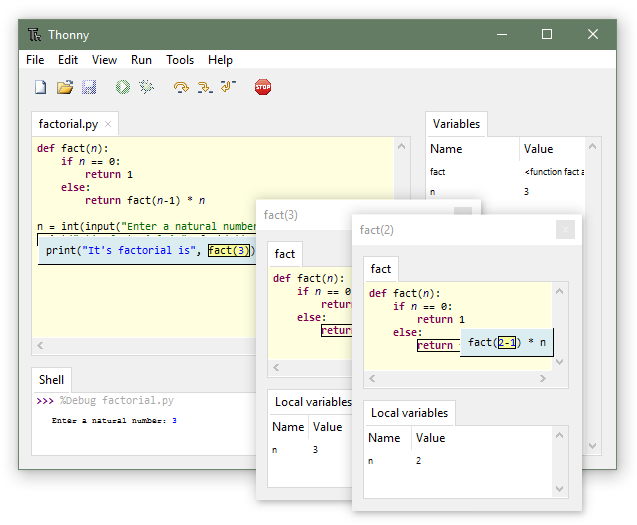
For beginners, we recommend an IDE called Thonny. It's designed specifically for learning to code. It has a simple, clean interface and comes with Python built-in, so you don't have to worry about complex configuration. It also has a great debugger that helps you visualize how your code is running, step-by-step.
Your First Program
It's a tradition for programmers to start with a simple program that just prints the text "Hello, World!" to the screen. Let's write one in Python.
Open Thonny and type the following line of code into the editor window:
print("Hello, World!")
Let's break this down.
print() is a built-in Python function. A function is a reusable block of code that performs a specific action. The print() function's action is to display text on the screen.
The text you want to display, "Hello, World!", goes inside the parentheses. This is called an argument. The quotation marks tell Python that this is a string of text, not a command to be executed.
To run this code in Thonny, click the green 'Run' button in the toolbar. The output Hello, World! will appear in the shell pane at the bottom of the window.
That's it! You've just written and executed your first Python program.
What is a key design philosophy of the Python programming language?
What is the primary role of the Python interpreter?