Python Fundamentals for Beginners
Introduction to Python
What Is Python?
Python is a programming language, which is a way for humans to give instructions to computers. It’s known for being one of the easiest languages to read and write. The syntax, or grammar, of Python is clean and simple, making it a popular choice for beginners.
Despite its simplicity, Python is incredibly powerful. It’s used in a huge variety of fields. Data scientists use it to analyze information and build artificial intelligence models. Web developers use it to create the backend of websites and apps. It's also a go-to tool for automating repetitive tasks, like organizing files or sending emails.
Setting Up Your Workspace
To start writing Python code, you need two things: the Python interpreter and a place to write your code.
The interpreter is the program that actually understands and runs your Python instructions. You can download it for free from the official Python website, python.org. It's best to grab the latest stable version available for your operating system.
The second piece is an Integrated Development Environment, or IDE. An IDE is basically a text editor built specifically for coding. It helps you by highlighting parts of your code, spotting errors, and providing tools to run and test your programs. Popular choices for beginners include PyCharm, Visual Studio Code (with the Python extension), and Jupyter Notebook.
For general-purpose programming, PyCharm or Visual Studio Code are excellent. For data analysis and learning interactively, Jupyter Notebook is fantastic because it lets you run code in small, manageable chunks.
Your First Program
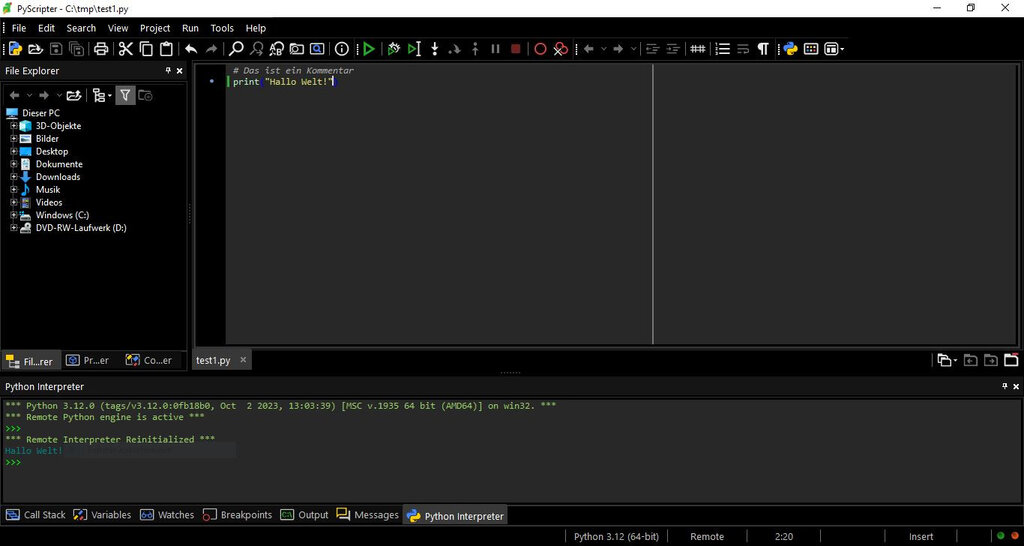
A long-standing tradition in programming is to make your first program display the text "Hello, World!". This simple task confirms that your setup is working correctly and introduces you to the basic syntax of the language. In Python, it's just one line.
print("Hello, World!")
Let's break that down.
print() is a built-in function in Python. A function is a named block of code that performs a specific task. The print() function's job is to display output on the screen.
The text "Hello, World!" is called a string, which is just a sequence of characters. In Python, you create a string by putting text inside either single or double quotes.
To run this program:
- Open your IDE and create a new file.
- Save the file with a
.pyextension, likehello.py. - Type the code above into the file.
- Find the "Run" button in your IDE and click it.
You should see Hello, World! appear in an output window or terminal.
Now you're ready to test your knowledge.
What is the primary role of the Python interpreter?
Which of the following lines of code will correctly display the text 'Hello, World!' on the screen?
With your environment set up and your first program running, you've taken the first step into the world of programming.