Python Fundamentals for Beginners
Introduction to Python
What Is Python?
Python is a high-level, general-purpose programming language. Think of it as a versatile tool, like a Swiss Army knife for coders. It's known for its simple, clean syntax, which reads a lot like plain English. This design choice makes it one of the easiest languages for beginners to pick up, yet it's powerful enough to be used by major companies like Google, Netflix, and NASA.
Python was created in the late 1980s by Guido van Rossum, a Dutch programmer. He wanted to design a language that was both powerful and easy to read. Development began in December 1989, and its first official release came in 1991.
Why It's So Popular
Python's popularity isn't an accident. It's the result of a few core features that make it incredibly useful for a wide range of tasks. Its design philosophy emphasizes code readability and simplicity, allowing programmers to express concepts in fewer lines of code than might be used in languages like C++ or Java.
This focus on readability is a core part of the "Zen of Python," a collection of 19 guiding principles. Two of the most famous are "Beautiful is better than ugly" and "Readability counts."
Here are some of the key features that define the language:
| Feature | Description |
|---|---|
| Easy to Learn & Read | The syntax is straightforward and clear, which lowers the barrier to entry for new programmers. |
| Interpreted Language | Python code is executed line by line. This makes debugging easier and development faster since you don't need a separate compilation step. |
| Large Standard Library | Python follows a "batteries-included" philosophy, providing a huge collection of pre-built modules for tasks ranging from web development to data analysis. |
| Free and Open-Source | Anyone can use Python for free, and its development is managed by a large, active community that contributes to its improvement. |
What Is It Used For?
Python's versatility means you'll find it almost everywhere. It’s not just for one specific type of job; it’s a general-purpose language used across many different industries.
Some of the most common applications include:
-
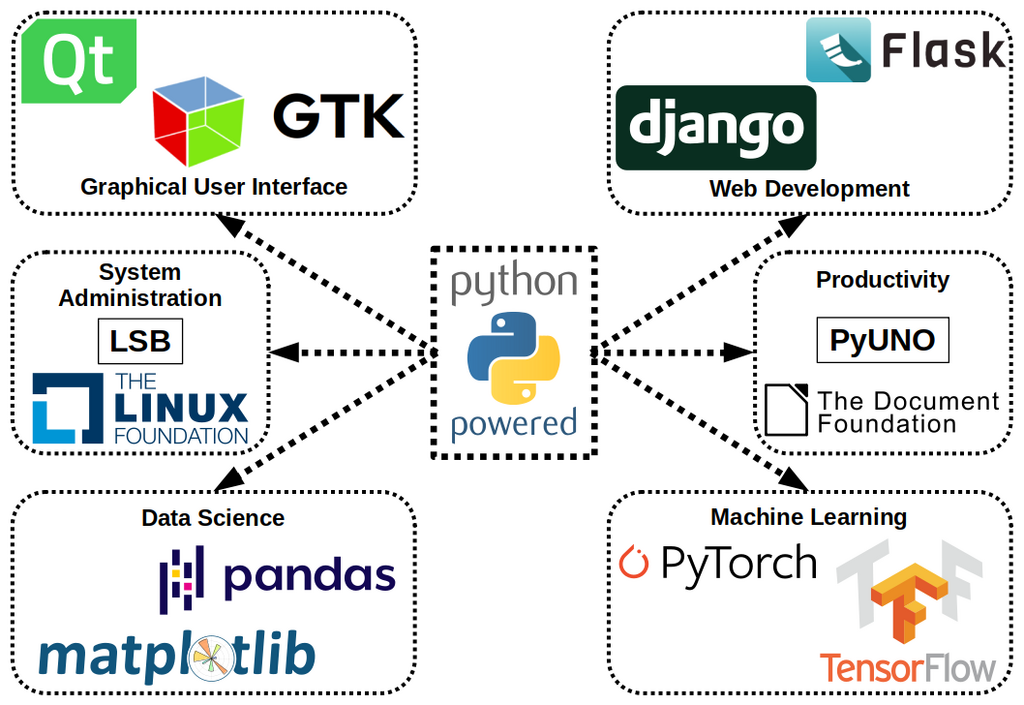
Data Science and Machine Learning: This is one of Python's biggest strengths. Powerful libraries like Pandas for data manipulation, NumPy for numerical operations, and Scikit-learn, TensorFlow, and PyTorch for machine learning have made it the go-to language for data scientists.
-
Web Development: On the server-side, Python is used to build the backend logic of websites and applications. Popular frameworks like Django and Flask make it simple to build robust, scalable web services.
-
Automation and Scripting: Python is excellent for writing small scripts to automate repetitive tasks. Whether it's organizing files, scraping data from websites, or sending automated emails, Python can handle it efficiently.
-
Software Development: It's also used to build desktop applications, games, and business software. Companies like Dropbox and Instagram have famously used Python to build major parts of their platforms.
Who is credited with creating the Python programming language?
What is the core design philosophy that Python is known for?
With its simple syntax and powerful capabilities, Python has become a fundamental tool for developers, data scientists, and engineers worldwide. Now you know what it is and where it comes from, you're ready to see how it works.