Python for Young Coders
Introduction to Python
Getting Started with Python
Python is a programming language known for being powerful yet easy to read. Its design philosophy emphasizes code readability with its notably simple syntax. Think of it less like a cryptic code and more like a set of structured English instructions for your computer.
This simplicity makes it a great first language for beginners. But it's also versatile enough for professionals who use it for everything from web development and data science to machine learning and automation.
Setting Up Your Workspace
To start writing Python, you need a place to write and run your code. We'll use an Integrated Development Environment, or IDE. An IDE is like a workshop for programmers. It combines a text editor for writing code with tools that help you run and test it, all in one application.
We'll be using Thonny, an IDE specifically designed for learning Python. It's simple, clean, and has everything you need to get started without overwhelming you.
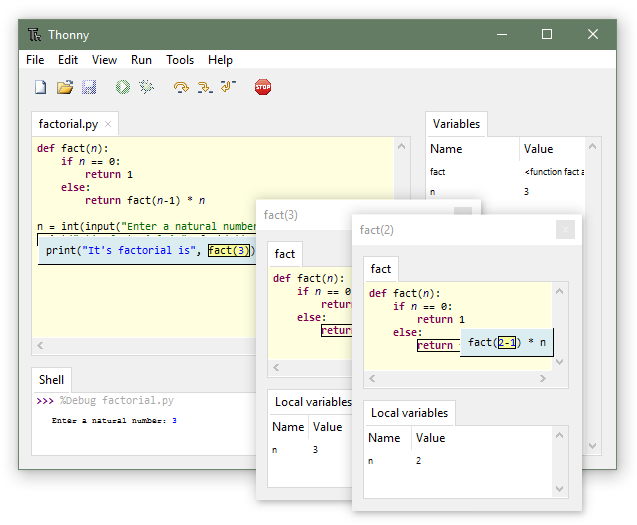
To get Thonny, go to its official website (thonny.org) and download the installer for your operating system, whether it's Windows, macOS, or Linux. The installation is straightforward; just follow the on-screen instructions. A great feature of Thonny is that it comes with Python already built-in, so you don't need to install it separately.
Your First Program
It's a long-standing tradition in programming that the first thing you do when learning a new language is to make it say "Hello, World!". This simple task confirms that your setup is working correctly and gives you a feel for the language's basic syntax.
In Python, displaying text is incredibly simple. You use a built-in function called print().
A function is a reusable block of code that performs a specific action. You "call" a function by writing its name followed by parentheses.
Open Thonny. You'll see a text editor at the top and a "Shell" at the bottom. Type the following line of code into the text editor:
print("Hello, World!")
Let's break this down. We're calling the print function. Inside the parentheses, we give it the data we want it to work with. In this case, the data is the text "Hello, World!". Text in programming is often called a "string," and in Python, strings are enclosed in quotation marks.
Now, let's run it. Click the green "Run" button on the toolbar (it looks like a play symbol). Thonny will ask you to save the file first. Name it something like hello.py and save it. The .py extension is important as it tells the computer this is a Python file.
Once you save it, the code will execute. You should see the text Hello, World! appear in the Shell area at the bottom of the window. Congratulations, you've just written and run your first Python program!
What is the primary design philosophy of the Python programming language?
In programming, what is the primary role of an Integrated Development Environment (IDE) like Thonny?
That single line of code is your first step into the world of programming. You've set up your environment and successfully told the computer to perform a task.