Python for BCI Project Beginners
Python Basics
Getting Started with Python
Python is a popular programming language known for its clear, readable syntax. It's a great choice for beginners because it lets you write powerful programs with very few lines of code. Before you can start coding, you need to set up your programming environment.
Setting Up Your Workspace
First, you'll need to install Python on your computer. You can download the latest version from the official website, python.org. The installation is straightforward, just follow the instructions for your operating system (Windows, macOS, or Linux).
When you install Python, it comes with a simple program called IDLE (Integrated Development and Learning Environment). Think of an IDE as a workshop for coders. It's a text editor with special tools that help you write and run your Python code. For now, IDLE has everything you need to get started.
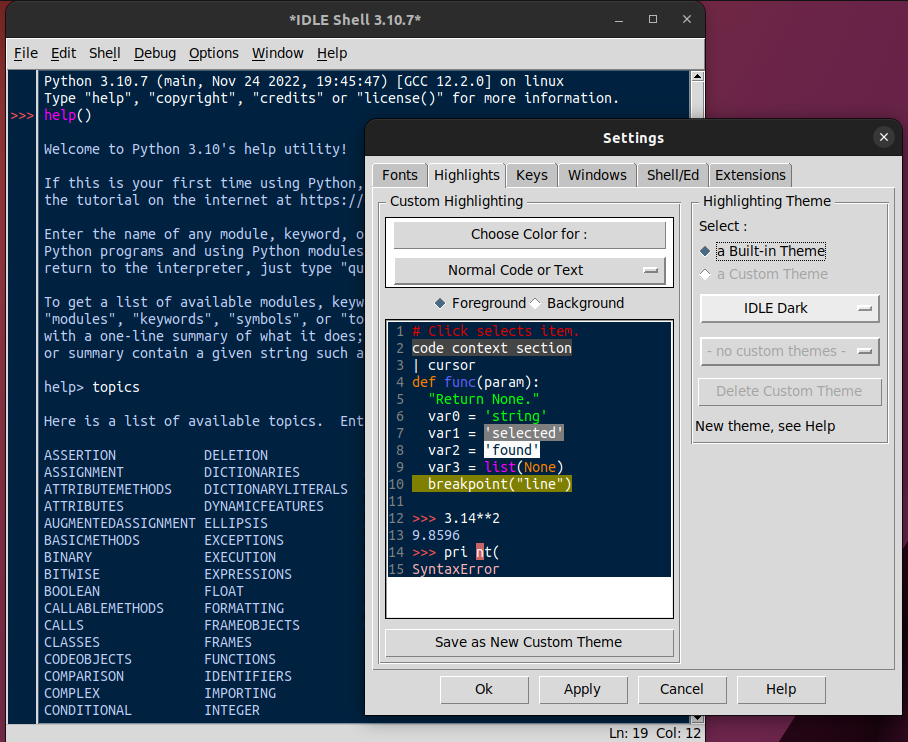
Let's write our first line of code. The most basic operation in any language is displaying information. In Python, we use the print() function to show text, numbers, or other data on the screen. Open IDLE and type the following into the main window, then press Enter.
print("Hello, World!")
You should see the text
Hello, World!appear right below your command. Congratulations, you've just run your first Python program.
Variables and Data Types
Programs need a way to store and manage information. We do this using variables. A variable is like a labeled box where you can keep a piece of data. You give the box a name, and you can put different things inside it. To create a variable in Python, you just choose a name and use the equals sign (=) to assign it a value.
# Create a variable named 'greeting' and store text in it
greeting = "Welcome to Python!"

# Print the value stored in the variable
print(greeting)
The information we store in variables can be of different types. Python recognizes many data types, but we'll start with the most common ones.
| Data Type | Description | Example |
|---|---|---|
String (str) | A sequence of characters, like text. | "Hello" or 'Python' |
Integer (int) | A whole number, without a decimal. | 10, -5, 2024 |
Float (float) | A number that has a decimal point. | 3.14, -0.5, 99.0 |
Python is smart enough to figure out the data type on its own when you assign a value to a variable. This is called dynamic typing.
# A string for a name
student_name = "Alex"

# An integer for an age
student_age = 21

# A float for a score
average_score = 92.7

print(student_name)
print(student_age)
print(average_score)
Interacting with the User
Besides just printing information out, you can also write programs that ask the user for information. We do this with the input() function. This function displays a message to the user and then waits for them to type something and press Enter.
# Ask the user for their name and store it in a variable
user_name = input("What is your name? ")

# Greet the user by name
print("Hello, " + user_name + "!")
When you run this code, it will first print "What is your name? ". After you type your name and press Enter, it will print a personalized greeting.
One important thing to know is that the input() function always gives you back a string, even if the user types a number. If you need to treat the input as a number, you have to convert it first.
# Get the user's age as a string
age_string = input("How old are you? ")

# Convert the string to an integer
user_age = int(age_string)

# Now you can do math with it
years_until_100 = 100 - user_age

# To print it, we need to convert it back to a string
print("You will be 100 in " + str(years_until_100) + " years.")
This covers the absolute basics of getting data in and out of a Python program and storing it for later use. With these simple tools, you have the foundation for building much more complex and interesting applications.
Which Python function is used to display text and other data on the screen?
What is the primary role of a variable in a Python program?