Python for AI and Quantitative Engineering
Advanced Data Structures
Smarter Ways to Store Data
You already know that how you organize data matters. Simple structures like arrays and linked lists are great for many tasks, but they have their limits. When you're dealing with massive datasets or complex relationships, you need more advanced tools. These structures aren't just about storing data; they're about storing it in a way that makes your programs faster and more efficient.
Choosing the right data structure is the difference between an algorithm that finishes in a second and one that takes a year.
We'll explore a few powerful structures that are cornerstones of modern software, from search engines to social networks: trees, heaps, graphs, and hash tables.
Hierarchies and Trees
Trees are data structures that represent hierarchical relationships. Think of a company's organization chart or a computer's file system. Each item, called a node, connects to others below it, called children. The top node is the root, and nodes with no children are leaves.
A Binary Search Tree (BST) is a special type of tree with a strict rule: for any given node, all values in its left subtree are smaller, and all values in its right subtree are larger. This simple rule makes searching incredibly fast. Instead of checking every single item, you can eliminate half the remaining data with each comparison. On average, this gives search, insertion, and deletion operations a time complexity of , which is a huge improvement over the of a simple list.
But BSTs have a weakness. If you insert data in a sorted order, the tree becomes lopsided and effectively turns into a linked list. This pushes the performance back to the slow we were trying to avoid. To solve this, we use self-balancing trees.
An AVL Tree is a self-balancing BST. It keeps track of the height of each subtree and performs clever adjustments called rotations whenever an insertion or deletion makes it unbalanced. This guarantees that the tree remains bushy and balanced, ensuring that search, insertion, and deletion operations always maintain their efficient performance.
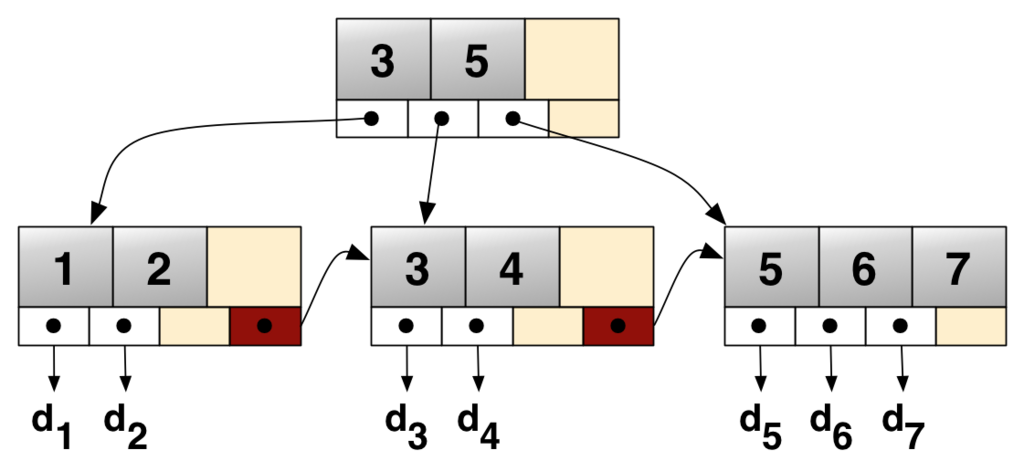
Another important variant is the B-Tree. Unlike binary trees, B-Tree nodes can have many children. This makes the tree very wide and shallow. B-Trees are optimized for systems that read data from storage in large blocks, like hard drives. By keeping the tree's height to a minimum, they reduce the number of slow disk reads required to find data, which is why they are fundamental to databases and filesystems.
Priorities and Heaps
What if you don't need a full sorted order, but you always need to know the most important item? This is a common problem in task schedulers, network routers, and event simulations. For this, we use a heap.
Heap
noun
A specialized tree-based data structure that satisfies the heap property: in a min heap, every parent node is smaller than or equal to its children; in a max heap, every parent is larger than or equal to its children.
The key feature of a heap is that the smallest (in a min heap) or largest (in a max heap) element is always at the root. This makes finding the minimum or maximum value an extremely fast operation. Adding a new element or removing the top element is also very efficient, typically taking time. This structure is perfect for implementing priority queues, which are essential for algorithms that need to process items based on their importance rather than their arrival time.
Networks and Graphs
Many real-world problems are about connections. Think of a social network, a road map, or the internet itself. These systems are modeled using graphs.
A graph consists of vertices (or nodes) that represent things, and edges that represent the connections between them. Edges can have a direction (like a one-way street) or be undirected. They can also have a weight (like the distance between two cities).
Graphs are incredibly versatile and are used to solve problems like finding the shortest path between two points (GPS navigation), identifying communities in social networks, and recommending friends or products. The way you store a graph in memory—whether as an adjacency list or an adjacency matrix—depends on the specific problem you're trying to solve.
Instant Lookups with Hash Tables
Imagine a magical dictionary where you could find any word instantly, without flipping through pages. That's the idea behind a hash table. It's a data structure that maps keys to values for highly efficient lookups.
Here’s how it works: you provide a key (like a username), and a special hash function converts that key into a numerical index. This index points directly to a location in an underlying array where the corresponding value (like a user profile) is stored.
When the hash function is well-designed, finding, inserting, and deleting data takes, on average, constant time—. This is astonishingly fast and makes hash tables the go-to structure for things like database indexing, caching, and implementing sets. In Python, the dict and set types are implemented using hash tables.
Sometimes, two different keys can produce the same hash index, an event called a collision. There are various strategies to handle collisions, like storing multiple items at the same index in a linked list. A good hash function minimizes these collisions, keeping performance close to that ideal lookup time.
Ready to check your understanding?
What is the primary rule for organizing a Binary Search Tree (BST)?
Under which scenario does a Binary Search Tree's search performance degrade to ?
These advanced data structures are the building blocks for creating efficient, scalable, and powerful algorithms. Understanding when and why to use each one is a critical skill in computer science.