Python Basics with Mental Maps
Introduction to Python
Welcome to Python
Python wasn't created in a sterile corporate lab. It was a passion project started in the late 1980s by a Dutch programmer named Guido van Rossum. He wanted to create a language that was easy to read and powerful enough for complex tasks. As for the name, it has nothing to do with snakes. Van Rossum was a big fan of the British comedy troupe Monty Python's Flying Circus.
Why Is It So Popular?
Python's design philosophy is all about readability. Its syntax is clean and straightforward, which means you spend less time wrestling with complicated rules and more time thinking about the problem you're trying to solve. Code written in Python often looks a lot like plain English.
This simplicity doesn't mean it's weak. Python is a general-purpose language used for everything from building websites and analyzing data to developing artificial intelligence and automating repetitive tasks. A huge global community contributes to a massive collection of pre-written code, called libraries, that you can use to add powerful features to your programs without starting from scratch.
Key Features: • Readable and simple syntax • Versatile for many applications • Supported by a large, active community
Getting Set Up
To start writing Python, you need two things: the Python interpreter and a place to write your code.
The interpreter is a program that reads your Python code and translates it into instructions the computer can understand. You can download it for free from the official Python website, python.org.
Once Python is installed, you can write code in a simple text editor. However, most developers use an Integrated Development Environment (IDE) or a code editor like VS Code, PyCharm, or Sublime Text. These tools offer helpful features like syntax highlighting, which colors your code to make it easier to read, and error checking.
Your First Program
It's a tradition in programming to make your first program display the message "Hello, World!" on the screen. It's a simple way to confirm that your setup is working correctly. In Python, this takes just one line of code.
print("Hello, World!")
Let's break that down. print() is a built-in function in Python. A function is a named block of code that performs a specific task. The print() function's job is to display output on the screen. The text you want to display goes inside the parentheses, wrapped in quotation marks.
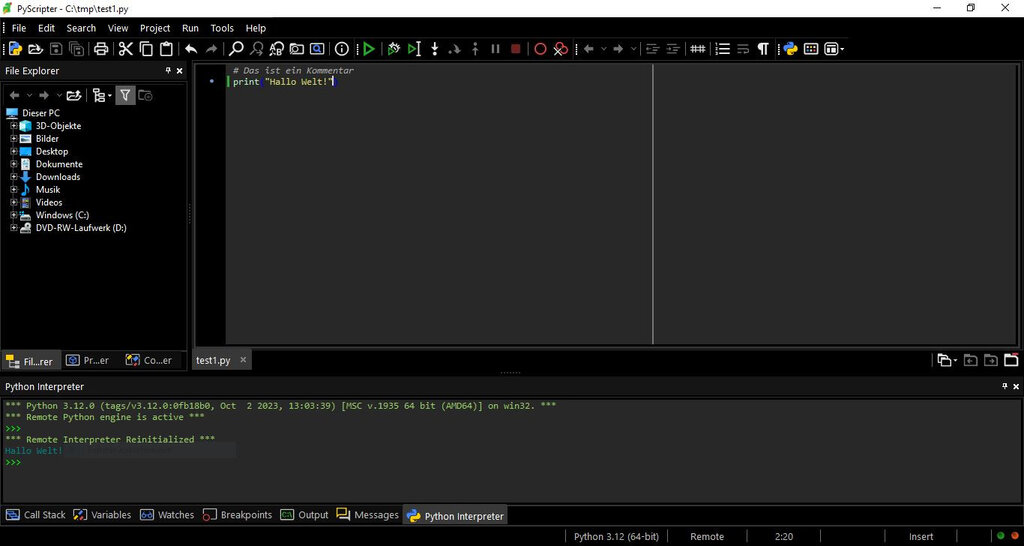
When you run this line of code, the interpreter sees the print command and displays the text inside the parentheses. That's it! You've just written and run your first Python program.
Who is the original creator of the Python programming language?
The name 'Python' was inspired by the creator's love for a specific type of snake.
With this foundation, you're ready to start exploring the core components of the language.